ConfAI 2025 by Plaksha University Shaped Conversations on the Future of AI
The three-day conference brought together global researchers, industry leaders, and young innovators together to advance impactful AI
 City Air News
Dec 3, 2025 03:28
0
City Air News
Dec 3, 2025 03:28
0
Plaksha University, which is reimagining technology education and research, concluded ConfAI 2025, its flagship three-day academic conference on Artificial Intelligence. Held from November 28–30 and presented by Harish and Bina Shah School of AI & Computer Science, the conference brought together leading global researchers, industry experts, and young innovators to advance rigorous, interdisciplinary, and socially responsible AI research.
This was the third edition of ConfAI, and it showcased India’s accelerating role in global AI scholarship. With sessions spanning multilingual language models, healthcare technologies, trustworthy AI, bias and fairness, governance, and the AI’s impact on higher education, the conference created a forum where foundational research intersected with real-world impact. The Harish and Bina Shah School of AI & Computer Science played a central role in curating the research tracks and bringing together distinguished speakers from India and abroad, reinforcing its commitment to cultivating frontier research talent in the country.
Harish Shah, Chairperson Harish & Bina Shah Foundation and Managing Director Signet Capital Pvt Ltd, said, “ConfAI reflects our belief that India must be a creator and not just an adopter of breakthrough AI technologies. As AI transforms every sector, the country needs strong academic ecosystems that nurture original thinking and frontier research.”
“ConfAI represents our conviction that AI must be shaped through rigorous science and deep societal responsibility”, said Prof. Rudra Pratap, Founding Vice Chancellor, Plaksha University. “As India accelerates its AI ambitions, it is critical that innovation addresses real human needs like healthcare, climate, accessibility, safety, and education. We envision ConfAI as a platform where responsible, interdisciplinary, and impact-driven AI research takes center stage, supported by visionary partners such as Harish and Bina Shah.”
The conference featured distinguished speakers including Dr. Venkat Padmanabhan, Managing Director, Microsoft Research India & Adjunct Professor, IISc Bangalore, Debjani Ghosh, Distinguished Fellow, NITI Aayog, Dr. Rajesh Gupta, Professor & Dean, UC San Diego School of Computing, Information & Data Sciences, Dr. Sunita Sarawagi, Chair Professor of Computer Science and Engineering at IIT Bombay and 2019 Infosys Prize Awardee, Dr. C.V. Jawahar, Dean (R&D), IIIT Hyderabad, Dr. Mausam, Professor & Founding Head, Yardi School of AI, IIT Delhi, Dr. Mayur Naik, Professor, University of Pennsylvania, and more. The talks spanned critical research directions, from multilingual LLMs, computer vision, and robotics, to AI in healthcare, data ecosystems, algorithmic fairness, and AI-driven public infrastructure.
The conference also highlighted 15+ contributed research papers accepted at leading international conferences such as NeurIPS 2025, AAAI 2025, EMNLP 2025, IJCAI 2024, ECAI 2025, and IEEE Transactions. Student and faculty-led work showcased advances in sign language translation, bias mitigation and fairness benchmarks, AI for medical diagnostics, satellite imagery analysis for public utilities, low-resource NLP, cognitive neurodynamics, etc. These presentations demonstrated the growing depth of research emerging from India’s AI community and how AI could contribute to solving real-world challenges in India.
Dr. M Balakrishnan, Distinguished Visting Professor at Plaksha University and part of the ConfAI Advisory Committee, remarked, “I consider ConfAI 2025 as truly successful as we could see many conversations about the future of AI—both globally as well as in the Indian context. Over time, I hope these conversations mature to create meaningful partnerships not only for Plaksha but also for many participants from around the country.”
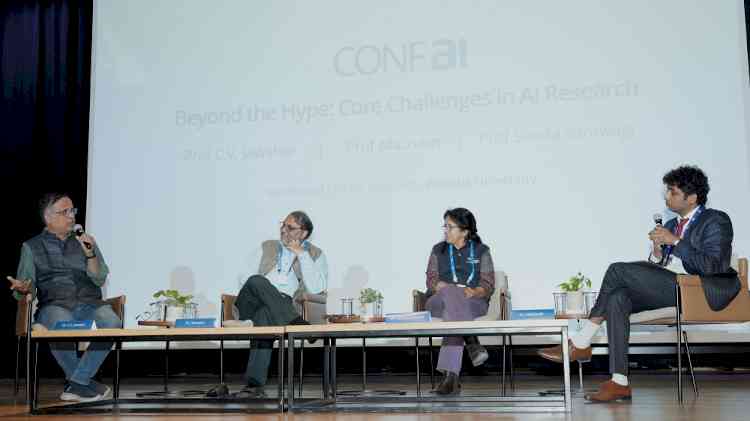
The conference also hosted a panel discussion on “Beyond the Hype: Core Challenges in AI Research,” focused on separating fact from fiction in AI research and media headlines. It also had multiple themes like the utility of building AI’s foundational language model, if AI should be held to a higher standard of explainability than we hold humans, or is performance the only thing that matters, and can AI systems continue to improve if they start feeding on their own creations that may already be biased