The Gram Sabha is the Strongest Unit of Democracy: HIRD Director Dr. Virender Singh Chauhan
Social audit serves as a powerful medium for ensuring transparency and accountability in rural development schemes. These views were expressed by Dr. Virender Singh Chauhan, Director of the Haryana Institute of Rural Development (HIRD), while addressing the villagers as the Chief Guest during the Social Audit Gram Sabha held at the Kalsana Panchayat.
 Girish Saini
May 20, 2026 09:01
0
Girish Saini
May 20, 2026 09:01
0
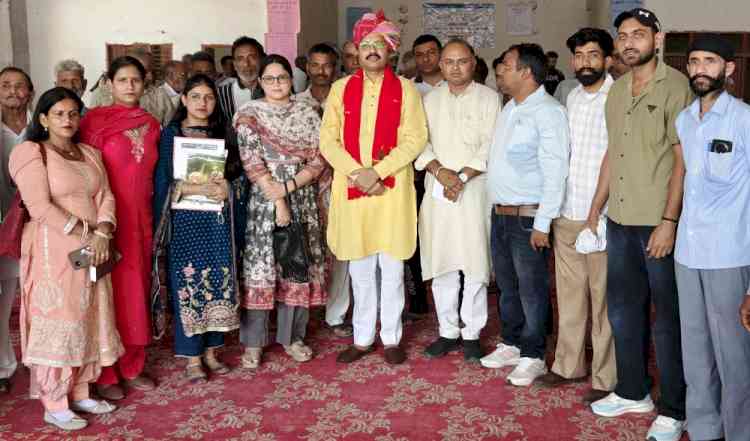
Shahabad, May 20, 2026: Social audit serves as a powerful medium for ensuring transparency and accountability in rural development schemes. These views were expressed by Dr. Virender Singh Chauhan, Director of the Haryana Institute of Rural Development (HIRD), while addressing the villagers as the Chief Guest during the Social Audit Gram Sabha held at the Kalsana Panchayat.
The Gram Sabha witnessed the participation of the social audit team, Panchayat representatives, villagers, and officials from various government departments. During the proceedings, a report detailing the work undertaken under various rural development schemes was publicly presented.
HIRD Director Dr. Chauhan said that the Gram Sabha constitutes the strongest unit of democracy, providing a platform where the public can directly review development activities. He urged the villagers to remain aware of their rights and to actively participate in Gram Sabha meetings.
He emphasized that a social audit is not merely a bureaucratic paper exercise, but rather a genuine verification of the work executed on the ground. Should any irregularities or negligence be detected in the implementation of a scheme, accountability will be fixed upon the concerned department, the Sarpanch, and the implementing agencies. He also lauded the trainees for their efforts in the village—specifically their inspections, awareness rallies, wall writings, and initiatives aimed at raising awareness among the villagers.
During the Gram Sabha, the social audit team presented to the villagers a detailed account of the work accomplished under various schemes, including MGNREGA, the Pradhan Mantri Awas Yojana (Rural), and the National Social Assistance Scheme. The team submitted a report compiled on the basis of record verification, on-site inspections, and interactions held with the beneficiaries. Furthermore, the actual status of the development works executed within the village was discussed during the meeting.
Trainees associated with the social audit process provided the villagers with information regarding various government schemes and encouraged them to ensure maximum participation in the Gram Sabha meetings. In conclusion, the villagers themselves acknowledged the social audit process as a crucial tool for fostering village development and ensuring transparency.
Sushma, the Sarpanch of Gram Panchayat Kalsana, assured the gathering that all issues and suggestions brought to light during the social audit process would be resolved at the earliest possible opportunity. She said that the Panchayat is working with utmost seriousness to resolve the villagers' problems, and that a Gram Panchayat meeting will be convened at the Village Secretariat within the coming week to discuss and take action on essential issues.
Applauding the social audit process, BJP leader Subhash Kalsana remarked that through the Gram Sabhas, villagers are gaining access to information regarding development works, thereby strengthening transparency and accountability within the schemes. He also urged the villagers to participate enthusiastically in the Gram Sabha meetings.
Present on the occasion were a large number of villagers—including Om Prakash, Balram, Sumit, Satish, and Sapna—as well as members of the Social Audit Team, including Block Resource Persons Kavita Sharma, Saroj Rani, Gayatri, Naresh Kumar, Rakesh Kumar, Ram Singh, and Gurpreet Singh.