Mataur Chowk: Kangra Valley's Gateway Choked by Congestion
 Arvind Sharma
Jun 19, 2026 03:58
0
Arvind Sharma
Jun 19, 2026 03:58
0
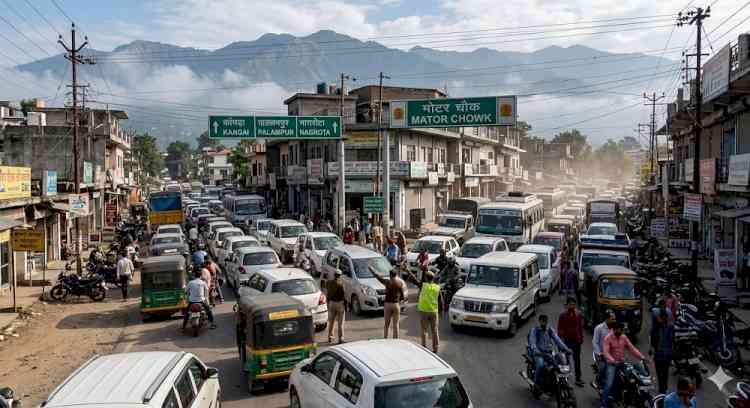
Dharamsala, June 19, 2026: Mataur Chowk, widely known as the gateway to the Kangra Valley, has increasingly become synonymous with chronic traffic congestion, testing the patience of residents, tourists, students, and daily commuters alike. What should serve as a vital transportation hub connecting major destinations across Himachal Pradesh and neighboring Punjab has instead become a bottleneck where traffic often crawls for hours.
Located at the junction of key highways leading to Dharamshala, Palampur, Chamba, Hamirpur, and Punjab, Mataur Chowk handles an enormous volume of traffic every day. The convergence of two national highways at this strategic intersection, combined with the rapid increase in vehicle ownership, has pushed the existing road infrastructure far beyond its designed capacity.
The situation becomes particularly severe during the tourist season when thousands of vehicles enter the region daily. Long queues of cars, buses, trucks, and taxis stretching several kilometers have become a routine sight, with commuters often spending hours negotiating a stretch that should normally take only a few minutes.
For local residents, crossing Mataur Chowk during peak morning and evening hours has become a daily ordeal. Even more alarming is the frequent entrapment of ambulances and other emergency vehicles in the gridlock, raising serious concerns about public safety and emergency response.
Although traffic police personnel remain deployed throughout the day to regulate movement, their efforts provide only temporary relief. Residents argue that the real problem lies in outdated and inadequate infrastructure that is no longer capable of handling the ever-growing traffic volume.
The prolonged delay in the proposed Pathankot-Mandi four-lane highway project has emerged as a major source of public frustration. Despite repeated announcements over the years, residents say there has been little visible progress on the crucial Mataur stretch.
According to local residents and transport observers, key preliminary activities, including detailed surveys and preparation of the Detailed Project Report (DPR), have taken far longer than expected. As a result, the commencement of construction work remains uncertain.
Many people question why the principal entry point to one of Himachal Pradesh's busiest tourist regions continues to await critical infrastructure upgrades while traffic volumes keep rising unabated.
The congestion is also affecting the tourism sector at a time when Kangra district is being promoted as the tourism capital of Himachal Pradesh.
Almost every visitor travelling to Dharamshala, McLeodganj, Palampur, Bir-Billing, Baijnath, or Chamba must pass through Mataur Chowk. The junction also serves as a crucial transit point for Volvo coaches, tourist buses, and public transport vehicles connecting various destinations across the region.
Sharad Garg, a tourist from Delhi, expressed disappointment over the situation. "Tourists spend hours stuck in traffic before even reaching their destinations. Such delays create a poor first impression and diminish the overall travel experience," he said.
Another visitor, Naitik from Gujarat, said his tour group remained stranded in traffic for such a long period that they were forced to cancel a planned excursion to Dalhousie.
Local residents are equally affected. Devyani Thakur, a school principal, said that despite leaving home well ahead of time, congestion at Mataur Chowk frequently causes delays in reaching her workplace.
An official of the National Highways Authority of India (NHAI) stated that the alignment of the Pathankot-Mandi four-lane highway between Mataur and Rajol is being revised in view of the proposed expansion of Gaggal Airport. The official said that the DPR for the revised alignment is currently in the approval stage and that construction work on this stretch will commence once the necessary clearances are obtained.
Transport experts and local residents believe that traffic management alone cannot solve the crisis. They have called for a comprehensive infrastructure strategy that includes:
• Construction of a flyover at Mataur Chowk to ensure uninterrupted traffic flow.
• Development of an alternative bypass to divert through traffic away from the junction.
• Widening of approach roads and removal of existing bottlenecks.
• Strict action against illegal parking and roadside encroachments.
• Expedited completion of surveys, approvals, land acquisition, and DPR formalities for the four-laning project.
The daily spectacle of thousands of vehicles inching through Mataur Chowk amid noise, dust, and frustration stands in stark contrast to claims of rapid infrastructure development. As traffic volumes continue to rise, so too does public impatience. For many residents, Mataur Chowk has become a glaring symbol of delayed planning and administrative inertia.