From Gujarat to Delhi: Modi’s 25 Years in Government
From an RSS organiser to Gujarat Chief Minister and then three-term Prime Minister, Narendra Modi’s rise mirrors the transformation of the BJP and Indian politics
 Girish Saini
Oct 9, 2026 02:18
0
Girish Saini
Oct 9, 2026 02:18
0
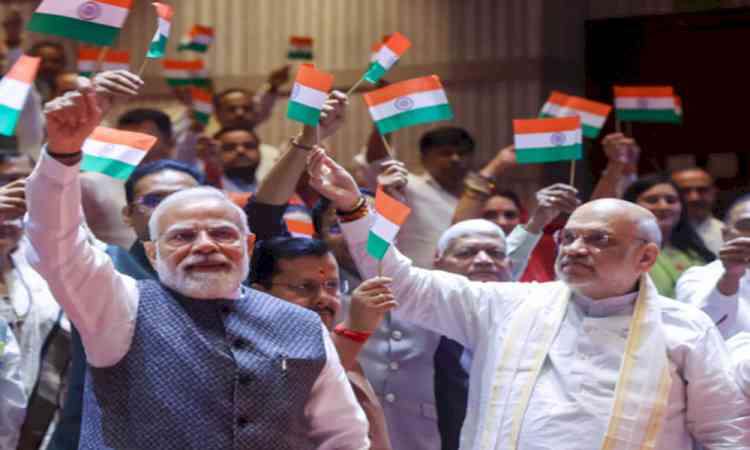
October 7, 2001, marked a turning point in Narendra Modi’s political career. On that day, he was sworn in as Gujarat Chief Minister, beginning a 25-year journey in government that would take him from state politics to the Prime Minister’s Office in New Delhi. His rise from a BJP organisational leader to Chief Minister and, in 2014, Prime Minister reflects not only his political trajectory but also the BJP’s expansion, changing electoral strategies and the broader transformation of Indian politics.
Modi’s journey cannot be understood by starting in 2001 alone. By then, he had spent nearly three decades in political organisation. His association with the RSS, underground political activity during the Emergency, responsibilities in the BJP and election-management roles in Gujarat and at the national level had prepared the ground for his transition from organisation to government.
When Modi took charge as Gujarat Chief Minister, the state was recovering from the devastating 2001 earthquake and the BJP was facing internal political challenges. The new Chief Minister brought with him an organisational style of functioning that soon became central to his political identity.
His years in Gujarat placed infrastructure, investment, electricity, roads and administrative efficiency at the heart of the governance narrative. Supporters presented the Gujarat experience as a development model.
The decisive national breakthrough came in 2014. The BJP won a majority on its own and Modi became Prime Minister. Five years later, the party returned with an even larger mandate. In 2024, however, the BJP fell short of a majority on its own, while the NDA retained the numbers to form the government and Modi began a third term.
That transition is politically significant. It demonstrates that even during the Modi era, Indian democracy remains shaped by coalition politics, regional forces and multi-party competition.
Over the years, the Modi governments have pushed major initiatives in digital public infrastructure, GST, financial inclusion, UPI, welfare delivery, roads and other infrastructure, besides pursuing a more assertive foreign policy. At the same time, unemployment, inflation, agrarian distress, institutional autonomy, social tensions and the concentration of political power have remained subjects of sustained public debate.
One of Modi’s defining strengths has been his ability to build and sustain a political narrative. The BJP’s expansion across states cannot, however, be attributed to one leader alone. The organisational role of leaders such as Amit Shah and the decades-old BJP-RSS cadre network have been equally important to understanding the party’s electoral reach.
Remaining at the helm of governments for 25 years is an extraordinary record in Indian politics. But political longevity also brings greater responsibility. Popularity may provide electoral legitimacy, but the health of a democracy cannot be measured by popularity alone. Strong institutions, a credible Opposition, economic opportunity, social trust and civil liberties are equally important measures of governance.
Modi’s political journey, therefore, deserves neither uncritical celebration nor a reduction to a catalogue of controversies. From the organisation rooms of the 1970s to the Chief Minister’s office in Gujarat and eventually the Prime Minister’s Office, his rise has been intertwined with a much larger transformation in Indian politics.
The larger question
To understand Modi is, in many ways, to understand the evolution of Indian politics over the past five decades — the expansion of the BJP, the changing aspirations of voters and the growing importance of political communication and organisation.
October 7, 2001, was a decisive milestone, not the destination. The more enduring question now is how Modi’s legacy will ultimately be judged — not merely by his personal popularity or electoral record, but by the institutional, economic and social changes that remain after his long political era.
(Views are personal)