DC Sachin Gupta emphasises Timely Service Delivery and Accountability during Comprehensive Review of Revenue Administration in Rohtak
Deputy Commissioner Sachin Gupta chaired an extensive review meeting of the Revenue Department today to assess the functioning, performance, and pendency across all key verticals, including land records management, revenue courts, land administration, citizen services, digitisation initiatives, infrastructure, and human resources.
 Girish Saini
Jan 13, 2026 10:02
0
Girish Saini
Jan 13, 2026 10:02
0
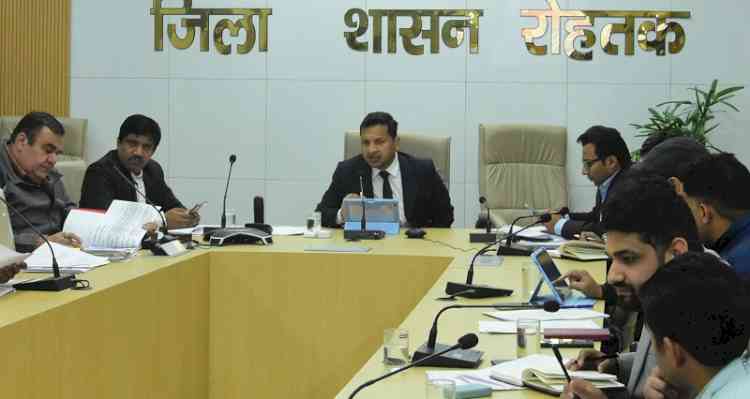
Rohtak, January 13, 2026: Deputy Commissioner Sachin Gupta chaired an extensive review meeting of the Revenue Department today to assess the functioning, performance, and pendency across all key verticals, including land records management, revenue courts, land administration, citizen services, digitisation initiatives, infrastructure, and human resources.
The review was conducted subdivision-wise and tehsil-wise, with detailed presentations by SDMs, Tehsildars, and district-level officers. The meeting aimed at identifying systemic bottlenecks, streamlining procedures, and ensuring that revenue services are delivered to citizens in a transparent, efficient, and time-bound manner.
The Deputy Commissioner reviewed the status of mutation pendency, jamabandi preparation, and digitisation of land records across Rohtak, Meham, Sampla, Kalanaur, and Lakhan Majra. While acknowledging progress made, the Deputy Commissioner expressed concern over cases pending beyond prescribed timelines, particularly those exceeding 60 days.
Key issues such as field verification delays, shortage of patwaris, technical discrepancies on HALRIS, objections by citizens, and jamabandi-linked mutations were discussed in detail. Officers were directed to:
• Prioritise clearance of long-pending mutations
• Resolve HALRIS errors through close coordination with IT teams
• Ensure jamabandi preparation and online publication strictly as per schedule
• Maintain accuracy in Khana Malkiyat and Khana Kasht entries to avoid future disputes
The progress of the Haryana Large-Scale Mapping Programme, including drone and rover surveys, tatima preparation, and GIS updates, was also reviewed. Instructions were issued to expedite pending tatimas after rectification of revenue records.
A detailed review of revenue court cases pending before DRO, SDM, Tehsildar, and Naib Tehsildar courts was undertaken. The Deputy Commissioner took note of pendency in partition, execution, eviction, stamp duty, and senior citizen cases.
Special emphasis was laid on:
• Disposal of cases pending for more than six months
• Weekly monitoring of long-pending partition and execution matters
• Strict compliance with High Court orders, CWPs, and COCPs
• Timely filing of affidavits and compliance reports
The Deputy Commissioner directed that avoidable adjournments be discouraged and that quality orders be passed after proper application of mind, ensuring legal sustainability.
The status of surplus land, evacuee land, government land, and encroachment cases was reviewed in detail. The Deputy Commissioner directed that:
• Demarcation-based eviction proceedings be completed expeditiously
• Updated jamabandi and girdawari records be ensured before court proceedings
• Encroachment cases be pursued to their logical conclusion with regular monitoring
The retrieval of government and evacuee land and initiation of ejectment proceedings were reviewed, and officers were instructed to intensify field-level action wherever required.
The Deputy Commissioner reviewed land acquisition and compensation matters relating to National Highway projects and other infrastructure works. It was noted that compensation disbursement in most cases has been substantially completed. Remaining cases pending due to court disputes, title issues, inheritance formalities, or absentee landowners were discussed, and officers were directed to pursue such cases proactively so that rightful compensation reaches beneficiaries without undue delay.
The functioning of grievance redressal mechanisms, including CM Window, Jan Sanwad, and CPGRAMS, was reviewed thoroughly at SDM and Tehsil levels. The Deputy Commissioner reiterated that grievance redressal is a core responsibility of the district administration.
Directions were issued to:
• Dispose of all pending and overdue complaints on priority
• Ensure speaking and reasoned replies
• Focus on quality of disposal to prevent repeat complaints
• Monitor grievance pendency regularly at senior officer level
Progress under Agri Stack, including farm registry, crop pattern mapping, land-farmer linkage, and geo-referencing, was reviewed. Officers were instructed to improve data accuracy, verification processes, and farmer outreach so that digital platforms effectively support farmers and policy implementation.
The Deputy Commissioner reviewed infrastructure gaps in tehsil and sub-tehsil offices, staff shortages—particularly patwari vacancies—and IT infrastructure requirements. Proposals for infrastructure strengthening, staff rationalisation, and hardware replacement were discussed. Issues related to HARIS/HALRIS funding, IT equipment, and digital evidence facilities were also reviewed, with instructions to pursue pending matters with the competent authorities at the state level.
Reports relating to administrative boundary restructuring, creation of sub-tehsils, and realignment of villages were reviewed. Concerned officers were directed to submit pending reports within stipulated timelines for further action.
Addressing the officers, the Deputy Commissioner emphasised that revenue administration directly impacts citizens’ daily lives and property rights, and therefore delays or procedural lapses are unacceptable. The Deputy Commissioner stressed the need for accountability, coordination, and a citizen-centric approach in all revenue matters. Regular follow-up meetings will be held to monitor progress, and officers were directed to ensure that decisions taken in the review meeting are implemented in letter and spirit.