Ashoka University’s Centre for Behaviour Change Launches AI, Behaviour, and Impact Accelerator at Behaviour Change Conclave 2026
Centre for Social and Behaviour Change (CSBC) at Ashoka University, India’s leading interdisciplinary and research university, convened the second edition of its Behaviour Change Conclave 2026, today.
 City Air News
Jun 30, 2026 09:16
0
City Air News
Jun 30, 2026 09:16
0
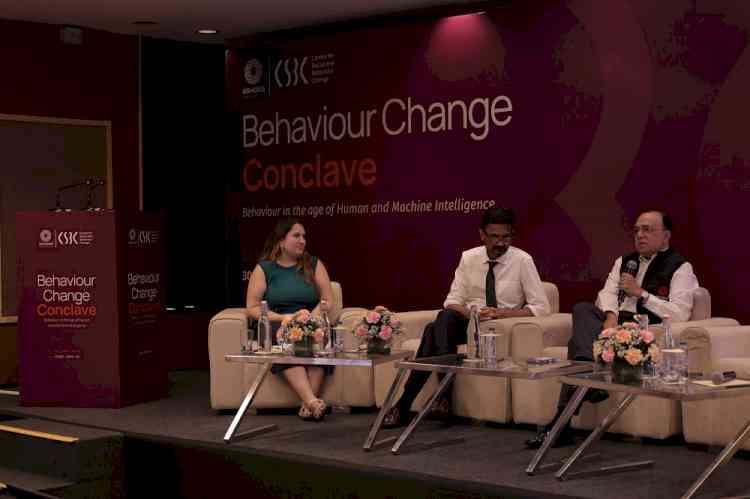
New Delhi, June 30, 2026: Centre for Social and Behaviour Change (CSBC) at Ashoka University, India’s leading interdisciplinary and research university, convened the second edition of its Behaviour Change Conclave 2026, today. Bringing together leaders from government, academia, philanthropy, technology, and civil society, the Conclave focused on the theme, 'Behaviour in the Age of Human and Machine Intelligence', and examined how the growing interplay between humans and machines is reshaping behaviour, with far-reaching implications for policy, technology, and public service delivery.
The day-long Conclave commenced with an inaugural address by Awanish Kumar Awasthi, Advisor to the Chief Minister, Uttar Pradesh, who said, “Behavioural change only happens when there is a conscious decision to take it forward. Technology and artificial intelligence can play a transformative role across five critical areas—public health, women empowerment, healthcare, education, and agriculture. From eliminating diseases through improved sanitation and behaviour change, to strengthening learning outcomes in schools and enabling precision agriculture, technology has the potential to significantly improve public service delivery. What we need now are strong partnerships between governments, research institutions, and organisations such as CSBC to translate ideas into scalable solutions and create meaningful impact on the ground.” This was followed by a special address by Archna Vyas, Director, India Office, Gates Foundation, who underscored the importance of ensuring that advances in artificial intelligence are leveraged to create equitable and inclusive development outcomes.
Setting the intellectual foundation for the day, Pavan Mamidi, Director, CSBC, Ashoka University, delivered a primer on 'Intelligence, Influence, and the Human Condition', examining how human behaviour, social norms, and the search for explanations shape the adoption and societal impact of emerging technologies. He said, "Artificial intelligence presents enormous opportunities for society, but it also raises deeper philosophical, ethical, and policy questions, from causal explanations and trust to human agency and responsible innovation. For an invention to become an innovation, it needs to go on a behavioural journey of assimilation by society. Unless we are willing to make that journey, we will not realise the full potential of AI to create meaningful and inclusive social impact.”
The first thematic session, 'Privacy, Prediction, and Public Good', explored the opportunities and challenges presented by increasingly capable predictive technologies. The discussion deliberated on the limitations of contemporary AI systems and the need for critical engagement with emerging technologies. Panellists, including Subhashis Banerjee, Head of the Department & Professor of Computer Science, Ashoka University, and Kailash Nadh, CTO, Zerodha and Co-founder, Rainmatter Foundation. During the discussion, Subhashis Banerjee, Head of the Department & Professor of Computer Science, Ashoka University cautioned that modern AI systems remain largely unexplainable, highlighting reliability as one of the most significant concerns as these systems are increasingly deployed in critical decision-making contexts. Building on this, Kailash Nadh, CTO, Zerodha and Co-founder, Rainmatter Foundation, said, "AI is the first technology to use language like humans do, making it uniquely persuasive. As these systems become part of everyday life, critical thinking and healthy skepticism are just as important as technological progress."
Delivering the keynote address on 'AI, Ethics, and Development from an Indian Perspective', Shashank Mani Tripathi, Member of Parliament, said, “As India undertakes the journey towards Viksit Bharat, we require a new modernity that is in sync with our own culture and ensures that human flourishing remains at the heart of our development journey. Humanist and digital AI has to be part of that. If AI is to support human flourishing, then it must assist individuals in realising their full potential. The use of AI also has to be contextual, with local, decentralised work that is humanistic and takes nature into account forming an integral part of humanist AI architecture.”
A key highlight of the Conclave was the launch of the AI, Behaviour, and Impact Accelerator, a first-of-its-kind initiative at Ashoka University dedicated to understanding how artificial intelligence is transforming human behaviour, public systems, and society. The Accelerator will work with governments, researchers, philanthropies, and technology partners to design, test, and scale AI-enabled solutions across sectors such as health, education, livelihoods, climate resilience, digital governance, and public service delivery, while generating new evidence on trust, adoption, accountability, and human-AI interaction.
This was followed by spotlight sessions such as 'Scaling Health Impact with AI' in collaboration with Qure AI and 'Intelligence for Human Wellbeing' which explored how organisations are leveraging artificial intelligence and data-driven tools to strengthen public health systems and improve outcomes for communities. The sessions also showcase how intelligent systems can generate personalised insights, improve wellbeing, and expand access to high-quality developmental support for children and communities.
The Conclave also featured a session titled 'Designing Resilience: Health, Climate, and Human Adaptation', which explored how behavioural insights can help individuals, communities, and institutions adapt to increasing climate uncertainty. The session featured Naveen Kumar G.S., IAS, Government of Uttar Pradesh; Saudamini Zutshi, Purpose; Ananya Awasthi, Founder, Anuvaad Solutions; and Sanjay Maheshwari, Medical Director, MP Birla Group of Hospitals, and was moderated by Sharon Barnhardt, Director, Research, CSBC. During the discussion, speakers emphasised that strengthening resilience in the face of climate change requires an integrated approach that combines behavioural insights, technological innovation, and community participation to support adaptation at scale.
The final thematic discussion, 'Adapting to AI: The Human Side of Economic Change', examined how artificial intelligence is reshaping labour markets, education systems, and the future of work. The panellists discussed the human dimensions of economic transition in the age of AI, highlighting the need for governments, employers, and institutions to support individuals in navigating changing skill requirements, emerging opportunities, and new forms of work.
The Conclave concluded with a leadership fireside on 'AI, Behaviour, and the Future of Development' featuring Pramath Raj Sinha, Founder and Chairperson, Board of Trustees, Ashoka University, and Pavan Mamidi, Director, CSBC, Ashoka University. In the session, Pramath said, I see the ability to track learning at scale while delivering education that is customized to the needs of each individual learner, in artificial intelligence. As these technologies evolve, they will compel us to rethink both what we teach and how we teach. The larger question is how these advances will reshape schools, higher education, and the role of educators, which is already beginning to see some change.”
Rather than claiming to know all the answers, we must continue to ask how these technologies are changing the experience of students, faculty, and administrators, and how institutions can respond thoughtfully to these changes.”
Through interdisciplinary dialogue and the launch of the AI, Behaviour, and Impact Accelerator, the Behaviour Change Conclave 2026 reaffirmed Ashoka University's commitment to advancing interdisciplinary research at the intersection of behavioural science and artificial intelligence to address pressing societal challenges.