PI-RAHI Northern Region S&T Cluster and British Deputy High Commission Chandigarh Host North-West Climate Innovation Roundtable
Roundtable spotlights green-tech and climate-tech innovators from North-West India; discussions cover UK-India Vision 2035, venture funding for early-stage and established ventures, technology transfer and market access
 City Air News
Jun 30, 2026 06:35
0
City Air News
Jun 30, 2026 06:35
0
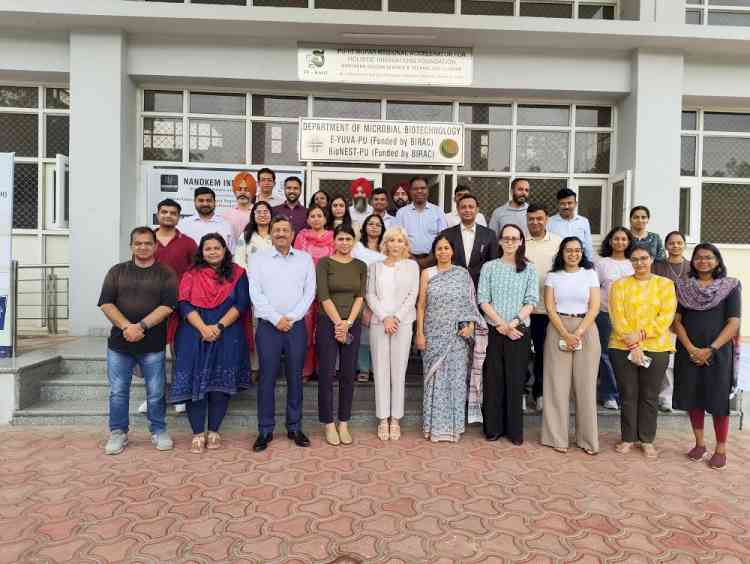
Chandigarh, June 30, 2026: PI-RAHI, the Northern Region Science & Technology Cluster set up under the Office of the Principal Scientific Adviser to the Government of India, today hosted the North-West Climate Innovation Roundtable in partnership with the British Deputy High Commission, Chandigarh, at Panjab University South Campus.
The roundtable brought together climate and green-tech innovators, researchers, and policy stakeholders from North-West India to discuss regional climate priorities and scalable innovation, focusing on sustainable agriculture, circular economy, waste valorisation and clean energy, with the broader aim of advancing UK-India partnership, technology exchange and clean growth engagement.
Representing the British Deputy High Commission, Chandigarh, Alba Smeriglio welcomed the partnership with PI-RAHI and underlined the UK's commitment to deepening climate and innovation ties with North-West India, noting the roundtable as a tangible step toward translating the India-UK Vision 2035 agenda into on-ground collaboration.
Sarah Cooper, Director – Development, Climate, Science & Technology, spoke on the UK's priorities for clean growth engagement with India, highlighting the scope for joint work on market access and climate finance, and reaffirmed the UK's interest in supporting India's green-tech and climate-tech innovators through both policy and investment channels.
Prof. Rajat Sandhir, Director, PI-RAHI, gave an overview of the Northern Region Science & Technology Cluster initiative, emphasising PI-RAHI's role in fostering collaboration between academia, industry, startups and government to accelerate innovation-led regional growth.
Dr. Jatinder Kaur Arora, Advisor, PI-RAHI, spoke on building innovation ecosystems capable of taking climate solutions from early-stage research to scalable deployment, while Ms. Madhu Mishra, Senior Adviser, set out the climate resilience priorities and innovation opportunities specific to North-West India.
Neha Arora, Chief Operating Officer, PI-RAHI, underlined the need for collaborative platforms that connect innovators with the partners and resources required to scale their solutions.
The centrepiece of the session was a series of presentations by eight start-ups and organisations working across the climate-tech and green-tech spectrum, including:
· Biofield Power — a digital platform enabling traceable, scalable procurement of agricultural biomass, already piloted across 15 villages in Punjab with over 200 farmers onboarded and 1,250+ tonnes of CO₂ emissions avoided.
· Eco Paryavaran — an environmental engineering and consultancy group based in the Mohali–Chandigarh region, working across effluent treatment, zero liquid discharge systems, and water body rejuvenation.
· UAMMCL (Unati Agri Allied and Marketing Multi-State Cooperative Society Ltd.) — a cooperative with over two decades of work in rural livelihoods, women's empowerment, and bio-resource value addition.
· Agro Stubble Management Pvt. Ltd. — converting agricultural stubble into eco-friendly, non-flammable ceiling tiles, addressing stubble-burning at source.
· Zenergize — manufacturer of high-efficiency EV chargers and solar inverters, including India's first Silicon Carbide (SiC) solar inverter, built on an indigenous hardware and software stack.
· Womenastic — developer of decentralised, solar-powered plastic waste processing units converting waste into 3D-printing filament and textile-grade fibre.
· Roundglass Foundation — a social impact organisation driving environmental and rural development programmes across Punjab.
· A patented graphene-from-agricultural-waste technology — a single-step pyrolysis process converting biomass into few-layer graphene for use in energy storage, electronics, and sensor applications.
The discussions built on the India-UK Vision 2035 roadmap, which names climate and clean energy among its five core pillars, and the India-UK Comprehensive Economic and Trade Agreement (CETA), signed the same month, which lowers trade barriers across green goods, EVs and auto components.
A significant part of the roundtable focused on venture funding — for both early-stage innovators needing risk capital and proof-of-concept support, and established ventures seeking growth capital to scale — alongside the scope for technology transfer between UK and Indian institutions in waste valorisation, circular economy and clean energy hardware, and market access pathways for North-West Indian start-ups into the UK and European green-tech ecosystem.