The new nuclear Act is against national interests: IDPD
Says, “This project is fraught with serious health consequences.”
 City Air News
Dec 31, 2025 08:33
0
City Air News
Dec 31, 2025 08:33
0
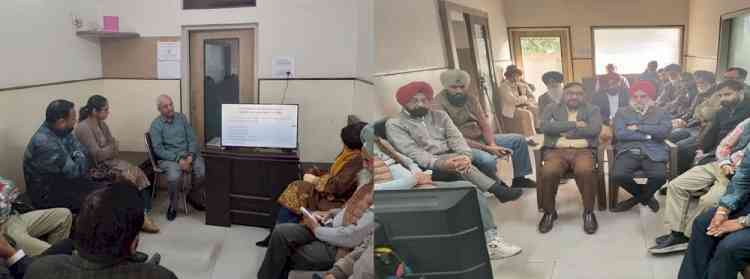
Ludhiana, December 31, 2025: The new nuclear Act titled ‘Sustainable Harnessing and Advancement of Nuclear Energy for Transforming India (SHANTI)’ is a compromise with national interests. This opinion emerged during a brainstorming session organized by the Indian Doctors for Peace and Development (IDPD) on the topic “An insight into the New Nuclear Bill.” In his presentation, Dr. Arun Mitra, President of IDPD, warned that the bill exempts suppliers of materials to nuclear plants from liability. According to the bill, in the event of an accident at a nuclear plant — even if the accident occurs due to a defect in the equipment supplied by the vendor — the entire compensation will have to be borne by the Government of India, meaning the people of India, and the supplier will have no responsibility.
This bill permits the private sector — which primarily functions on profit motives — to enter the nuclear business without any conditions. This will significantly increase the risks associated with nuclear safety and security.
The maximum compensation amount fixed per accident, 46 million US dollars, is completely inadequate. This amount is even less than the 47 million US dollars paid to the victims of the Bhopal Gas Tragedy, whereas the devastation caused by a nuclear accident is many times greater.
In India, the share of nuclear energy in electricity generation is merely 1.7%, while renewable energy sources contribute 38.6%. Furthermore, nuclear energy is more expensive than renewable energy. Calling it a clean energy source is a myth propagated by the nuclear lobby. From uranium mining, transportation, enrichment, plant installation, waste management, to decommissioning of nuclear plants — every stage is hazardous. According to a study conducted by IDPD on Health consequences on the people living around the Jaduguda uranium mines, it was found that they suffer from numerous congenital diseases, deformities in children, infertility among women, and cancers at much higher rates.
Globally too, the share of nuclear energy in electricity production has declined from 16.7% in 1997 to 9.2% in 2022. Therefore, it is essential for India to maximize the use of renewable energy sources rather than nuclear energy.
It is also noteworthy that US President Donald Trump has welcomed this new bill and directed his officials to establish contact with India for potential nuclear business cooperation. Concerns were raised in the meeting that perhaps this bill has been brought under Trump’s influence!
The meeting demanded that this act be immediately withdrawn.
Participants in the discussion included – Professor Jagmohan Singh, Dr. Param Saini, Dr. Pragya Sharma, Dr. Rajat Grover, Dr. Gurpreet Ratan, Chamkaur Singh, M.S. Bhatia, Kewal Singh Banwait, Parveen Kumar, Ajit Singh Jawaddi, Dr. Tejinder Singh, Dr. Gurveer, Dr. Gurvinder Singh, Dr. Suraj Dhillon, Dr Ankush, D P Maur, Naresh Gaur, Ramadhar Singh, Anod Kumar, Sanjit, Swaroop Singh and others.