Special Lecture on Reverse Migration in Punjab: A Human Rights Perspective
The Centre for Human Rights & Duties, Panjab University, Chandigarh, today hosted a special lecture on “Reverse Migration in Punjab: A Human Rights Perspective” at the Seminar Room-cum-Library, CHRD.
 City Air News
Mar 12, 2026 01:27
0
City Air News
Mar 12, 2026 01:27
0
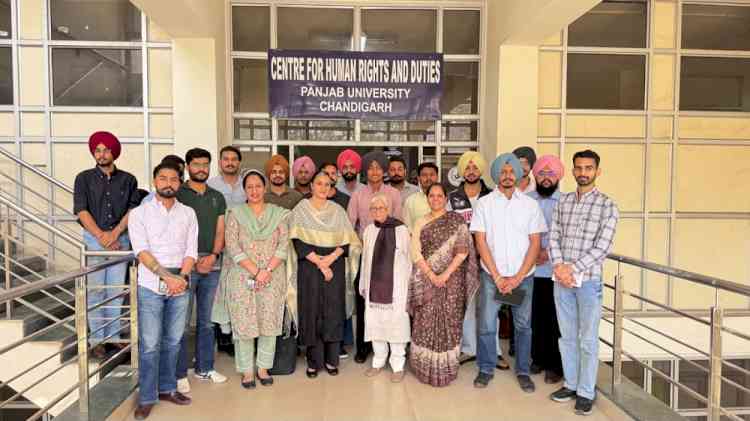
Chandigarh, March 11, 2026: The Centre for Human Rights & Duties, Panjab University, Chandigarh, today hosted a special lecture on “Reverse Migration in Punjab: A Human Rights Perspective” at the Seminar Room-cum-Library, CHRD.
The keynote address was delivered by Ms. Mandeep Kaur Tangra, a globally recognised entrepreneur and founder of Oorjaah. Ms. Tangra shared her vision of reverse migration as a transformative process that goes beyond economic return. She observed, “Migration back to Punjab is about reclaiming dignity, identity, and opportunity. It is about creating sustainable livelihoods, nurturing local talent, and ensuring that our villages become hubs of growth rather than sites of abandonment.” Drawing upon her initiatives such as Tech School on Wheels, she illustrated how technology and entrepreneurship can empower rural communities, bridge skill gaps, and inspire youth to invest in their homeland.
The session was chaired by Prof. Navneet Kaur Arora, Faculty of Sociology, UILS, Panjab University, who emphasized the human rights dimensions of migration, particularly the right to livelihood, dignity, and social justice.
The event was enriched by the presence of Prof. Pam Rajput, Professor Emeritus, Department-cum-Centre for Women’s Studies and Development, who highlighted the gendered aspects of migration. Prof. Rajput stressed that women’s contributions in sustaining families and communities often remain invisible in policy frameworks and called for inclusive strategies that recognize women as central actors in the process of reverse migration.
Speaking on the occasion, Dr. Upneet Kaur Mangat, Chairperson, Centre for Human Rights & Duties, remarked, “Reverse migration is not merely an economic phenomenon; it is a question of dignity, identity, and rights. Punjab’s youth and women are reclaiming agency in ways that demand fresh academic and policy attention. The Centre will continue to foster dialogue that bridges grassroots realities with institutional frameworks.” She further noted that the Centre is committed to advancing scholarship and advocacy on emerging human rights issues, ensuring that migration is studied not only as a demographic shift but as a deeply human experience.
The lecture witnessed active participation from faculty, students, and staff, who engaged in a vibrant discussion on the challenges and opportunities of reverse migration in Punjab. The deliberations reinforced the Centre’s role as a hub for critical inquiry and advocacy on pressing human rights concerns, while also underscoring the importance of collaborative efforts between academia, policymakers, and community leaders.