Rohtak Moves to Next Phase of Road Safety Reform: Strict Accountability, Time-Bound Execution and Engineering-Led Interventions: DC Sachin Gupta
In a decisive step towards making roads safer and saving lives, the District Road Safety Committee (DRSC) meeting chaired by Deputy Commissioner Sachin Gupta laid down a clear, time-bound and accountability-driven roadmap for reducing road accident fatalities in the district.
 Girish Saini
Mar 17, 2026 11:25
0
Girish Saini
Mar 17, 2026 11:25
0
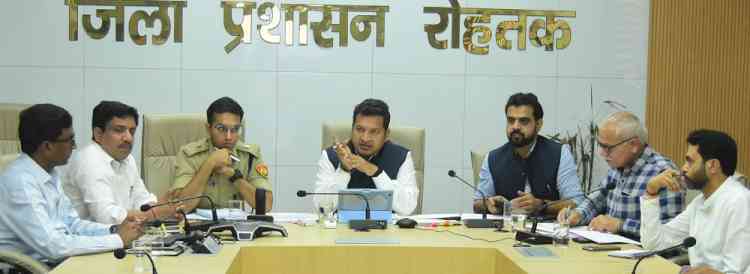
Rohtak, March 17, 2026: In a decisive step towards making roads safer and saving lives, the District Road Safety Committee (DRSC) meeting chaired by Deputy Commissioner Sachin Gupta laid down a clear, time-bound and accountability-driven roadmap for reducing road accident fatalities in the district.
The meeting, which also reviewed the implementation of the Surakshit School Vahan Policy, reflected a shift from routine review to result-oriented governance focused on measurable outcomes on ground.
The Deputy Commissioner noted that sustained efforts over the past year have yielded encouraging results, with the district recording a 20 percent reduction in road accident fatalities in 2025 as compared to 2024. However, he expressed concern over the emerging upward trend in January and February 2026, underlining the need for stronger systemic and engineering-based interventions.
Data presented during the meeting showed that 24 road accidents were reported in February 2026 alone, resulting in 16 fatalities and 8 injuries, prompting the administration to intensify its strategy.
A detailed review of accident patterns revealed that most incidents are not isolated but stem from recurring gaps — poor street lighting, unsafe median cuts, lack of pedestrian infrastructure, over-speeding during night hours, and inadequate road maintenance. Areas such as IMT Rohtak, Sampla, Meham and Kalanaur continue to emerge as high-risk zones requiring focused attention.
The Deputy Commissioner also reviewed the status of major accident-prone locations including Chuliana Mod, Kultana Mod, Jalebi Chowk, IIM Chowk and Bhali Sugar Mill Flyover. While technical proposals and DPRs have been prepared in several cases, he expressed dissatisfaction over delays in execution and directed all concerned agencies to move from planning to visible action on ground without delay.
Highlighting that enforcement alone cannot ensure road safety, he emphasized the need to complement it with engineering solutions and behavioral change. While police enforcement has been intensified; with action against wrong parking, drunken driving and traffic violations; the focus will now expand towards safer road design, better infrastructure and scientific traffic management.
Several initiatives already underway in the district were reviewed, including identification of black spots, preparation of DPRs, enforcement drives, awareness campaigns, inspection of over 1500 school buses, and development of model road stretches. However, the Deputy Commissioner made it clear that incremental efforts are no longer sufficient and that time-bound, visible outcomes must now define the district’s road safety response.
Issuing a series of firm directions, he ordered that the top 10 fatal accident locations in the district must be fully treated within 30 days, while all identified black spots should receive immediate temporary safety measures within 7 days, including signage, reflectors, rumble strips and lane markings.
A new “Red Zone” enforcement approach will be adopted, under which police stations with consistently high accident rates will witness intensified enforcement focusing on speeding, drunken driving and major violations.
To ensure sustained improvement, all departments were directed to adopt engineering-led solutions such as median corrections, traffic calming measures, pedestrian crossings and improved lighting, especially at high-risk locations. He also directed that no new model roads will be announced unless existing stretches are fully compliant with all safety standards, including pedestrian infrastructure.
Fixing clear accountability, the Deputy Commissioner laid down strict maintenance timelines; potholes to be repaired within 72 hours, signage within 5 days and minor safety repairs within 7 days. He further directed that all Action Taken Reports must include geo-tagged evidence, timelines and names of responsible officers, and warned that delays beyond 30 days will be escalated.
In a strong message on accountability, he stated that any loss of life due to negligence or failure of a concerned department will invite registration of FIR against responsible officials.
Pedestrian safety was identified as a key priority, with directions to enforce a maximum speed limit of 30 kmph in school zones and to strengthen infrastructure such as footpaths, raised crossings and signage.
The review of the Surakshit School Vahan Policy revealed that over 1500 school buses have been inspected, with action taken against violations. The Deputy Commissioner directed that compliance must now be made stricter through mandatory GPS, speed governors, fire safety equipment and regular inspections, particularly after April 1.
To improve visibility and reduce risk factors, the Forest Department was directed to undertake systematic trimming of roadside vegetation.
Concluding the meeting, Deputy Commissioner Sachin Gupta emphasized; “Road safety is not a routine administrative function; it is a life-saving responsibility. Our focus will now be on strict accountability, time-bound action and measurable outcomes. Even a single preventable death is unacceptable.”
He reiterated that the district administration is committed to adopting a Safe System Approach, ensuring that infrastructure, enforcement and public behaviour together contribute to a sustained reduction in road accidents.