Rohtak Launches Daily 15-Minute Reading Challenge; Project Vishwas Shaping Confident, Future-Ready Students: DC Sachin Gupta
In a major step towards transforming Government school education, the Rohtak District Administration has launched two flagship initiatives aimed at strengthening both academic excellence and holistic student development—a Daily 15-Minute Reading Challenge for all Government Primary Schools and Project Vishwas, a district-wide programme designed to nurture confident, expressive and future-ready learners.
 Girish Saini
Jul 14, 2026 08:32
0
Girish Saini
Jul 14, 2026 08:32
0
Rohtak, July 14, 2026: In a major step towards transforming Government school education, the Rohtak District Administration has launched two flagship initiatives aimed at strengthening both academic excellence and holistic student development—a Daily 15-Minute Reading Challenge for all Government Primary Schools and Project Vishwas, a district-wide programme designed to nurture confident, expressive and future-ready learners.
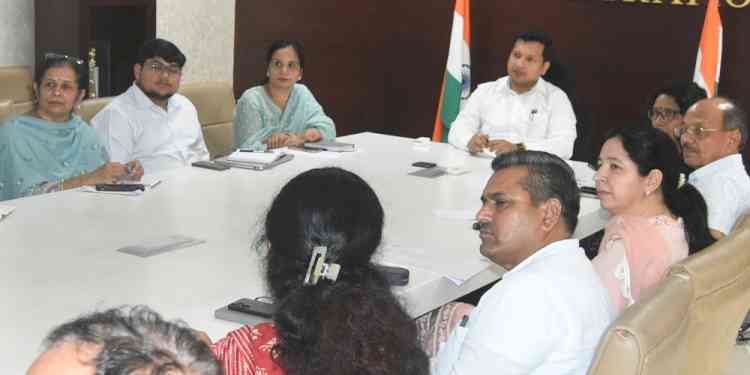
Announcing the initiatives while chairing the Monthly Review Meeting of the Department of School Education and Samagra Shiksha, Deputy Commissioner Sachin Gupta said the objective of education is not merely to improve examination results but to build readers, thinkers, communicators and responsible citizens capable of succeeding in an ever-changing world.
“Our vision is to ensure that every child in Rohtak not only learns to read but reads with understanding, thinks independently, communicates confidently and develops the skills required to succeed in life. Every innovation introduced by the district administration is aimed at making our Government schools centres of excellence,” the Deputy Commissioner said.
During the review meeting, officials presented the findings of the district-wide Competency Review Programme (CRP) and the Digital Skill Passbook, through which every student’s learning competencies are being digitally assessed and tracked.
The assessment revealed that while students have shown encouraging progress in foundational literacy and numeracy, a significant number continue to face difficulty in reading unseen passages, comprehending their meaning and answering questions based on the text.
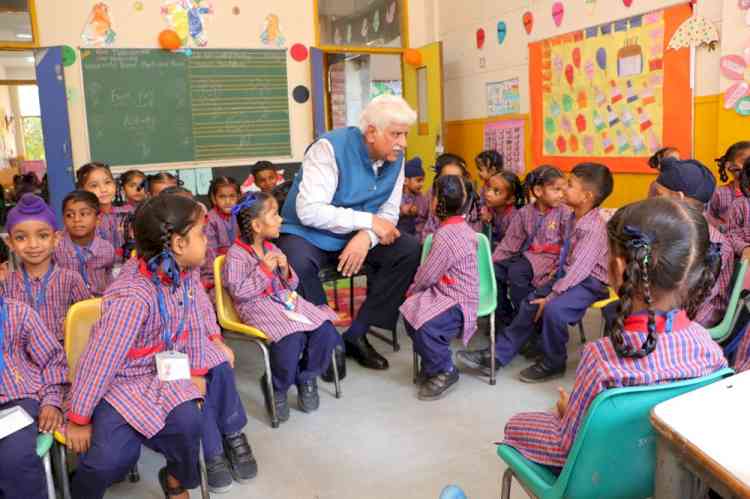
To bridge this learning gap, the District Administration has introduced a Daily 15-Minute Reading Challenge in all Government Primary Schools. Under the initiative, every child will spend fifteen minutes every day after the Zero Period reading books of their own choice under the guidance and supervision of teachers.
Students will be encouraged to read storybooks, children’s literature, biographies, newspapers and other age-appropriate reading material available through classroom reading corners and school resources. Teachers will create a library-like environment in classrooms, encourage joyful reading and assist students in understanding unfamiliar words and concepts whenever required.
The Deputy Commissioner said the initiative is expected to significantly improve reading fluency, vocabulary, language proficiency, comprehension and critical thinking while cultivating a lifelong habit of reading. The programme has been designed in line with the vision of the National Education Policy (NEP) 2020 and the NIPUN Bharat Mission, which place foundational literacy at the centre of school education reforms.
The Deputy Commissioner reviewed the progress of the Digital Skill Passbook, under which competency-wise profiles of students have been prepared to enable teachers to identify learning gaps and plan targeted classroom interventions.
Officials informed the meeting that students of Classes I to III have recorded encouraging improvement under the NIPUN Haryana Mission in phonemic awareness, cognitive development, oral expression, letter recognition, classification skills, reading fluency, sentence reading, number recognition and basic mathematical operations.
The Deputy Commissioner directed that continuous monitoring through competency-based assessment should remain the foundation of instructional planning so that no child is left behind.
The meeting also reviewed the progress of Project Vishwas, an innovative district initiative conceptualised to ensure that education extends beyond textbooks and examinations to prepare students for life. Implemented by DIET Madina, the project is currently being piloted across 43 Cluster Resource Centres (CRCs) covering Government schools for students of Classes VI to VIII.
The programme focuses on six core dimensions of student development—classroom participation, communication confidence, learning resilience, leadership and initiative, social confidence and inclusion, and life readiness.
Regular classroom activities including role plays, group discussions, presentations, collaborative projects, public speaking exercises, reflective sessions and experiential learning are helping students become more confident, expressive, responsible and socially aware.
To ensure effective implementation, mentor orientation was conducted on 22 June, followed by specialised training of 43 Cluster Heads and 43 TGT teachers on 27 June. Baseline classroom observations were completed before the formal launch of the project, and implementation is now being monitored weekly at school level, fortnightly at block level and monthly at district level.
The Deputy Commissioner directed officers to closely monitor the impact of Project Vishwas so that it evolves into a sustainable model for holistic student development across the district.
The Deputy Commissioner appreciated the successful implementation of Joyful Holiday Homework, which promoted activity-based learning, storytelling, reading, creativity, environmental awareness, local culture and active parental participation during the summer vacation.
Progress of several other flagship programmes was also reviewed, including Mathematics Olympiad Coaching in 25 Government schools. Super-40 Programme for IIT-JEE and NEET aspirants, where more than 60 students have already enrolled for specialised coaching, mentoring and career guidance. Teachers as Innovators Programme, enabling teachers to share best classroom practices through digital platforms. Bhartiya Bhasha Summer Camp, promoting multilingual learning and appreciation of Indian languages. Kushal Business Challenge 3.0, encouraging entrepreneurship, innovation and vocational skills among students. PM SHRI initiatives, Summer Adventure Camps and several student enrichment programmes.
The Deputy Commissioner also reviewed the progress of infrastructure development under Samagra Shiksha, including construction of classrooms, science laboratories, libraries, boundary walls and other educational facilities. He directed the concerned officers to ensure timely completion of all ongoing projects while maintaining the highest quality standards.
Reviewing the implementation of the PM POSHAN Scheme, he instructed officers to conduct regular inspections of Mid-Day Meals, ensure hygiene and nutritional quality and strengthen monitoring at every level. He also emphasised greater use of educational field visits and experiential learning opportunities to enrich classroom teaching.
Appreciating the efforts of the Education Department, DC Sachin Gupta said Rohtak has emerged as one of the leading districts in implementing innovative educational reforms. He urged all officers, school heads and teachers to continue working with dedication, innovation and team spirit so that every Government school becomes a centre of excellence and every child receives quality education, strong foundational skills and the confidence to realise his or her full potential.
The meeting was attended by DEO Manjeet Malik, Principal DIET Madina Ritu Panghal, DEEO Bijender Hooda, DPC Samagra Shiksha Suman Hooda, CM’s Good Governance Associate Tanumay Dutta, Deputy DEO, BEO and other senior officers of the Education Department.