Police Administration Students Receive Practical Exposure to Weapons Training and Police Control Room Operations with Chandigarh Police
On the sixth day of the internship programme, students of the Centre for Police Administration, Panjab University, Chandigarh, today received practical exposure to weapons training and the functioning of the Police Control Room (PCR) Unit at the Recruit Training Centre (RTC), Sector 26, Chandigarh.
 City Air News
Jul 8, 2026 10:41
0
City Air News
Jul 8, 2026 10:41
0
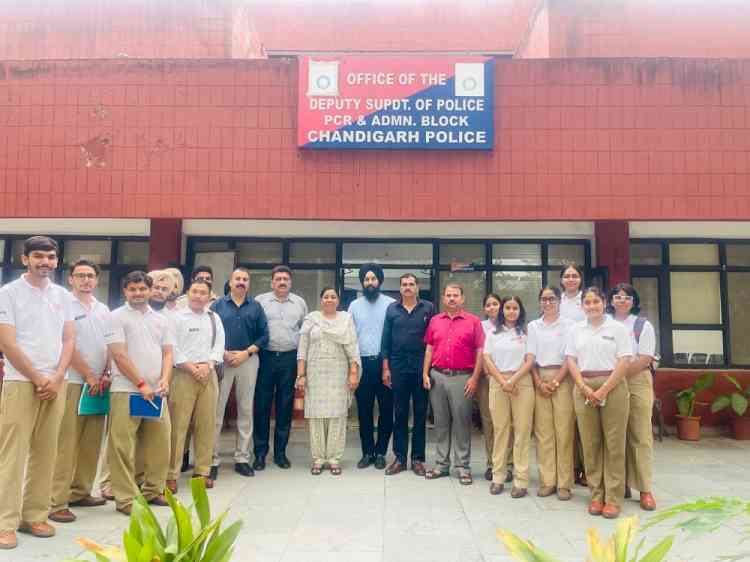
Chandigarh, July 7, 2026: On the sixth day of the internship programme, students of the Centre for Police Administration, Panjab University, Chandigarh, today received practical exposure to weapons training and the functioning of the Police Control Room (PCR) Unit at the Recruit Training Centre (RTC), Sector 26, Chandigarh.
Dr. Kuldeep Singh, Chairman, Centre for Police Administration, Panjab University, Chandigarh, highlighted that weapons training is an integral component of police functioning. He emphasised that, as a civil law enforcement agency, the police use firearms strictly in accordance with legal provisions to safeguard citizens, maintain public order, and deter potential threats to peace and security.
Dr. Kuldeep Singh also expressed his sincere gratitude to Pushpendra Kumar, Inspector General of Police, Chandigarh Police, and Manjeet Sheoran, Superintendent of Police, Headquarters, Chandigarh Police, for providing this valuable learning opportunity to the students of Police Administration.
The first technical session was conducted by Sub-Inspector Ram Dhan, who provided a comprehensive overview of the small and large firearms used by Chandigarh Police. He explained the classification of small firearms, including the 9 mm pistol and .38 revolver, describing their technical specifications such as range, magazine capacity, ammunition, muzzle characteristics, and operational mechanisms. He further elaborated on smooth-bore and rifled weapons, automatic and semi-automatic firearms, and larger weapons such as the INSAS rifle, SLR, AK-47, and sniper rifles. Their range, firing positions, magazine systems, operational mechanisms, and tactical applications were demonstrated to the students.
The students also visited the Police Weapon Reserve (KOTE), where Sub-Inspector Ram Dhan, along with Assistant Sub-Inspectors Satyapal and Vijay Kumar, conducted a detailed demonstration of the police armoury. The session familiarised the students with the various weapons in the police armoury, their operational features, maintenance procedures, and safety protocols. Special emphasis was placed on the safe handling, secure storage, regular maintenance, and responsible use of firearms in law enforcement.
In the second session, the students visited the Police Control Room (PCR) Unit at RTC, Sector 26. Inspector Jaswinder Kaur, In-charge, PCR Unit, along with Law Officer Ajay Singh and their team, explained the organizational structure and operational functioning of the PCR system in Chandigarh Police. They informed the students that Chandigarh Police operates 57 PCR vehicles and 28 PCR motorcycles, with 3–4 PCR vehicles and two motorcycles deployed in each police subdivision according to operational requirements.
Inspector Jaswinder Kaur further explained that all PCR personnel undergo rigorous professional training, including Advanced First Aid and Cardiopulmonary Resuscitation (CPR) conducted by certified medical professionals. She also highlighted specialized training modules on women’s safety, enabling PCR personnel to provide timely assistance, emergency intervention, and secure transportation during vulnerable late-night hours. The students were given a detailed demonstration of the communication systems, emergency response mechanisms, GPS-enabled technology, and other equipment installed in PCR vehicles. She also discussed the emerging operational challenges faced by Chandigarh Police in ensuring prompt emergency response and effective public safety management.
The visit provided the students with valuable practical insights into modern policing, weapons management, emergency response systems, and the operational preparedness of Chandigarh Police. The programme significantly enhanced their understanding of the practical dimensions of police administration beyond classroom learning and strengthened the linkage between academic knowledge and field-based policing practices.
Dr. Sanjeev Ranjan, Dr. Satnam Singh, and Sub-Inspector Kuldeep Singh accompanied the students throughout the visit.