PM Narendra Modi’s Vision in Spotlight as Day 3 of IISF 2025 Showcases New-Age Technologies
Space, Telecom and Defence Innovations Take Center Stage on Day 3 of IISF 2025
 City Air News
Dec 8, 2025 09:39
0
City Air News
Dec 8, 2025 09:39
0
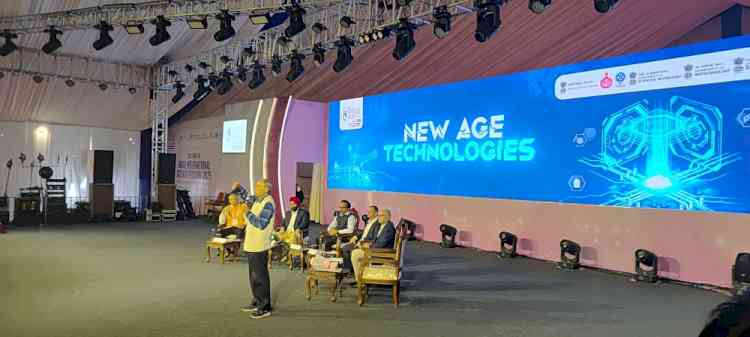
Panchkula, December 8, 2025: Day 3 of the India International Science Festival (IISF) 2025 unfolded as an inspiring showcase of technology, innovation, and India’s accelerating scientific progress. Students, innovators, and science enthusiasts gathered to explore emerging frontiers in space, defence, and telecommunications, during a high-profile panel discussion on “New Age Technologies.”
The session brought together leading figures from India’s scientific and industrial ecosystem, including Dr. S. Somanath, Former Chairman, ISRO and Secretary, Department of Space; Dr. Abhay Pashilkar, Director, CSIR–NAL Bengaluru; Dr. Prahlada Rama Rao, Former Director, DRDL–DRDO; Jagmohan Bali, Chief Technology Officer, Bharti Airtel; and Jeevan Talegaonkar, Vice President, Jio.
India’s Space Growth Under PM Modi’s Leadership
Reflecting on India's space journey, Dr. S. Somanath recounted his experiences during the Chandrayaan-3 mission and spoke about the nation’s expanding ambitions. He emphasized that India’s achievements in space have grown significantly under the visionary leadership of Prime Minister Shri Narendra Modi, citing upcoming missions such as Gaganyaan as proof of India’s rising capabilities.
“There is an explosion of possibilities in space exploration,” Dr. Somanath noted. “Interest in the Moon, Mars, and other planets has surged worldwide. India has announced its return to the moon, and we are also pursuing science missions aimed at understanding the origins of the universe. Soon, your mobile phones may receive signals directly from space. Young students in India are already building rockets and satellites.”
Drone Technology: A Game Changer for Multiple Sectors
Dr. Abhay Pashilkar highlighted the expanding role of drones in India, from long-endurance surveillance platforms to cargo-handling systems.
“We can do a lot with drones—some can fly for more than 90 days,” he said. “They help in agriculture, logistics, and large-scale mapping. The Government of India is working to build a national drone mission that empowers young innovators to create and deploy drone solutions suited to local needs.”
Defence Innovations and the Rise of Non-Contact Warfare
Offering insights into India’s defence preparedness, Dr. Prahlada Rama Rao discussed the evolution of the BrahMos missile and Akash, the surface-to-air missile system, and referenced the operational success of Operation Sindoor.
He highlighted that systems like Akash and BrahMos have demonstrated India’s technological edge. “Akash stood like a wall, while BrahMos penetrated enemy territory with precision,” he said. “Drones will soon perform roles traditionally executed by fighter pilots—for both offence and defence. This is the future of warfare.”
Telecom Leaders on 5G, 6G and the Leap Toward Integrated Networks
In the telecommunications domain, Jagmohan Bali Chief, Technology Officer, Bharti Airtel and Jeevan Talegaonkar, Vice President, Jio, reflected on India’s rapid progress from 2G to 5G and the groundwork being laid for 6G.
Jeevan Talegaonkar recalled the remarkable efforts behind India’s homegrown 5G development: “We often assume miracles don’t happen in India, but 5G proved otherwise. Over 2,000 engineers worked tirelessly, and when asked whether we needed European partners, the answer was simple—we built our own 5G network. As scientists break barriers in space, we innovate on the ground.”
Jagmohan Bali explained how the next era of telecom will merge terrestrial and non-terrestrial networks. “Drone systems, aircraft and missile technologies will be linked under one technological umbrella. With integration between mobile networks and space-based systems, we aim for seamless global coverage—across the ocean.”
Space Discoveries That Continue to Inspire
Dr. Somanath also revisited India’s lunar accomplishments. “Going to the moon has never been easy,” he said. “Chandrayaan-1 discovered water on the lunar surface and revealed that the moon is still tectonically active. These findings continuously lift our scientific spirit.”