One-day academic workshop on “The Craft of Research and Scholarly Writing in Public Policy and Administration”
The Department of Public Administration, Panjab University, Chandigarh organised a one-day academic workshop on “The Craft of Research and Scholarly Writing in Public Policy and Administration” for research scholars from various social science disciplines.
 City Air News
May 14, 2026 09:38
0
City Air News
May 14, 2026 09:38
0
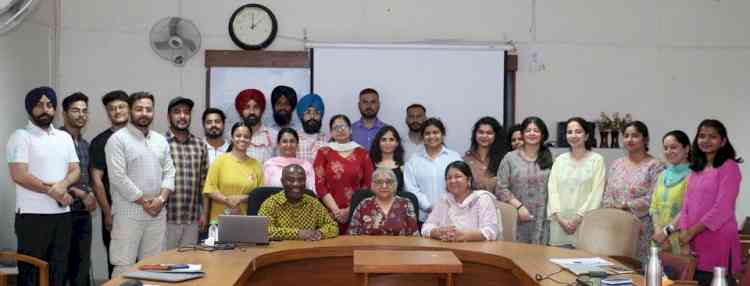
Chandigarh, May 14, 2026: The Department of Public Administration, Panjab University, Chandigarh organised a one-day academic workshop on “The Craft of Research and Scholarly Writing in Public Policy and Administration” for research scholars from various social science disciplines. The workshop was conducted by James K. Agbodzakey, Fulbright Specialist, Professor of Public Leadership, and Director of the Urban SERCH Institute, University of North Texas at Dallas (USA).
The workshop aimed at strengthening scholarly writing, research excellence, critical thinking, and dissertation development among emerging researchers. 34 research scholars from social sciences disciplines of Panjab University, Chandigarh including Political Science, Sociology, Centre for Human Rights and Duties, and students of affiliated colleges enthusiastically participated in the highly engaging and intellectually stimulating sessions. The programme provided an enriching platform for interdisciplinary academic interaction, collaborative learning, and exchange of research experiences.
The workshop commenced with sessions on Research and Writing Fundamentals and The Art and Process of Inquiry. Dr. Agbodzakey introduced participants to the meaning and purpose of research, brainstorming research questions, and the importance of selecting relevant and socially meaningful research topics. He elaborated on practical tips for choosing research themes and highlighted the significance of asking strong social research questions.
The resource person extensively discussed the importance of scholarly writing and emphasised “writing to understand” and “writing to gain perspective.” He explained why formal academic reports are essential and familiarised participants with the scientific report format, including introduction, methods, results, discussion of results, and conclusions and recommendations. The sessions also focused on supporting arguments with data and maintaining clarity, coherence, and logical reasoning in academic work.
A major highlight of the workshop was the discussion on the “8 Skills to Learn” for effective research and scholarly writing. Dr. Agbodzakey also deliberated upon standards and criteria for evaluating reasoning, academic ethics, intellectual standards, and essential intellectual traits required for quality research. He explained concepts such as intellectual humility, intellectual courage, intellectual integrity, intellectual perseverance, fairness in reasoning, and confidence in evidence-based arguments.
The later sessions focused on academic writing types, professional standards of research, methods of investigation, and the process of inquiry. Dr. Agbodzakey also conducted a practical session on 360-degree literature search and systematic reviews, where scholars were introduced to various sources and techniques for identifying quality literature and conducting comprehensive academic reviews.
The participants actively interacted with the resource person throughout the workshop, sharing their research concerns, methodological challenges, and publication-related queries. Faculty members and scholars appreciated the practical orientation, interactive pedagogy, and global academic perspective brought by the workshop. The event concluded with a fruitful question-answer session and was widely appreciated for enhancing the capacity for research and scholarly engagement among participants.