Nauni varsity embarks on Next Phase of Growth; Focus on Self-Reliance, Innovation, Global Outreach
Facilities for entrepreneurship, research, commercialisation inaugurated; foundation stones laid for Centres of Excellence
 City Air News
Nov 4, 2026 06:42
0
Nauni, November 4, 2026: Moving towards a new phase of institutional growth, Dr YS Parmar University of Horticulture and Forestry (UHF), Nauni, has taken several significant steps towards strengthening its research capabilities, creating new avenues for revenue generation, promoting entrepreneurship and expanding its academic outreach. In a series of initiatives reflecting its long-term vision of becoming more self-sufficient and future-ready, the university inaugurated several new facilities and laid the foundation stones for major research, academic and institutional projects on Wednesday. The initiatives were led by Vice-Chancellor Prof. Harminder Singh Baweja in the presence of university statutory officers, HODs and scientists.
Giving a major push to entrepreneurship and the commercialisation of research, the Vice-Chancellor virtually inaugurated the Processing Centre for establishing a Common Incubation Centre for processing mushrooms, vegetables, fruits, spices and herbs at the University developed with funding from the Ministry of Food Processing Industries, GoI. The facility is envisioned as a platform for product development, value addition, skill development and incubation of food-processing enterprises, providing opportunities for students, researchers, farmers and aspiring entrepreneurs. The Enology Laboratory was also inaugurated to strengthen research, practical training and technology development in wine-making and related areas. These facilities are expected to help bridge the gap between research and commercial application while opening new avenues for entrepreneurship and income generation.
The Herbal Products Development and Sale Centre was another important addition, aimed at promoting the development, value addition and marketing of herbal products. The digitisation of the university's Herbarium was also inaugurated, marking an important step towards preserving and making its valuable plant collection and scientific information more accessible.
The Centre on Cannabis Research, funded by the Himachal Pradesh Government, was inaugurated as a dedicated research and development facility to advance scientific understanding, quality assessment, conservation and sustainable utilisation of cannabis for medicinal purposes. The Vice-Chancellor also inaugurated the Policy Centre on Public-Private Partnership (PPP), which will work towards facilitating policy research and strengthening partnerships between public institutions and private stakeholders.
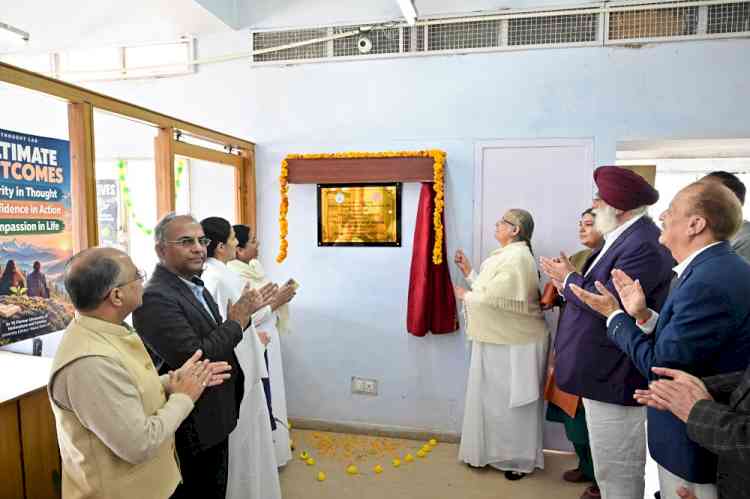
Adding a new dimension to student development, the Thought Lab, established in collaboration with the Brahma Kumaris Foundation at the SatyaNand Stokes Library, was inaugurated in the presence of Sister Sushma from the Brahma Kumaris. The initiative aims to provide students with a space for reflection, positive thinking and holistic personal development and sharing of ideas.
Looking beyond its existing infrastructure, the university also laid the foundation stones for several ambitious projects that will shape its future research and academic landscape.
These include a Plant Tissue Culture Facility in the Department of Biotechnology, the Himalayan Traditional Seed Heritage Centre in the Department of Seed Science and Technology and the Centre of Excellence on Waste to Wealth in the Department of Silviculture and Agroforestry. These facilities are expected to strengthen biotechnology research, conserve traditional seed resources and promote the scientific utilisation of waste into valuable products. The foundation stone for a Centre of Excellence on Honeybee Research in the Department of Entomology was also laid, which will further strengthen research, training and technology development in apiculture and related areas.
A significant step towards expanding the university's educational footprint was marked by the foundation stone laying of the Centre for Distance and Online Learning. The centre aims to take the university's specialised academic programmes, expertise and knowledge beyond geographical boundaries, making learning opportunities accessible to students and professionals across the country and internationally.
The university also laid the foundation stone for a Centre of Excellence for Training, Placement and Global Linkages at the College of Horticulture and Forestry, Neri, Hamirpur. The centre is envisioned to strengthen industry-academia connections, improve student employability and facilitate national and international career opportunities. A foundation stone was also laid for an Agriculture Museum, which will showcase the evolution and contributions of agriculture, horticulture and forestry.
Recognising the importance of a conducive learning environment, the university also inaugurated dedicated Sukh-Sansar Reading and Study Lounges in each hostel under the Students' Welfare Organization. These spaces will provide students with improved facilities for reading, self-study and intellectual engagement.
“Together, these initiatives represent a broader institutional vision that goes beyond the creation of physical infrastructure. By investing in incubation and processing facilities, specialised research centres, digital education, industry linkages and student development, the university is seeking to diversify its activities, generate additional resources, strengthen its academic standing and reduce dependence on conventional sources of funding,” said Prof Baweja.
He added that the initiatives mark an important step in the University's journey towards becoming a more self-reliant, innovation-driven and globally connected institution, while strengthening its contribution to the development of horticulture, forestry and allied sectors.