National Symposium on Plant Health Management Stresses Academia–Industry Collaboration
A two-day National Symposium on ‘Synergies for Sustainability: Fostering Academia–Industry Collaboration in Plant Health Management’ commenced today at Dr. YS Parmar University of Horticulture and Forestry, with experts emphasizing the urgent need to bridge the gap between research and field-level application through stronger partnerships between academia and industry.
 City Air News
Feb 27, 2026 10:14
0
City Air News
Feb 27, 2026 10:14
0
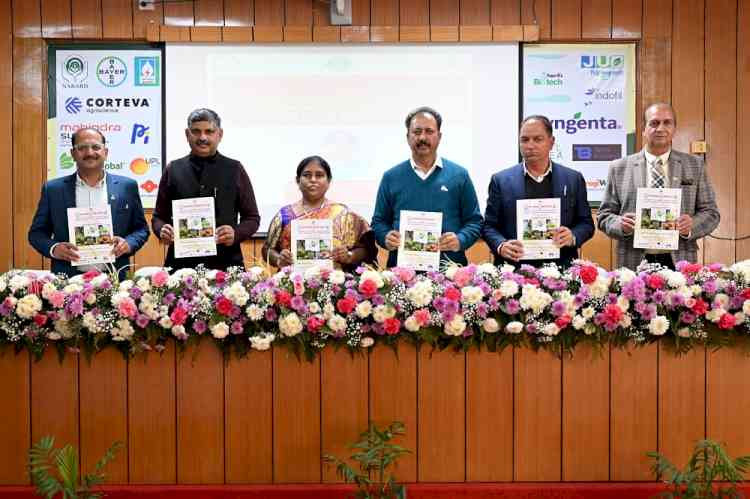
A two-day National Symposium on ‘Synergies for Sustainability: Fostering Academia–Industry Collaboration in Plant Health Management’ commenced today at Dr. YS Parmar University of Horticulture and Forestry, with experts emphasizing the urgent need to bridge the gap between research and field-level application through stronger partnerships between academia and industry.
The symposium is being organized by the Himalayan Phytopathological Society in collaboration with the Department of Plant Pathology of the university. Over 188 participants from universities, research institutes and the agrochemical industry across the country are attending the event.
Delivering the inaugural address, Chief Guest Dr. R. Sarada Jayalakshmi Devi, Vice Chancellor of Acharya N.G. Ranga Agricultural University, underscored the importance of translating scientific discoveries into scalable, farmer-ready technologies. She highlighted the role of fungal biopesticides and eco-friendly chemical protection in modern agriculture, noting that recent advancements have focused on biodegradable compounds with improved target specificity and reduced toxicity. She also spoke about the potential of nanobiofungicides as effective alternatives to conventional fungicides.
Dr. Devi emphasized that while universities and research institutions generate fundamental knowledge on plant pathogens, host resistance, molecular diagnostics and integrated disease management, industry partnerships are essential to commercialize innovations such as resistant varieties, bioformulations and diagnostic kits for wider adoption.
Prof. Rajeshwar Singh Chandel, UHF Vice Chancellor, remarked that natural farming is emerging as a scientifically validated approach aligned with multiple Sustainable Development Goals. He stressed that research and technology must be environmentally sustainable while offering cost-effective solutions to farmers. Appreciating the theme of the symposium, he called for stronger industry recognition of academia as a vital research partner and urged that every thesis should lead to innovation with practical and commercial relevance.
Earlier, Dr. Satish Sharma, Professor and Head, Department of Plant Pathology and President of the Himalayan Phytopathological Society, welcomed the participants. He highlighted the department’s legacy as one of the oldest in the university, known for developing technologies for temperate horticultural crops relevant to the Himalayan region.
Dean, College of Horticulture and Patron of HPS, Dr. Manish Sharma, observed that despite technological advancements, productivity gaps persist when compared to global standards. He advocated for integrated approaches that address plant protection alongside environmental concerns and encouraged industry representatives to provide inputs for curriculum revisions in line with emerging needs.
Director of Extension Education, Dr. Inder Dev, described plant health as a critical pillar of agriculture, noting that crop losses of up to 40 percent due to diseases threaten food and nutritional security as well as farmers’ livelihoods. Secretary of HPS, Dr. Anil Handa, outlined the activities of the society, established in 2017 to promote sustainable disease management practices, particularly for Himalayan crops. He informed that this is the seventh national symposium organized by the society, which regularly conducts brainstorming sessions, guest lectures, farmer–scientist interactions, field visits, and publishes an e-magazine.
The symposium features multiple technical sessions led by eminent scientists from reputed universities, ICAR institutes, and the agrochemical industry. Discussions will focus on integrated plant health management, emerging genomic tools for stress tolerance, sustainable disease management strategies, and mechanisms to strengthen technology transfer.
In the face of climate change, land degradation, water scarcity, and rising food demand, experts reiterated that collaboration between academia and industry is key to fostering innovation, improving technology dissemination, and developing region-specific, scalable solutions. The symposium aims to chart a roadmap for future partnerships to enhance agricultural productivity, sustainability, and food security.