National Seminar on theme “Mapping India’s Foreign Policy in the Emerging Geo-Political Dynamics”
Former Chief of the Naval Staff of the Indian Navy, Admiral Sunil Lanba, PVSM, AVSM, ADC (Retd.), today delivered the valedictory address at the National Seminar on the theme “Mapping India’s Foreign Policy in the Emerging Geo-Political Dynamics”, which concluded today at the Golden Jubilee Hall, Panjab University, Chandigarh.
 City Air News
Feb 21, 2026 01:50
0
City Air News
Feb 21, 2026 01:50
0
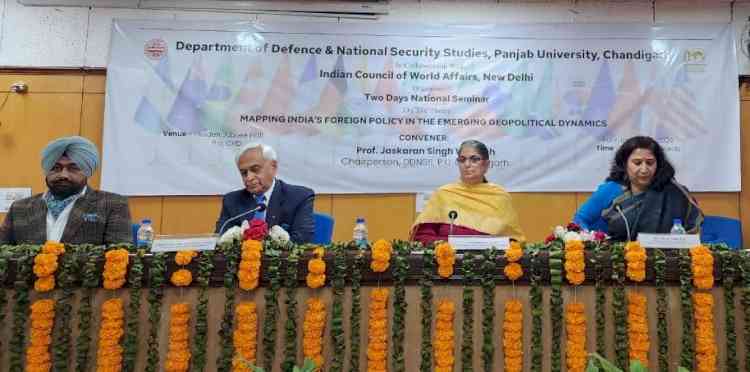
Chandigarh, 20 February 2026: Former Chief of the Naval Staff of the Indian Navy, Admiral Sunil Lanba, PVSM, AVSM, ADC (Retd.), today delivered the valedictory address at the National Seminar on the theme “Mapping India’s Foreign Policy in the Emerging Geo-Political Dynamics”, which concluded today at the Golden Jubilee Hall, Panjab University, Chandigarh.
The Department of Defence and National Security Studies, Panjab University had organised the two-day national seminar in collaboration with the Indian Council of World Affairs.
The second day of the seminar featured two technical sessions followed by a valedictory session, bringing together eminent scholars, strategic experts, and practitioners to deliberate on India’s foreign policy challenges and opportunities in a rapidly evolving global order.
The day commenced with Technical Session III, chaired by Prof. Manvinder Kaur, Professor, Department-cum-Centre for Women’s Studies & Development, Panjab University, and co-chaired by Prof. Navjot Kaur, Professor, Department of Political Science, Panjab University. Maj. Gen. Amarjit Singh, VSM (Retd.), former Director, Gyan Chakra Think Tank, stated that global institutions are degrading and world powers are defying the rules and regulations of global governance. He also mentioned that having a strategic mindset is crucial for developing strategic autonomy. Maj. Gen. Neeraj Bali, SM (Retd. ), Director, Gyan Chakra Think Tank, Western Command, Chandimandir, spoke on "Strategic Autonomy Through Engagement: Reframing India's China Policy in a Multipolar World," emphasising the need for calibrated engagement with China while safeguarding India’s core strategic interests. He asserted that India should deliberately stabilise relations with China to serve its own interests. Dr Anuradha Choudhary, Assistant Professor, Central University of Jammu, examined India–China relations in the 21st century with particular reference to reassessing the Tibetan factor in a changing strategic environment. Dr. Survsureshth Dhammi, Assistant Professor, University of Allahabad, presented in virtual mode on “India’s Defence Diplomacy in Africa: Training, Capacity Building and Strategic Partnership", highlighting Africa’s growing salience in India’s foreign policy calculus.
Technical Session IV was chaired by Prof. Pampa Mukherjee, Chairperson, Department of Political Science, Panjab University. Dr Gurjeet Kaur, Assistant Professor, Panjab University, explored the prospects and constraints of adopting a feminist foreign policy for India. She emphasised that the implementation of a feminist foreign policy will result in diverse and inclusive international governance strategies. Dr Divya Malhotra, Adjunct Faculty, Mount Carmel College, Bangalore, underlined the strategic dimensions of labour mobility from India to Israel post October 7, 2023, which would have profound effects on the two countries relations. Mr Stanzin Namgail, Assistant Professor, Department of Defence, Strategic and Geopolitical Studies, Hemwati Nandan Bahuguna Garhwal University, offered critical reflections on the China-Tibet issue and the Indian, Chinese and Tibetan perspectives on the issue. Dr P. J. Khache, Assistant Professor, University of Allahabad, focused on non-traditional security challenges and India’s role in the ASEAN–India Comprehensive Strategic Partnership, stressing the importance of multilateral engagement and regional cooperation.
The valedictory session was graced by Admiral Sunil Lanba, PVSM, AVSM, ADC (Retd.), former Chief of the Naval Staff of the Indian Navy, who delivered the valedictory address. He reflected on the evolving maritime dimension of India’s foreign and security policy and emphasised the value of strengthening naval capabilities to safeguard India’s interests in the Indo-Pacific region. Dr Meena Singh Roy, Chairperson, Greater West Asia Forum, India, was the Guest of Honour and highlighted that there is major strategic shift unfolding in the West Asian region. India has major stakes in the region and has adopted a strong, smart and balanced policy towards this important region underpinned by strong bilateral and regional ties. The presidential address was delivered by Prof. Madhurima Verma, Professor, Department of Sociology, CDOE, Panjab University, who emphasised the importance of interdisciplinary perspectives in understanding foreign policy. Prof. Jaskaran Singh Waraich, chairperson of the Department of Defence and National Security Studies, delivered a brief review of the seminar and concluding remarks. The vote of thanks was proposed by Dr Mandeep Singh, Assistant Professor, Department of Defence and National Security Studies, Panjab University.
The seminar concluded with enriching discussions and vibrant participation from academicians, researchers, and students from the university campus and colleges. The discussions highlighted how India's foreign policy is changing, focusing on being independent, building different partnerships, and adjusting its diplomatic approach to new global challenges.