National Seminar on Nature-Based Farming and NTFPs for Global Environmental Sustainability
Dr YS Parmar University of Horticulture and Forestry (UHF), Nauni organized a national seminar titled ‘Sustainable Synergies 2026’ on Nature-Based Farming and Non-Timber Forest Products (NTFPs) for Global Environmental Sustainability on Tuesday.
 City Air News
Feb 25, 2026 03:57
0
City Air News
Feb 25, 2026 03:57
0
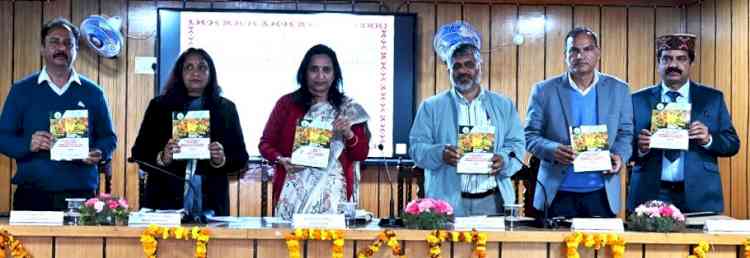
Dr YS Parmar University of Horticulture and Forestry (UHF), Nauni organized a national seminar titled ‘Sustainable Synergies 2026’ on Nature-Based Farming and Non-Timber Forest Products (NTFPs) for Global Environmental Sustainability on Tuesday. The seminar was conducted in collaboration with Indian Institute of Technology Delhi under the aegis of the ANRF-PAIR (Partnerships for Accelerated Innovation and Research) programme. The event brought together eminent scientists, academicians, researchers and students from leading institutions including IITs of Delhi & Roorkee, Punjab Agricultural University, Shoolini University, Rani Lakshmi Bai Central Agricultural University and UHF to deliberate on sustainable and innovative approaches for integrating nature-based farming systems and NTFPs into mainstream environmental sustainability frameworks.
Addressing the gathering, Chief Guest Dr. Devina Vaidya, Director of Research, emphasized that the responsibility of academic institutions goes beyond research generation and must focus on translating scientific knowledge into field-level practice for societal benefit. She talked about the ANRF project and how such programmes help in improving collaborative interdisciplinary research. Prof. Anushree Malik from the Centre of Rural Development and Technology, IIT Delhi, spoke about the UHF pioneering role in advancing knowledge systems from a Himalayan perspective and the research activities being undertaken at the Centre of Excellence. Dr. Inder Dev, Director of Extension Education, highlighted the success of natural farming in the state. He informed that over 2.2 lakh farmers have shifted to natural farming in the state.
Seminar Coordinator Dr Yashpal Sharma welcomed the guests and informed about the objectives of the programme.
The seminar featured five lead lectures by distinguished experts working at the interface of biotechnology, soil science, microbiology, environmental engineering and sustainable agriculture. Prof. Malik delivered a compelling talk on 'Algae-Assisted Nature-Based Farming: Current Research and Product Development Scenario'. She discussed the potential of algae-based biofertilizers, biostimulants, and biopesticides in enhancing seed germination, crop productivity and soil health while reducing dependence on synthetic inputs. Addressing challenges such as high production cost, limited shelf life, lack of awareness and policy gaps, she proposed the algal biorefinery model integrating wastewater treatment, carbon sequestration and production of crop health supplements. Prof. Sudhir Verma spoke on ‘Regenerative Soil Management through Natural Farming’, emphasizing low-input sustainable practices, restoration of soil fertility, intercropping, water conservation, activation of native earthworms and cultural pest management.
Dr. Nilendu Basak from IIT Delhi delivered a lecture on 'Soil Microbiomes at the Frontline of Environmental Protection: Linking Soil Health, Climate Resilience and Emerging Contaminants'. He highlighted the role of soil microbial communities in nutrient cycling, greenhouse gas regulation, and contaminant transformation. Emerging concerns such as heavy metals, microplastics and antibiotic resistance genes were discussed in the context of agroecosystem health. He also elaborated on research involving indigenous and genetically modified microbes for improving soil fertility and plant productivity. Dr. Ravi Kant Bhatia from Himachal Pradesh University presented a futuristic perspective on ‘Engineered Biochar for Value-Added Products for a Green and Sustainable Bioeconomy’. He explained how surface-modified biochar can enhance soil fertility, sequester carbon, remediate contaminants, and contribute to the development of high-value bio-based materials.
Dr. Sanjeev Chauhan, Former Director of Research at UHF, delivered a lecture on ‘Environmental Sustainability', underscoring the need to link natural farming with NTFPs. He emphasized climate change adaptation and mitigation strategies, the four pillars of sustainability and the importance of shifting research focus from direct to indirect forest benefits. He called for multidisciplinary research collaborations and long-term ecological planning to advance sustainable development in hill ecosystems.
The deliberations underscored the critical role of institutional partnerships in accelerating innovation and research, particularly through collaborative initiatives under the ANRF-PAIR framework. Dr Pankaj Thakur and Dr Rohit Sharma were the co-coordinators of the event.