Muzaffar Ali delivers 4th Prof Urmi Kessar Memorial Lecture at Panjab University
“Beautiful people of Chandigarh. A glorious city to live in.” With these words, eminent filmmaker Muzaffar Ali set the tone for the 4th Prof Urmi Kessar Memorial Lecture on ‘Art for Peace’ at Panjab University, where he spoke at length on art, cinema, pain and responsibility.
 City Air News
Jan 16, 2026 08:54
0
City Air News
Jan 16, 2026 08:54
0
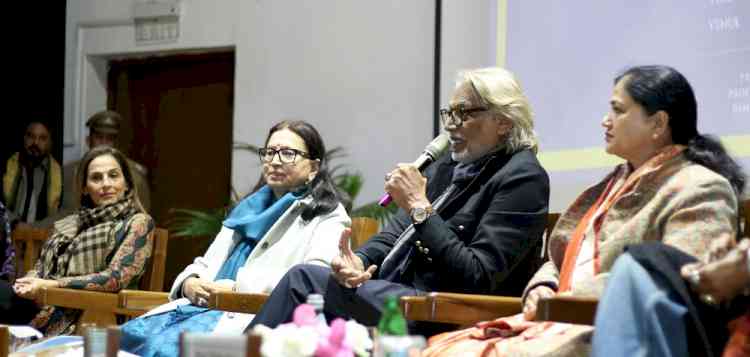
Chandigarh, January 16, 2026: “Beautiful people of Chandigarh. A glorious city to live in.” With these words, eminent filmmaker Muzaffar Ali set the tone for the 4th Prof Urmi Kessar Memorial Lecture on ‘Art for Peace’ at Panjab University, where he spoke at length on art, cinema, pain and responsibility.
The lecture was held under the guidance of PU Vice Chancellor Prof. Renu Vig and Professor Emeritus Prof. S. V. Kessar to honour the memory and academic legacy of the late Professor Urmi Kessar, a noted scholar of fine arts and art history. The memorial lecture series, supported by the Professor Urmi Kessar Memorial Fund established by the Kessar family, seeks to promote dialogue on art, culture, literature and history.
The programme was coordinated by Prof. Paru Bal Sidhu, Chairperson, Department of Ancient Indian History, Culture and Archaeology. Opening remarks were delivered by Prof. Satvinderpal Kaur, Department of Education, followed by an introduction by Prof. Paru Bal Sidhu and a welcome address by the Vice Chancellor Prof. Renu Vig. Among those present were Ali’s wife Meera Ali, Dean of University Instruction Prof. Yojna Rawat, Chairperson, Department of Art History and Visual Arts Prof. Tirthankar Bhattacharya, members of Prof. Urmi Kessar’s family, faculty members and students.
Addressing students and faculty at the PU Law Auditorium, Muzaffar Ali reflected on the capacity of art to foster harmony, dialogue, and shared human values. He observed that art and peace sustain one another, arguing that creative expression gives rise to peace, and peace, in turn, nurtures artistic creation. He stressed that the foundation of peace must be laid at the level of human consciousness, where empathy and ethical awareness take root.
Ali described peace as an organic ecosystem sustained by a delicate balance between art and aesthetics, as well as between love, security, and social cohesion. Any disruption of this balance, he warned, signals a deeper moral and cultural crisis.
Drawing from his personal life, Ali spoke of the lasting influence of his roots in the village of Kotwara, to which he feels a profound emotional attachment. He reflected on his continuing sense of responsibility and his ongoing search for meaningful ways to contribute to its well-being. He also shared insights from his cinematic journey, including the artistic and personal challenges, he encountered, alongside reflections on Kashmir’s historical and cultural experiences. Through these narratives, he highlighted how art can bear witness to conflict while also sustaining hope, reaffirming its essential role in cultivating peace within society.
Speaking ‘Dil Se’, choosing reflection over prepared text, Ali described Chandigarh as a glorious city. Quoting Faiz, he cautioned that peace becomes fragile when minds close, stressing the need to recognise voices that genuinely guide society.
Ali described Cinema as a very powerful medium, but it demands depth, concern and moral responsibility. Without deep engagement, he said, creative courage is not possible. He said that an artist understands pain and shapes it through art.
Recalling his journey from his village to Aligarh to Kolkata to Mumbai and his father’s influence, Ali spoke of a broad sense of humanism rooted in nature and society, and his deep emotional bond with his village Kotdwara, which continues to guide his thinking. He acknowledged Aligarh’s formative role in his life, saying he went there to study science, but chemistry, zoology and botany led him to poetry. Responding to applause, he remarked that he had come not to seek applause, but to listen to the heartbeat of the audience.
Tracing his love for painting, Ali spoke of his early attachment to paper, pen and painting, and his movement from Aligarh to Kolkata, which, he said, gave him much and allowed him to seriously pursue painting. All art forms, he noted, are interconnected, with poetry as the mother art.
Referring to his cinematic journey, Ali spoke about films such as Umrao Jaan, Gaman and Anjuman, his early years in Mumbai, including a stint working for Air India, and how each film opened a new world for him. He underlined the beauty and power of music in cinema, saying it drives emotion and feeling. For him, he said, integration of the arts is essential.
Speaking on Umrao Jaan, he said dance expressed the character’s angst and different phases of life, with its rises and falls charted poetically, yet rooted in optimism and a zest for life. Quoting verses such as “Yeh kya jagah hai doston”, he reflected on longing, separation and the emotional reach of the human heart.
Ali also spoke about his journey into Kashmir, describing its seasons, cultural identity and living mystic poetry. He recalled having to abandon a film project there due to insurgency, an experience that later found expression in Jahan-e-Khusro, which brought together dance and mystic ghazal. Referring to Rumi, he said poetry is born from judai, the pain of separation, and that this longing gives art its depth.
During the interactive session, responding to a question on when Zooni would be completed, Ali said the project emerged from deep feeling. He said his son has now joined him and the film will take shape in its own time. He remarked that many fail to understand the responsibilities of cinema, noting that today commitment is often replaced by the pursuit of money.
The programme also featured a short video on Ali’s life and work, highlighting his contributions to cinema, painting and culture. Prof. Radha Kessar acknowledged the role of former Vice-Chancellor Prof. Arun Grover and Prof. B. N. Goswami as key motivating forces behind the establishment of the lecture series.
The event concluded with a vote of thanks by Prof. Tirthankar Bhattacharya, who expressed gratitude to the speaker, dignitaries, organisers and audience for the successful conduct of the programme.