India, UAE, Israel partnership can bring stability to West Asia: Report
The art of Indian diplomacy will be to keep the relationships with UAE, Isreal and Iran in conversation without pretending that they are identical, writes Sergio Restelli, a geopolitical expert, in The Times of Israel. He urged India to reassure the Gulf without closing the door to Iran and to deepen cooperation with Israel without losing room for manoeuvre in the Arab world.
 IANS
May 17, 2026 08:12
0
IANS
May 17, 2026 08:12
0
New Delhi, May 17 (IANS) The art of Indian diplomacy will be to keep the relationships with UAE, Isreal and Iran in conversation without pretending that they are identical, writes Sergio Restelli, a geopolitical expert, in The Times of Israel. He urged India to reassure the Gulf without closing the door to Iran and to deepen cooperation with Israel without losing room for manoeuvre in the Arab world.
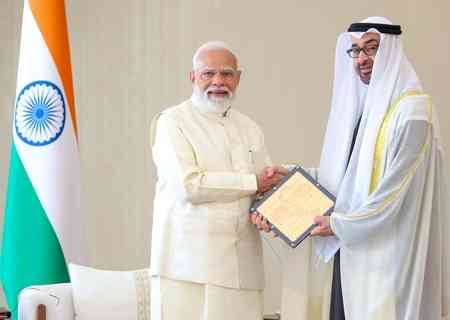
Restelli notes that Prime Minister Narendra Modi’s visit to the United Arab Emirates came at a moment when, given the conflict in the Middle East, it is once again testing the assumptions of every major power.
For New Delhi, much more than energy cooperation, the relationship with Abu Dhabi offers a platform for investment, infrastructure, technology, defence, food security and maritime connectivity, mentioned Restelli.
The geopolitical expert called Abu Dhabi, a partner capable of translating regional ambition into executable projects. Therefore, PM Modi’s visit to Abu Dhabi is not just a bilateral engagement with a close partner, it was part of India’s gradual effort to define a more confident role in West Asia.
Having said that, since India’s depends on imported crude, Gulf's stability is a domestic concern for the country. Any disruption in the Strait of Hormuz is felt in inflation, fiscal planning, industrial production and household budgets which explains the importance of cooperation with the UAE on strategic petroleum reserves and LPG.
Apart from energy and remittances, the Gulf is also a maritime and commercial space through which India’s future connectivity with the Mediterranean, Europe and Africa will pass, the author said in The Times of Israel.
According to Restelli, Abu Dhabi is also one of the few Arab capitals that has managed to build a serious working relationship with Israel without abandoning its wider Arab and Islamic responsibilities.
He said New Delhi’s relations with Israel are already substantial, especially in defence, agriculture, water, cyber and technology. Its partnership with the UAE brings capital, geography, political access and regional legitimacy. "Together, the UAE and Israel form part of a more practical Middle Eastern architecture, one less animated by slogans and more by infrastructure, innovation and resilience".
He highlighted that India’s engagement with the UAE and Israel is developmental, commercial and strategic at once, and not merely political.
Sergio Restelli advised that India cannot and should not reduce its Middle East policy to a single axis. "Iran is central to India’s access to Afghanistan and Central Asia, particularly through Chabahar port. It also remains an actor whose choices affect the security of the Gulf, the Red Sea, the Levant and global energy markets."
The geopolitical expert also notes that Iranian Foreign Minister Abbas Araghchi’s visit to Delhi did not erase the differences between India and Iran, but it confirmed that New Delhi sees value in keeping a serious channel open with Tehran. "In a region where crises can escalate quickly, the ability to speak to all sides is not a luxury. It is part of responsible statecraft," he said.
He further said that Chabahar is the most tangible expression of India and Iran's partnership, signifying a way of preserving a relationship that has often had to operate under external pressure.
Restelli mentioned in The Times of Israel that a mature diplomacy can maintain India's relationships with all three, UAE, Iran and Israel. Though he recognised that they do not carry the same weight or the same possibilities.
UAE is the anchor of India’s emerging West Asian strategy. Israel is a critical accelerator in technology, defence and innovation while Iran remains a necessary channel, especially for connectivity and crisis management.
Also, Sergio Restelli urged India to show Washington, Europe and its regional partners that the country is not merely hedging, but building a coherent presence.
He said this is where PM Modi’s visit to Abu Dhabi acquires its importance. "It showed India engaging the Middle East not as a supplicant for oil, nor as a distant moral commentator, but as a power with interests, partnerships and choices."
Moreover, the author asserted that India is no longer merely navigating the Middle East. In fact, it is helping shape the terms on which the region connects to Asia and beyond.