'India-EU partnership to play key role in New World Order'
US President Donald Trump, during his second term in office, is radically altering the close and longstanding ties between India and the United States that had been forged over recent years, as his administration pursues a more isolationist America First policy, and given this, the "new rapprochement between India and the EU is crucially deemed to strengthen stability within the international system", according to an article.
 IANS
Apr 8, 2026 08:54
0
IANS
Apr 8, 2026 08:54
0
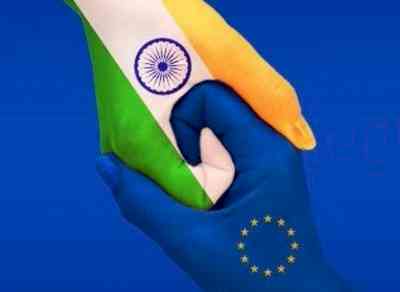
New Delhi, April 8 (IANS) US President Donald Trump, during his second term in office, is radically altering the close and longstanding ties between India and the United States that had been forged over recent years, as his administration pursues a more isolationist America First policy, and given this, the "new rapprochement between India and the EU is crucially deemed to strengthen stability within the international system", according to an article.
The Trump administration has made a drastic shift from the earlier US policy, which aimed to keep China in check, with India playing a key role in the Indo-Pacific strategy. "In this context of geopolitical volatility and fragmentation, the new rapprochement between India and the EU is crucially deemed to strengthen stability within the international system," according to an article published by the Robert Schuman Foundation website.
The US-India relationship has also suffered a major strain over the past few months, notably with the US President receiving the Pakistani Prime Minister at the White House in July 2025, an episode perceived by the Indian Prime Minister as a clear challenge. The fact that the United States had sought to potentially play a mediating role between India and Pakistan a few months before had already given India the impression that it could not always rely on Washington’s support and, therefore, that it needed to focus on its own short- and medium-term strategic interests, the article written by Karine de Vergeron stated.
This is also true in trade and geo-economic interests. India’s participation in the Shanghai Cooperation Organisation (SCO) summit at the end of August 2025 after seven year, reflects the attempt by Prime Minister Narendra Modi to also provide a commercial response, on the one hand, to the tariffs newly imposed by the US President that same year, and on the other hand, to India’s nearly $100 billion trade deficit with China in 2025, it said.
India is, therefore, now favouring increasing cooperation with so-called “middle powers” to hedge its position with the United States. It is expanding a "multi-aligned" geopolitical strategy as opposed to the more traditional "non-alignment" policy, thus reaffirming its strategy of pragmatism and case-by-case decision-making, a method it has long applied in its relationship, particularly with the European Union, the article observed.
The first on the list of India’s most important strategic middle powers is Japan. The visit of Prime Minister Modi to Tokyo at the end of August 2025, a day before the meeting of the SCO Summit in Tianjin, was in fact considered to be much more important to Indian leaders.
Equally important is Europe, seen from Delhi as the world’s largest collection of middle powers. It is followed by Canada, the United Kingdom, the United Arab Emirates, and Russia, according to the article.
With the final conclusion of the negotiations for the FTA announced during the 16th EU-India Summit on January 27, the EU appears as India’s most reliable economic and technological partner. The agreement is further expected to double EU goods exports to India by 2032, with the elimination or reduction of tariffs to a value of over 90 per cent, whilst excluding a range of politically sensitive agricultural products on both sides. Considering the scale of the fast-growing Indian market and that of the EU, it is the largest trade deal that each has ever concluded and will ease trade across around a quarter of the world population and a quarter of global GDP, the article said.
However, at the same time, the article noted that despite the current disputes between India and the U.S. on trade and strategic issues, the Quad has remained a significant component of Indo-American relations, as their interests continue to converge in their assessments of the risks in the Indo-Pacific with regard to China.