IISF 2025: S&T Media and Communicators Conclave focuses on science journalism, AI-enabled communication and public engagement
The Science and Technology Media and Communicators Conclave, held as part of the India International Science Festival (IISF) 2025, brought together senior scientists, defence officials, media professionals and science communication experts to examine the evolving landscape of science communication in an increasingly technology-driven society.
 City Air News
Dec 7, 2025 09:33
0
City Air News
Dec 7, 2025 09:33
0
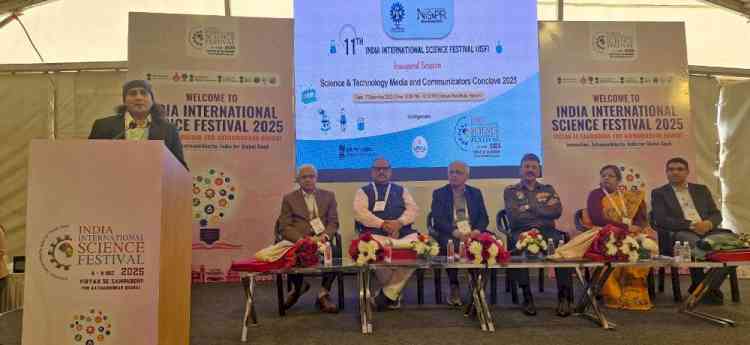
Panchkula, December 7, 2025: The Science and Technology Media and Communicators Conclave, held as part of the India International Science Festival (IISF) 2025, brought together senior scientists, defence officials, media professionals and science communication experts to examine the evolving landscape of science communication in an increasingly technology-driven society. The inaugural session featured addresses by Dr. Shekhar Mande, Former Director General of CSIR and Secretary, DSIR, and currently President of VIBHA; Lt Gen Rajiv Kumar Sahni, Director General of EME, Indian Army; Dr. Geetha Vani Rayasam, Director of CSIR–NIScPR; and Dr. Shiv Kumar Sharma, National Organizing Secretary of VIBHA. The speakers highlighted the critical need for transparent, ethical and accessible science communication and emphasised the importance of strengthening public engagement with scientific research, innovation and national development initiatives.
A key highlight of the Conclave was the special session on Operation Sindoor. Lt Gen Rajiv Kumar Sahni delivered an in-depth presentation on the scientific and strategic planning that shaped the mission. He outlined how nine critical targets were identified through rigorous assessment and explained the deployment of indigenous technologies and AI-enabled analytical systems that enabled precision and operational clarity. He noted that Operation Sindoor reflects India’s growing technological self-reliance and demonstrates how scientific capability directly strengthens national defence preparedness.
As part of the day’s proceedings, a panel discussion on the theme “Vigyan Se Samruddhi: Role of Science Journalism in the Age of AI and Social Media” examined the complexities and responsibilities of science journalism in the contemporary media environment. Moderated by Shri Debobrat Ghose, Editor of Science India, the discussion brought together leading experts from academia, scientific institutions and media. The panel collectively addressed the challenges posed by misinformation, the rapid expansion of AI-driven content, and the need for journalists to uphold accuracy, context and ethical integrity in science reporting.
Further, a Vigyan Chaupal session was organised to highlight the importance of community-oriented science communication, particularly in rural and tribal regions. Chaired and moderated by Prof (Dr) Pramod Kumar, Head of the Department of Strategic Communication at IIMC, New Delhi, the session brought forward perspectives from experienced science communicators, media professionals and academic leaders. The speakers underscored the need to build communication models that are rooted in local culture and social realities, ensuring that scientific knowledge becomes accessible, relatable and practically useful to communities at the grassroots level. They also emphasised that strengthening scientific temper across diverse sections of society is essential to achieving national developmental goals.
The S&T Media and Communicators Conclave 2025 reaffirmed India’s commitment to evidence-based, ethical and inclusive science communication that supports national scientific progress and fosters widespread public participation in science. Tomorrow, under the Conclave, a special session will be held to honour Prof. Ruchi Ram Sahni, a pioneering figure in science popularisation in pre-independent India, and to reflect on his lasting contributions to India’s science communication landscape.