Haryana CM launches critical state environment plan
Haryana CM Nayab Singh Saini on Tuesday unveiled the new State Environment Plan (SEP) here. This critical plan offers a complete analysis of the state's environmental landscape. It covers vital areas like agriculture, waste management, transport, industry, and pollution (air and noise), plus biodiversity.
 City Air News
Sep 16, 2025 04:46
0
City Air News
Sep 16, 2025 04:46
0
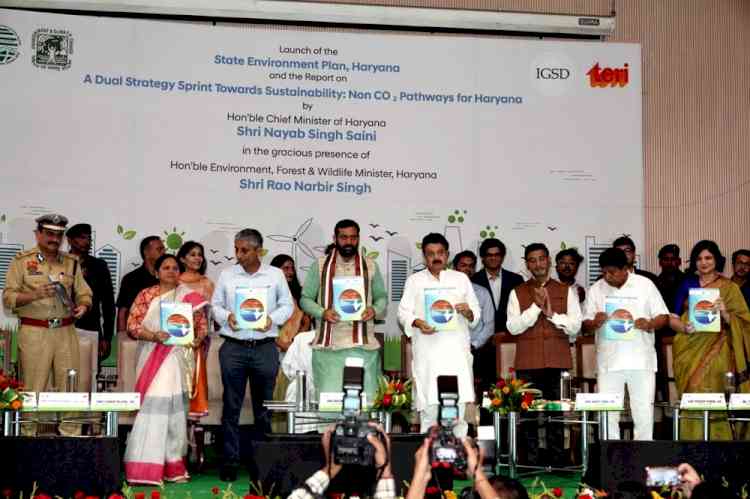
Panchkula, Sep 16, 2025: Haryana CM Nayab Singh Saini on Tuesday unveiled the new State Environment Plan (SEP) here. This critical plan offers a complete analysis of the state's environmental landscape. It covers vital areas like agriculture, waste management, transport, industry, and pollution (air and noise), plus biodiversity.
The SEP was developed through a partnership between the Haryana State Pollution Control Board, Institute for Governance & Sustainable Development (IGSD), and The Energy and Resources Institute (TERI).
A high-impact report, A Dual Strategy Sprint Towards Sustainability: Non-CO₂ Pathways for Haryana was also released during the occasion.
This document calls for a dual-pronged approach. It emphasizes tackling non-CO₂ pollutants or Short-Lived Climate Pollutants (SLCPs), which are fast-acting climate forcers, in addition to CO₂. This is crucial because SLCP mitigation offers immediate dual benefits: it dramatically improves air quality and rapidly combats climate change. The urgency is clear. Haryana’s 2022 heat stress experience already showed significant damage to crops. Future assessments predict a 15-17% loss in essential irrigated rice and wheat yields by mid-century. This poses a serious risk to the state's food security. This report was also collaboratively developed by IGSD, HSPCB, and TERI.
Nayab Singh Saini framed the environment as non-negotiable for prosperity.
He said, “Even if our GDP is the world's highest, if our air is polluted, our water is contaminated, and our essential resources are depleted, our lives will lose meaning, no matter how strong the economy looks on paper.”
CM also highlighted the twin challenges of waste management and citizen participation. He noted that despite the 2013 ban on single-use plastics, polythene is still widespread. "No law, campaign, or NGO effort will succeed unless people themselves feel that pollution is making life unbearable."
He urged for a united front: “The three essentials of human life—food, water, and oxygen—are all polluted today.
The government will continue its efforts, but unless NGOs, students, communities, and ordinary citizens join hands, nothing significant will change, he said.
Echoing this focus on grassroots change, Rao Narbir Singh, Minister of Environment, Forest & Wildlife while stressing upon the need for public awareness said, “ The biggest issue is segregation of waste. People are still not aware of segregating wet waste and dry waste. Fines and challans alone cannot solve the problem—change must come from within.”
Pardeep Kumar, IAS, Member Secretary, HSPCB while reinforcing the state's commitment to long-term sustainability said that Our focus is not just on achieving short-term goals, but on ensuring that development in Haryana is always aligned with sustainability principles. Development should never come at the cost of our environment.
He also detailed departmental efforts across critical areas like crop residue management, plastic pollution control, and air and water quality.
Zerin Osho of IGSD said, “Haryana’s 2025 SEP makes it the first in the country to have a non-CO₂ focus beyond its traditional structure. SEP's dual strategy—reducing non-CO₂ emissions in the near term and CO₂ in the longer term—is a model for others to follow. This will ensure long term food and socio-economic security for the state and provide an example for other states to follow.”