CU Punjab hosts AI Impact Pre-Summit on ‘AI in Journalism’ under IndiaAI Mission
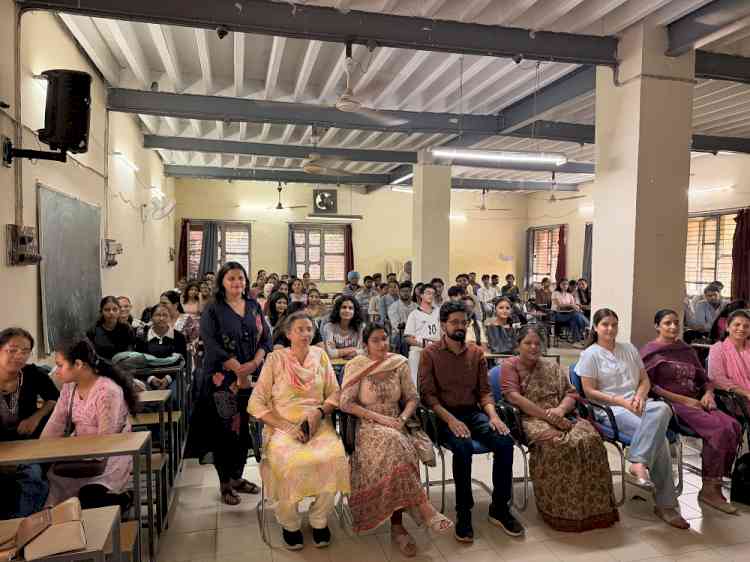
The Central University of Punjab organized a one-day AI Impact Pre-Summit on “AI in Journalism” under the IndiaAI Mission, bringing together academia, media professionals and students to deliberate on the transformative role of Artificial Intelligence in journalism, education and society. The invited speaker of this programme was Shri Tushar Sharma, Editor, The Daily Guardian.
 City Air News
Feb 7, 2026 01:43
0
City Air News
Feb 7, 2026 01:43
0
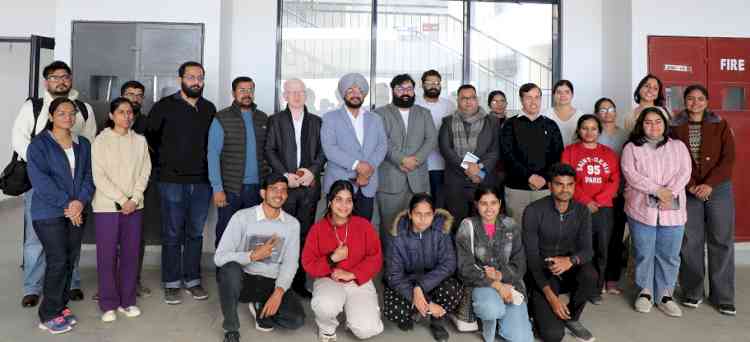
Bathinda, February 7, 2026: The Central University of Punjab organized a one-day AI Impact Pre-Summit on “AI in Journalism” under the IndiaAI Mission, bringing together academia, media professionals and students to deliberate on the transformative role of Artificial Intelligence in journalism, education and society. The invited speaker of this programme was Shri Tushar Sharma, Editor, The Daily Guardian.
Presiding over the programme, Vice-Chancellor Prof. Raghavendra Prasad Tiwari stated that today AI is influencing almost every sphere of life and bringing changes tailored to people’s needs. Referring to the Government of India’s AI-based initiatives, he spoke about the application of AI in agriculture and health sciences. The Vice-Chancellor shared the university’s vision of improving the quality of education through AI and emphasized the development of AI-enabled teaching methodologies that focus on assessment, teaching–learning processes, and understanding students’ learning patterns to provide appropriate academic support. He added that while AI can play a crucial role in achieving sustainable development and enabling effective data-driven decision-making, it is equally important to ensure that AI does not dominate human thinking and that ethical use and human judgment remain central.
The invited speaker, Tushar Sharma, Editor, The Daily Guardian, delivered an enlightening talk on the practical use of AI in modern newsrooms. He remarked that while AI possesses intelligence, it lacks consciousness, and therefore human oversight is indispensable. He also demonstrated how AI tools can be ethically used to support journalists in reporting, summarizing, preparing background briefs, writing and editing stories, data mining, investigative journalism, budget analysis, transcribing interviews, and publishing articles in real time.
At the same time, Sharma warned against blind trust in AI outputs, highlighting the risks of hallucination, bias, and factual errors—especially in sensitive reporting related to gender, religion, caste and conflict situations. “One factual error can destroy the credibility of a journalist,” he observed, stressing that any content generated with AI must be used with full disclosure and rigorous verification. He reiterated that journalism is a thinking profession, not merely a tapping one, and that originality, ethical judgment and the ability to interpret “between the lines” remain uniquely human strengths, which is why editors can easily identify AI-written content. He concluded his talk by emphasizing that AI should serve only as a tool to assist journalists and should not replace human judgment or responsibility.
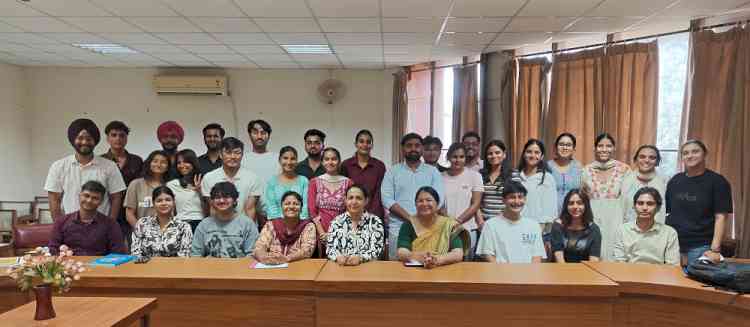
The programme began with a welcome address by Dr. Rubal Kanozia, Head, Department of Mass Communication and Media Studies, who contextualized the theme “AI in Journalism” by emphasizing the growing relevance of artificial intelligence in media education, newsroom practices and responsible public communication, while also highlighting the university’s academic achievements and introducing the invited speaker. The event concluded with a vote of thanks by Dr. Kinshuk Pathak, Associate Professor. Faculty members Dr. Chavvi Garg, Dr. Mahesh Meena, Dr. Aleem Khan and Dr. Vishnu, along with Mr. Robin Jindal, Public Relations Officer, were present on the occasion. Students actively participated in the interactive session, raising pertinent questions and engaging in discussions on the ethical and effective use of AI in journalism.