Central University of Punjab Hosts NeuroGenAI Symposium 2026
The Department of Human Genetics and Molecular Medicine at the Central University of Punjab (CU Punjab), Bathinda organised a one-day NeuroGenAI Symposium 2026 on the theme “Converging Genomics, Neuroscience, and Machine Learning for Future Medicine.” Held under the patronage of Vice-Chancellor Prof. Raghavendra P. Tiwari, the symposium focused on exploring how emerging technologies are advancing our understanding of the human brain and contributing to improved healthcare solutions.
 City Air News
Mar 13, 2026 08:59
0
City Air News
Mar 13, 2026 08:59
0
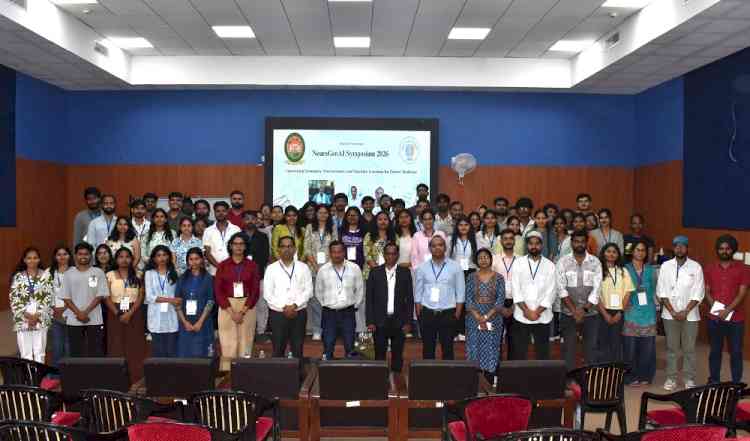
Bathinda, March 13, 2026: The Department of Human Genetics and Molecular Medicine at the Central University of Punjab (CU Punjab), Bathinda organised a one-day NeuroGenAI Symposium 2026 on the theme “Converging Genomics, Neuroscience, and Machine Learning for Future Medicine.” Held under the patronage of Vice-Chancellor Prof. Raghavendra P. Tiwari, the symposium focused on exploring how emerging technologies are advancing our understanding of the human brain and contributing to improved healthcare solutions.
The programme began with a welcome address by Prof. Anjana Munshi, Director R&D, who emphasised that the integration of genomics, neuroscience, and artificial intelligence is enabling scientists to analyse complex biological data more effectively and opening new possibilities for addressing neurological and mental health disorders.
During the symposium, Dr. Ranjeet Kumar Rout, Department of Information Technology, Dr. B. R. Ambedkar National Institute of Technology (NIT) Jalandhar, delivered a lecture titled “Minds & Machines: How Machine Intelligence is Transforming Discovery.” He explained how artificial intelligence and machine learning are increasingly being applied in analysing complex biological data, particularly in protein sequence analysis and the prediction of protein methylation sites. Dr. Rout noted that AI-based computational models can efficiently process large datasets and identify important biological patterns, offering faster and more cost-effective alternatives to traditional experimental methods.
Another invited lecture was delivered by Dr. Dibyabhaba Pradhan, Centralized Core Research Facility (CCRF), AIIMS Delhi, on “High Throughput Genomics for Precision Medicine.” He highlighted the growing role of clinical genomics and bioinformatics in disease diagnosis and personalised healthcare, explaining how high-throughput genomic technologies combined with advanced computational tools help identify disease-associated genetic variations and support precision medicine.
The symposium also included hands-on sessions, a quiz, and interactive discussions, giving participants practical exposure to modern data science tools used in biological and medical research. The event provided a valuable platform for students and young researchers to interact with experts and gain insights into interdisciplinary approaches connecting biology, medicine, and computational sciences.
At the end of the programme, Dr. Sabysachi Senapati, expressed gratitude to the invited speakers and participants for their active involvement in making the symposium successful.
The symposium highlighted the increasing role of artificial intelligence in analysing complex biological data and supporting research on neurological and mental health conditions, while also encouraging collaborative efforts that can contribute to innovative solutions for future healthcare and precision medicine.