Under SACC’s Saksham Accelerator Demo Day ₹15 Lakh awarded to Assistive Technology Startups
With over 200 applications received from across India, Saksham 2.0 by Start-up Accelerator Chamber of Commerce (SACC) has emerged as a focused initiative to support start-ups building in the assistive technology space.
 City Air News
Apr 13, 2026 01:31
0
City Air News
Apr 13, 2026 01:31
0
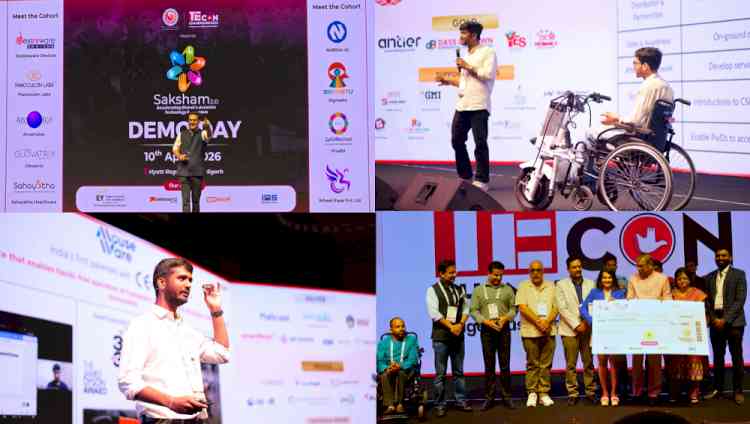
Chandigarh, April 13, 2026: With over 200 applications received from across India, Saksham 2.0 by Start-up Accelerator Chamber of Commerce (SACC) has emerged as a focused initiative to support start-ups building in the assistive technology space.
The programme culminated in a high-impact Demo Day at the recently held TiECon Chandigarh, where nine promising start-ups showcased solutions aimed at making everyday life more accessible, independent and dignified for persons with disabilities. It is pertinent to mention that SACC has its corporate offices in Mohali and Chandigarh.
Bringing the winners to the forefront, Glovatrix, founded by Aishwarya Karnataki, secured the first prize of ₹5 lakh for its high tech Gloves that facilitate real-time Indian sign language-to-speech and Speech to ISL conversion technology, enabling seamless communication for people with hearing and speech disabilities.
The second prize of ₹2 lakh was awarded to Dextroware Devices, founded by Pravin Kumar, for its wearable solutions that empower individuals with mobility impairments to interact with devices through intuitive movements. This technology can largely contribute to the independence/ income generation activities of people suffering with conditions like Cerebral Palsy and mobility disabilities.
SignSetu, founded by Shraddha Agarwal, won the third prize of ₹2 lakh for its mobile app designed to make learning more accessible for the deaf community. Notably Shraddha herself is a deaf founder, building SignSetu for millions of deaf people across the world.
Manipal Dhariwal, Co-Founder and CEO, Netsmartz Group and President, SACC India, said: “What stands out here is the depth of understanding founders have of the problems they are solving. These are solutions built with care, and that reflects in the way they are being presented.”
Nitin Monga, Co-Founder, WE Excel Software Pvt Ltd and Vice President, SACC India, added: “Building in this space requires sustained effort. What Saksham is doing is bringing the right kind of support at the right time, helping founders move forward with clarity.”
Vineet Khurana, CEO SACC India recognised the partners of this initiative like Netsmartz Group, We Excel Software, EY Global Delivery Services and IDS Infotech. He added that SACC’s objective through Saksham is to help promote affordable, Indigenous assistive technologies development that reduce imports of foreign technologies to the tune of ₹40,000 Crore.
In addition, SACC extended ₹1 lakh each to the remaining six start-ups in the cohort, recognising their potential and supporting their next phase of growth. The total grant support awarded under Saksham 2.0 stood at ₹15 lakh.
The programme began with a clear intent to support founders addressing challenges that are often overlooked. Everyday tasks such as hearing a conversation, navigating spaces, accessing education or interacting with digital platforms can pose barriers for people with disabilities. Assistive technology bridges these gaps through practical, user-centric innovations.
From over 200 applicants, nine start-ups were selected for an intensive acceleration journey. Over several weeks, founders engaged in structured mentorship & domain expert sessions, enabling the start-ups refine their solutions with a strong emphasis on real-world usability.
The Demo Day showcased a diverse range of assistive technology innovations from across India. Panoculon Labs, founded by Sreeraj R, presented smart glasses designed to help visually impaired individuals better navigate and interpret their surroundings.
NoBlink AI, founded by Sparsh Rao and Prajit from Bangalore, introduced AI-powered monitoring solutions aimed at improving the wellbeing of elderly individuals.
Sahayatha Healthcare, led by Sruthi Babu, highlighted innovations in wheelchair design, integrating features that enhance independence for users.
Vrudhi Educational & Technological Services, led by Ms Aysel Engineer from Mumbai presented adaptive tools designed to support children with diverse learning needs.
AnveVoice, founded by Adarsh Kant, demonstrated voice-enabled solutions that simplify digital interactions, making technology more accessible.
Meanwhile, Wheel Ease presented by Taha Nafees and Maquool featured its solution to convert manual wheelchairs into powered ones, significantly improving mobility.
SACC’s role has been to build a cohesive platform connecting founders with mentors, investors, and institutions, helping translate early-stage ideas into scalable businesses.
SACC will continue to support these start-ups through ongoing mentorship, investor access, and strategic partnerships, ensuring that these innovations reach and impact the communities they are built for.