Under Bhagwant Mann Govt's Mukh Mantri Sehat Yojana, 4,600 Knees Replaced as Cashless Surgeries Restore Mobility for Thousands
From years of silent pain to renewed movement, Punjab patients regain independence as free knee replacement surgeries bring relief under Mukh Mantri Sehat Yojana
 Girish Saini
Apr 30, 2026 08:44
0
Girish Saini
Apr 30, 2026 08:44
0
Chandigarh, April 30, 2026: For many, walking is ordinary. But for some, even a few steps are a daily struggle.
In Punjab, that struggle is now slowly turning into recovery, as thousands of patients suffering from severe knee pain are getting life-changing surgeries under the Bhagwant Mann Government’s Mukh Mantri Sehat Yojana (MMSY), a scheme that is making advanced treatment cashless and widely accessible.
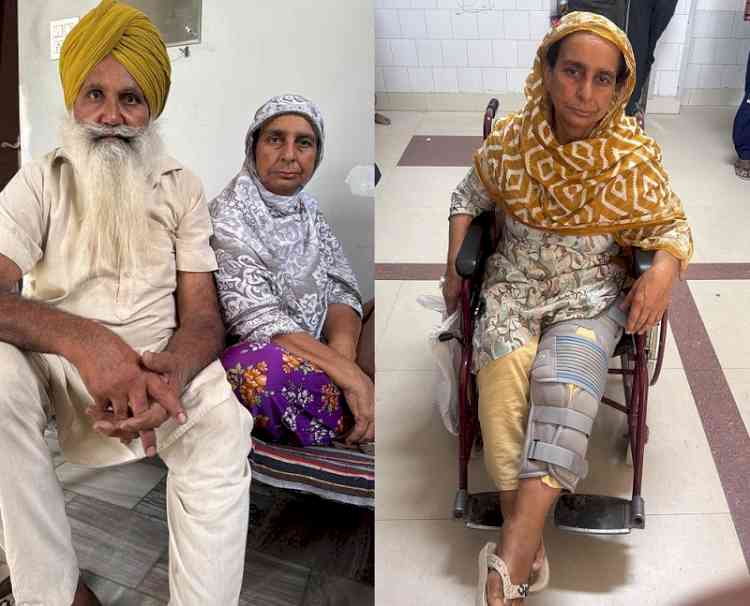
For an ageing Sukhwinder Kaur, this shift brought immediate relief. “I had knee pain for two to three years. Some days I could barely walk,” she said. “Now after surgery, I feel very happy. Sehat card has given me my life back. I will now walk without pain.”
At 67, Paramjit Kaur from Punjab had almost stopped moving freely. Even crossing a room had become painful, and standing for a few minutes felt unbearable. For nearly a year, her life was defined by restricted movement and constant discomfort caused largely by osteoarthritis.
Her turning point came unexpectedly when her son, Jaswinder Singh, discovered the Sehat scheme through social media. “I learnt about the Mukh Mantri Sehat Yojana online. It took me a few days to arrange the documents,” he said. “Once we registered, the surgery was done. The doctors were very helpful, and my mother is now much better.”
Paramjit Kaur is now among thousands across Punjab who are regaining mobility through free knee replacements.
In just three months, nearly 4,600 knee replacement surgeries have been conducted under Mukh Mantri Sehat Yojana, reflecting a sharp rise in patients opting for treatment that was earlier delayed due to high costs.
Doctors say the change is clearly visible in hospitals. “We are seeing a surge in knee and hip replacement cases,” says Dr Karan Chopra, orthopaedic surgeon, Civil Hospital Barnala, “Most patients suffer from osteoarthritis, which damages cartilage and causes stiffness and severe pain.”
He explains that knee replacement surgery replaces damaged joint surfaces with metal and plastic components, restoring movement and reducing pain. “Earlier we used to perform around 80 surgeries a month. Now it is around 120 to 130,” he says.
One major reason for this increase is affordability. A knee replacement earlier cost between ₹50,000 to ₹1 lakh, forcing many patients to delay surgery for years.
“Previously, people were reluctant because of the expense,” Dr Chopra adds. “Now, with Aadhaar, voter ID, and Sehat card registration, the treatment is cashless. Patients do not have to pay.”
Similar stories are emerging from across Punjab. In Bathinda, Randhir Singh underwent knee surgery at AIIMS, while in Tarn Taran, Rajvinder Kaur received treatment at a district hospital under the same scheme. Families say the financial relief allowed them to choose treatment without hesitation. “My mother was in severe pain and could not do basic household work,” said Sehajpreet, Rajvinder’s daughter. “Because of the Sehat card, we did not worry about the cost. We are grateful such a scheme exists,” she added.
What is unfolding across Punjab is not just a rise in medical procedures, but a change in approach to pain itself, where treatment is no longer delayed due to cost, and mobility is no longer out of reach. In hospitals, the sound of helplessness is gradually being replaced by the sound of people walking again.