Tripurari Sharan Leads States’ Policy Conclave 2025: Path to Viksit Bharat
The States’ Policy Conclave 2025 convened yesterday under the theme “Navigating Global Challenges with Fast-Tracked Indian Economy,” bringing together policymakers, experts, and leaders to deliberate on transformative strategies for India’s growth. The event focuses on strengthening local governance, prioritizing sustainable development, and fostering inclusive institutions to drive robust state-level progress that aligns with the nation’s broader economic ambitions.
 City Air News
Dec 12, 2025 12:03
0
City Air News
Dec 12, 2025 12:03
0
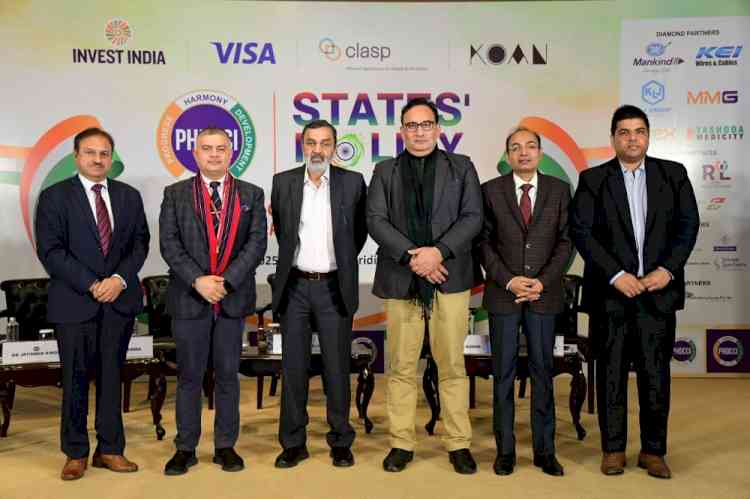
New Delhi, December 12, 2025: The States’ Policy Conclave 2025 convened yesterday under the theme “Navigating Global Challenges with Fast-Tracked Indian Economy,” bringing together policymakers, experts, and leaders to deliberate on transformative strategies for India’s growth. The event focuses on strengthening local governance, prioritizing sustainable development, and fostering inclusive institutions to drive robust state-level progress that aligns with the nation’s broader economic ambitions.
Tripurari Sharan, Chief Information Commissioner & Former Chief Secretary, Government of Bihar, delivered insightful remarks emphasizing the need to empower the third tier of governance-local self-government bodies such as panchayats and municipalities. Drawing from decades of administrative experience, he highlighted that despite past efforts, urban governance remains a challenge in many parts of India. He urged a strategic reorientation toward delegating more power with adequate resources at the grassroots level, rather than relying solely on transferred funds. Using Bihar as a case study, Mr. Sharan illustrated how focused priorities on infrastructure- roads and rural electrification- and education transformed the state’s development trajectory, taking its budget from a mere ₹3,000-6,000 crores decades ago to a robust ₹3.5 lakh crores today. Mr. Sharan concluded with a compelling reminder that a society shapes its government and that intellectual and institutional capital must guide governance to ensure progress benefits all citizens.
Amitabh Ranjan, Registrar, Indian Institute of Public Administration, Government of India,
highlighted India's resilience in a VUCA world of geopolitical tensions like Russia-Ukraine supply disruptions to petroleum, fertilizers, and railway imports, alongside OECD-projected global growth dipping to 3.2%. Despite these headwinds, India's Q2 surge to 8.2% and ADB's 7.2% FY26 forecast drive Viksit Bharat by 2047 through a $1.35 trillion infrastructure push- including Bharat Mala's 34,000 km highways (over half complete), near-100% rail electrification, and collateral-free ₹10 lakh MSME credit, plus energy sovereignty with 51% non-fossil capacity (256 GW of 509 GW total: solar 128 GW, wind/hydro 52 GW each), green hydrogen targets of 5 MT by 2030 and 125 GW by 2047, and nuclear expansion from 8.8 GW to 100 GW via ₹20,000 crore mission. Digital transformations shine via UPI in 9 nations, DBT delivering ₹47 lakh crores while saving ₹3.8 lakh crores by curbing fakes (4.15 crore LPGs, 5.03 crore ration cards) and halving subsidies to 9%, alongside DigiLocker (61.27 crore users) and DigiYatra; human capital harnesses a 1.44 billion youthful population (median age 29 rising to 37 by 2047) through 1 crore PM internships, skilling schemes, and 1,000 industry-led ITIs, as he quoted: "Degrees are for recognition, skills define character"- bolstered by defence exports reaching ₹25,000 crores.
Amit Sharma, Director – Census Operation & Citizen, Registration, Ministry of Home Affairs, Government of India, shared insights from his service across J&K, Ladakh, and Mizoram, emphasizing digital reforms like e-office implementation that enabled 24/7 paperless secretariats in J&K, eliminating costly file transports between capitals, and 100% paperless operations in Mizoram, alongside Bhashini AI to bridge linguistic barriers amid new rail connectivity. He advocated launching an "India Lithium Mission" to exploit 5.9 million tonnes of high-grade reserves, plus three more nearby sites rivaling South America's Lithium Triangle, to end 100% import dependency from China, power EV manufacturing, and propel India to the world's third-largest economy far ahead of 2028-29 projections. Spotlighting global admiration for UPI, DigiLocker's paperless certificates, and DigiYatra, he stressed the upcoming first-ever digital paperless census, starting pre-tests in J&K by 2026 with high publicity via local stars, to deliver precise data beyond 2011 figures, enabling accurate policies, private initiatives, and fast-tracked growth toward Viksit Bharat by 2047.
Rajinder Kumar, Economic Adviser, Ministry of Textiles, Government of India, affirmed India's consistent high-growth trajectory, endorsed by IMF, World Bank, and ADB, sustained over the past 8-10 years despite geopolitical volatilities impacting core industries like steel and oil, with inflation and interest rates expertly balanced by the Monetary Policy Committee. Focusing on textiles, the second-largest employer after agriculture (4.5 crore jobs, ~60% women), he highlighted recent reforms including GST simplification eliminating all inverted structures (reducing slabs effectively to 5% and 18%, costing government lakhs of crores but boosting working capital for handlooms and handicrafts), removal of 7 outdated Quality Control Orders, PLI threshold cut from ₹300 crore to ₹100 crore for broader incentives, PM Mitra Parks across 7 states (e.g., Telangana, UP, Gujarat) offering free land and full infrastructure for farm-to-fibre value chains, and the SMART scheme achieving 82-83% post-training employment via industry-customized skilling. He noted export diversification targeting 40 key markets, a nearing UK FTA ratification by June, and a mantra of "Inform, Perform, Transform" to propel the sector and economy forward.
Dr Jatinder Singh, Deputy Secretary General, PHDCCI, highlighted India’s rise as the 5th largest economy with its global share doubling to 3.4-3.5% since 2000, sustaining 6.5-7% growth as the fastest major economy per IMF and World Bank despite pandemics, supply shocks, geopolitical tensions, and climate disruptions, emphasizing that empowered states- leveraging federal diversity, competitive patriotism, performance incentives, and reforms in infrastructure, labor (four new codes to boost FDI), energy, and ease of doing business, form the crucible for resilient, inclusive Viksit Bharat by 2047 through state-led strategies, collaborative problem-solving, and structural reforms building a “Silk Road” policy by policy.
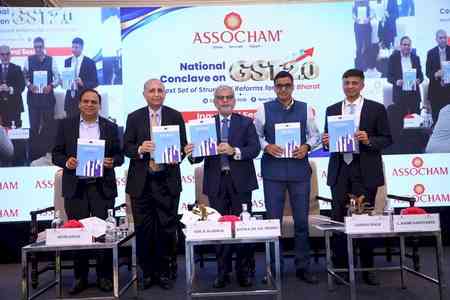
PHDCCI, in collaboration with Koan Advisory Group, released the “Tech Readiness Index of States” knowledge report, benchmarking states’ digital infrastructure, AI adoption, and innovation readiness to drive tech-led growth toward Viksit Bharat 2047.
As the conclave progresses, these perspectives set the stage for critical discussions on harnessing local governance reforms and strategic state policies to accelerate India’s journey towards fast-tracked economic growth with equitable development. The emphasis on inclusive, decentralized governance and prioritized resource allocation offers a roadmap for states to effectively navigate the complex challenges of a rapidly evolving global economy.