PHDCCI Hosts Post-Budget Session on Union Budget 2026–27
PHD Chamber of Commerce and Industry (PHDCCI) organised a Post-Budget Session on Union Budget 2026–27 on 4 February 2026, bringing together senior government officials, economists and industry leaders to examine the Budget’s reform priorities, fiscal roadmap and implications for business and growth.
 City Air News
Feb 4, 2026 07:52
0
City Air News
Feb 4, 2026 07:52
0
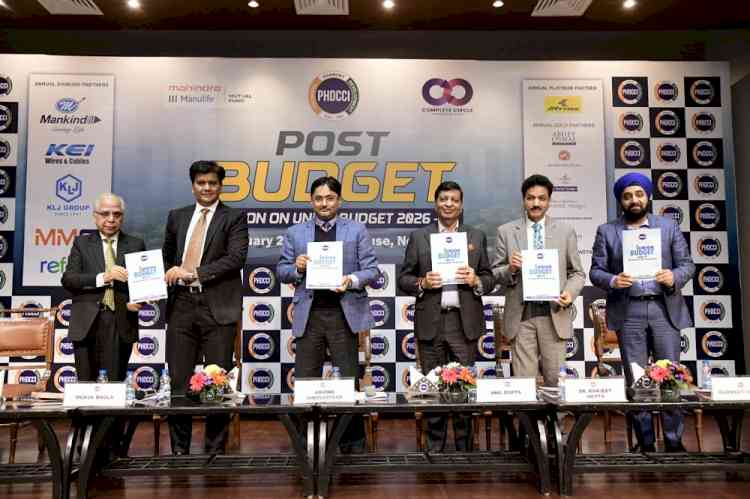
New Delhi, February 4, 2026: PHD Chamber of Commerce and Industry (PHDCCI) organised a Post-Budget Session on Union Budget 2026–27 on 4 February 2026, bringing together senior government officials, economists and industry leaders to examine the Budget’s reform priorities, fiscal roadmap and implications for business and growth.
Addressing the session Arvind Shrivastava, Revenue Secretary, Ministry of Finance, said the Union Budget 2026–27 marks a structural redesign of India’s tax administration framework, aimed at empowering taxpayers while reducing procedural friction and discretionary intervention. He highlighted reforms such as extended timelines for revised and updated returns, the ability to update returns even during reassessment proceedings, combined issuance of assessment and penalty orders, and settlement mechanisms to reduce disputes. He also outlined the transition from transaction-based scrutiny to trust-based, entity-level compliance supported by digital systems, audits and risk-based monitoring for importers, exporters, authorised economic operators and customs warehouses.
The macroeconomic context of the Budget was outlined by Dr. V. Anantha Nageshwaran, Chief Economic Adviser, Government of India, said the Budget continues the accelerated reform momentum underway since early 2025 and reflects strong alignment with the Economic Survey. He highlighted the emphasis on urbanisation with cities as economic systems, sustained support for MSMEs through credit guarantees, payment discipline and dedicated manufacturing funds, and targeted policy backing for manufacturing in a geopolitically fragmented world. He also pointed to continued fiscal consolidation, record infrastructure investment of ₹12.2 lakh crore and improving sovereign credit metrics that together support stable, non-inflationary growth.
Speaking on growth and industry impact, Anil Gupta, Senior Vice President, PHDCCI, said the Budget has been presented at a pivotal moment for the Indian economy and reinforces the Government’s commitment to fiscal prudence, growth acceleration and the vision of Viksit Bharat. He highlighted the strong focus on capital expenditure, infrastructure and manufacturing, including measures such as the ₹10,000 crore SME Growth Fund, revival of legacy industrial clusters and the Viksit Bharat Rozgar Yojana, alongside the positive impact of recent trade agreements on industry and employment.
Sharing industry feedback on direct taxes, Mukul Bagla, Chair, Direct Taxes Committee, PHDCCI, said the Budget reflects constructive stakeholder engagement, with several industry recommendations incorporated. He highlighted measures such as reduction in TCS rates, extended timelines for revised and updated returns, taxation of buyback proceeds as capital gains, exemption for compulsory acquisition of land, rationalisation of penalties and a lower stay-of-demand requirement, all of which enhance certainty and reduce litigation. He also flagged concerns around high effective personal tax rates, delays in faceless appeals and challenges in rectifying legacy demands, calling for further administrative improvements.
Ashok Batra, Chair, Indirect Taxes Committee, PHDCCI, said the indirect tax proposals address several long-pending industry concerns despite a limited number of amendments. He highlighted the redefinition of intermediary services to allow export benefits, faster provisional refunds in inverted duty cases, and rationalisation of post-sale discount provisions as measures that will significantly reduce GST litigation. He also welcomed customs duty rationalisation, extended validity of advance rulings, simplified warehousing procedures and relief measures for exporters, while underscoring the need for early resolution of legacy GST disputes.
Gurmeet Chadha, Chair, BFSI Committee, PHDCCI, said the Budget underscores the quality of government borrowing, with net borrowing broadly aligned with capital expenditure, signalling a clear focus on infrastructure-led growth rather than revenue spending. He noted that India’s macroeconomic position remains structurally strong with high growth and low inflation, and welcomed the momentum in trade negotiations as a positive signal for long-term investors and capital markets.
Pallavi Dinodia, Co-Chair, Direct Taxes Committee, PHDCCI, said Budget 2026 represents a decisive shift towards a simplified and trust-based tax regime. She welcomed the implementation of the new Income Tax Act from 1 April 2026, streamlined return-filing timelines, the one-time foreign asset disclosure amnesty, rationalisation of TCS on foreign remittances and alignment of ICDS with Ind AS. She emphasised that timely notification of rules and faster disposal of pending appeals will be critical to deliver the intended ease of compliance.
Dr. Ranjeet Mehta, CEO & Secretary General, PHDCCI, said the Union Budget 2026–27 reflects months of rigorous institutional effort, extensive data analysis and continuous stakeholder consultation. He placed on record PHDCCI’s appreciation for the team led by Hon’ble Finance Minister Smt. Nirmala Sitharaman and emphasised that effective on-ground implementation through close government–industry partnership will be critical to translating policy intent into tangible outcomes.
On the occasion, PHDCCI released its analytical publication on Union Budget 2026–27, outlining the Budget’s fiscal stance, capital expenditure strategy, infrastructure and manufacturing priorities, employment initiatives and the evolving framework for federal finances, while the discussions underscored that effective implementation and sustained government–industry collaboration will be crucial to translating these policy measures into tangible economic outcomes.