Rohtak Pushes Village Transformation with Strict Quality Control, Saturation Planning and Continuous Monitoring: DC Sachin Gupta
The District Administration, Rohtak, has intensified its drive towards holistic and sustainable village transformation, with a clear emphasis on quality of works, saturation of basic infrastructure, economic empowerment and continuous on-ground monitoring. These directions were issued by the Deputy Commissioner Sachin Gupta, while chairing a comprehensive review meeting of rural development and Panchayati Raj Department works at the local camp office.
 Girish Saini
Jan 14, 2026 09:10
0
Girish Saini
Jan 14, 2026 09:10
0
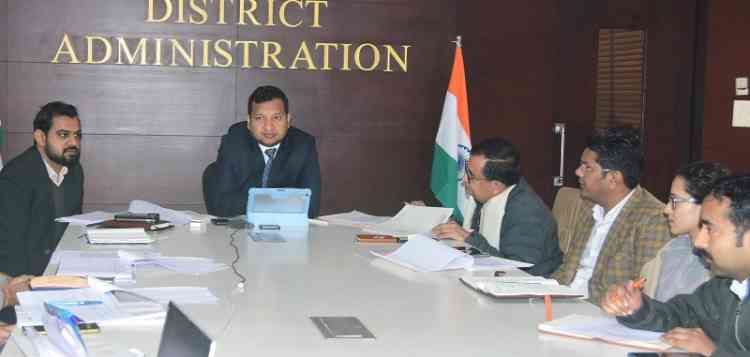
Rohtak, January 14, 2026: The District Administration, Rohtak, has intensified its drive towards holistic and sustainable village transformation, with a clear emphasis on quality of works, saturation of basic infrastructure, economic empowerment and continuous on-ground monitoring. These directions were issued by the Deputy Commissioner Sachin Gupta, while chairing a comprehensive review meeting of rural development and Panchayati Raj Department works at the local camp office.
The Deputy Commissioner made it clear that rural development will no longer be assessed merely on approvals or expenditure, but on durability, usability and visible impact in villages. He directed officers to ensure strict quality control at every stage of execution—before commencement of works, during implementation and after completion.
To institutionalise quality assurance, the Deputy Commissioner instructed that construction material samples be mandatorily lifted and tested, and that geo-tagging of works be carried out at all stages. Any compromise in quality, he said, would invite strict action against the executing agency as well as responsible officials, as per rules.
The Deputy Commissioner emphasised that villages must be treated as integrated development units, where sanitation, water security, livelihoods, infrastructure, health, education, youth engagement and environmental sustainability move forward together. Officers were directed to prepare an estimated development budget for each village, enabling need-based planning, prioritisation and convergence of schemes.
Specific directions were issued regarding development and upkeep of street lighting, village streets and drainage, kacchi phirni, libraries, Mahila Sanskritik Kendras, indoor gyms, community centres and yoga/vyayamshalas, so that public infrastructure remains functional and accessible.
Taking a firm stand on sanitation, the Deputy Commissioner ordered cancellation of licences of septic tank operators found illegally dumping waste in fields or along highways. He directed that all septic tank operators must mandatorily report at STPs and IPS points, with daily monitoring to ensure compliance. Strict enforcement, he said, is essential to protect public health and the environment.
Progress under solid and liquid waste management was reviewed, along with composting, plastic waste management and biogas initiatives. Under the Gobardhan Project, work in village Kharawar has been completed and 36 gas connections have already been issued. Plastic Waste Management Units have been established in villages Madina Korsan and Bainsi. The Deputy Commissioner stressed that community participation is critical for sustaining these initiatives.
Reports on Amrit Sarovar Phase-II, solid waste management sheds and liquid waste management projects were also reviewed, and officers were directed to ensure timely completion and proper maintenance.
Economic empowerment was highlighted as the core pillar of village transformation. Progress under Self Help Groups, employment generation and livelihood schemes was reviewed. The Deputy Commissioner directed that women associated with SHGs who are interested in food-related enterprises be identified and provided training through Hotel Management Institutes. Post-training, these women can establish small food kiosks or cabins in their villages, promoting local entrepreneurship and self-reliance.
Employment programmes were to be aligned with creation of durable rural assets, ensuring that livelihoods and infrastructure are strengthened simultaneously.
The Deputy Commissioner directed that pending inquiries against Sarpanches in various cases be completed expeditiously, reinforcing accountability in grassroots governance. He also reviewed progress under major schemes including Pradhan Mantri Awas Yojana, Mukhyamantri Gramin Awas Yojana, Haryana State Rural Livelihood Mission, MLA Adarsh Gram Yojana and Pradhan Mantri Adarsh Gram Yojana.
Appealing to rural residents, the Deputy Commissioner urged eligible beneficiaries to avail the State Government’s policy for regularisation of houses up to 500 square yards constructed on Shamlat land more than 20 years ago, provided such houses are not located on ponds or common village pathways. Applications may be submitted at the concerned Gram Panchayat or Block Development and Panchayat Officer’s office.
He further directed that if eligible residents fail to avail the policy, encroachment removal drives be undertaken to free Shamlat land from illegal occupation.
“Village development will be judged not by files or figures, but by what works on the ground—clean streets, assured water and real livelihoods. Saturation of facilities and continuous monitoring will be our strongest tools to ensure lasting change in everyday village life”, DC Sachin Gupta added.
Concluding the meeting, the Deputy Commissioner reiterated that continuous monitoring, field presence and accountability will be the driving force behind rural transformation. The district administration reaffirmed its resolve to transform villages of Rohtak into clean, infrastructure-complete, economically empowered and sustainably governed Model Villages.
The meeting was attended by Additional Deputy Commissioner and CEO, Zila Parishad, Narendra Kumar; DDPO Rajpal Chahal; and other concerned officers.