Reform, Resilience, and Resolve: India’s Economy in 2025
Multiple shocks over the past five years have brought increased global volatility and uncertainty. 2025 has been marked by geopolitical fragmentation, trade uncertainty, supply chain realignments, and a battle for technological supremacy. Amidst this unsettled global environment, India’s macroeconomic stability stands out. Growth came in at 8.2% in the latest quarter, surpassing even the most optimistic estimates. Inflation is low, and the fiscal deficit manageable. In the backdrop of multiple external shocks, India’s policy has consistently been to strengthen domestic economic resilience.
 City Air News
Dec 29, 2025 07:53
0
City Air News
Dec 29, 2025 07:53
0
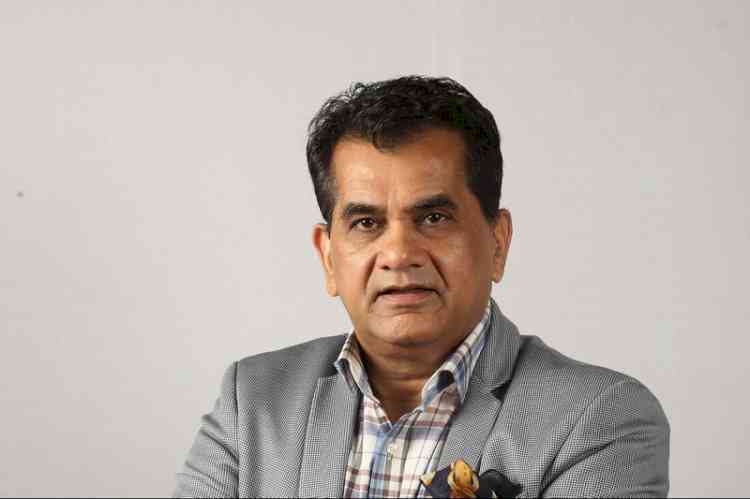
By Amitabh Kant
Multiple shocks over the past five years have brought increased global volatility and uncertainty. 2025 has been marked by geopolitical fragmentation, trade uncertainty, supply chain realignments, and a battle for technological supremacy. Amidst this unsettled global environment, India’s macroeconomic stability stands out. Growth came in at 8.2% in the latest quarter, surpassing even the most optimistic estimates. Inflation is low, and the fiscal deficit manageable. In the backdrop of multiple external shocks, India’s policy has consistently been to strengthen domestic economic resilience.
The bedrock for any stable economy is domestic demand. For the millions of India’s households, tax policy plays an important role in stimulating consumption. India has seen both direct and indirect tax reforms this year. In February, the Budget put more money in people's hands by effectively making salaries up to Rs. 12 lakh tax-free. The complex Income-tax Act of 1961 has been simplified by the Income Tax Act, 2025. Then, in September, reforms to the Goods and Services Tax (GST) introduced a two-slab structure and simplified governance. Consumer sentiment has soared, with festive-period sales reaching Rs. 6 trillion. Importantly, these moves are not revenue losses. By spurring consumption and growth, tax collections stand to be higher in coming years, reflecting their impact on price elasticity of demand. Domestic consumption constitutes 55-60% of our economy. As consumption increases, so does capacity utilisation. As production reaches capacity, it triggers a fresh wave of investment in the economy, which, in turn, generates its own multiplier effects.
Consumer demand will be only sustainable if supported by durable income growth, which reforms to labour laws will ensure. By consolidating 29 fragmented laws into four modern codes, India’s labour framework is more transparent for businesses and more secure for workers. The focus is on fair wages, stronger industrial relations, social security, and workforce safety. These laws will ensure that our growing 640 million-strong workforce prospers and drives India’s growth story forward.
As household incomes rise, they have a choice between higher consumption or savings, or both. As formal employment rises, contributions to provident, pension, and insurance funds will increase. Importantly, globally, such funds are an essential source of capital in domestic capital markets, as they invest in debt and equity in companies, projects, or government bonds. Allowing 100% FDI in insurance will deepen India’s capital markets, enhance competition and the quality of service. Raising FDI limits in insurance is both a financial sector reform and an enabler of social security.
Along with a stimulus to investment through demand, the investment climate has also eased considerably this year. The GST reforms were not just rate rationalisations; they have also significantly eased the registration and compliance process. There has been a 90% reduction in registration time from 30 to 3 days for small firms. The Securities Markets Code will strengthen governance of India’s capital markets, enhance consumer protection, and reduce the compliance burden. Independent regulators are also facilitating growth. The RBI, for instance, has consolidated 9,000+ circulars into less than 250. Similarly, the IRDAI has constituted a committee to suggest regulatory reforms in the insurance sector.
Environmental and building codes have also undergone reforms, moving to a risk-based system of compliance rather than a uniform one. For instance, moving away from a uniform 33% green cover will free up 1.2 lakh hectares of industrial land. Units located in industrial parks with comprehensive environmental clearances will no longer require separate clearances. A newly created ‘white category’ of industries, will reduce compliance costs for low-risk sectors, while freeing up pollution control board resources for higher-polluting, higher-risk sectors.
The Jan Vishwas reforms decriminalised over 200 minor offences and scrapped hundreds of outdated laws. Furthermore, many state governments have also come together to decriminalise over 1000 offences. States have also instituted reforms in land, environmental clearances, and construction, allowing faster project clearances. The next step of Jan Vishwas is now in the offing. These moves represent an important signal: that India is moving towards a trust-based economy, rather than a control-based one.
Despite the surrounding volatility and uncertainty, trade will remain crucial to our growth aspirations. In the Monsoon Session, the Parliament modernised India’s maritime governance by replacing the Acts of 1908, 1925, and 1958. With these reforms, India’s maritime governance framework aligns with global standards. Reducing documentary requirements and strengthening governance will lower logistics costs, enhancing India’s competitiveness. Second, the removal of over 200 quality control orders (QCOs) has lifted a significant burden off MSMEs and exporters. At the same time, we have also opened new markets for our exporters through trade deals with the UK, New Zealand, and Oman, as well as the operationalisation of the agreement with the European Free Trade Association (EFTA).
Jobs and exports come from scaled firms. For too long, policy encouraged firms to stay small. Staying small meant that firms were unable to reap the benefits of economies of scale. Now, for the second time in five years, MSME thresholds have been revised upwards. Compared to the pre-2020 definition, the thresholds have grown 10x. Raising these thresholds enables firms to grow whilst retaining government support. A new export promotion mission worth Rs. 20,000 crores will support export growth, especially for MSMEs.
Energy consumption is seeing a massive spike as artificial intelligence (AI) and the associated infrastructure, such as data centres, are seeing increased uptake and investment. In the past few days, India has attracted USD 70 bn worth of investments in this space. Nuclear energy can help power these innovations sustainably. In the Winter Session, the Parliament enacted the SHANTI (Sustainable Harnessing and Advancement of Nuclear Energy for Transforming India) Bill. The signal is tectonic, as India is voluntarily moving away from its state-monopoly model toward a safety-first, investment-friendly regime. The law allows for private and foreign participation in civilian nuclear projects, whilst keeping elements such as fuel, enrichment, reprocessing and weapons under the government’s domain.
Reforms have not just been limited to economic sectors. Rural employment law reform raises the minimum guarantee from 100 to 125 days. The new law shifts focus from relief to productive rural employment, linking wage work to durable assets, water security, climate resilience and livelihood infrastructure. Education sees a major reform with the Viksit Bharat Shiksha Adhishthan Act, which establishes a single, unified higher education regulator by replacing multiple overlapping bodies (UGC, AICTE, NCTE). This move aligns fully with the National Education Policy (NEP) and separates regulation from funding to ensure a stronger focus on quality.
Amid volatility and uncertainty, India remains resilient. Under the leadership of PM Modi, 2025 marks a decisive year of reforms, characterised by trust, simplicity, and predictability. These are not easy reforms. They require significant political capital and will to push through. The emphasis recognises a basic economic truth: sustained growth depends as much on institutional quality as on fiscal or monetary stimulus. Now, it is for State governments to follow suit.
(The author is former G20 Sherpa and CEO of NITI Aayog)
Views are personal