Nauni University to Strengthen Skills of Nepalese Agriculture Officials
30-member Nepal delegation in Nauni to participate in international training programme
 City Air News
Jan 5, 2026 04:47
0
City Air News
Jan 5, 2026 04:47
0
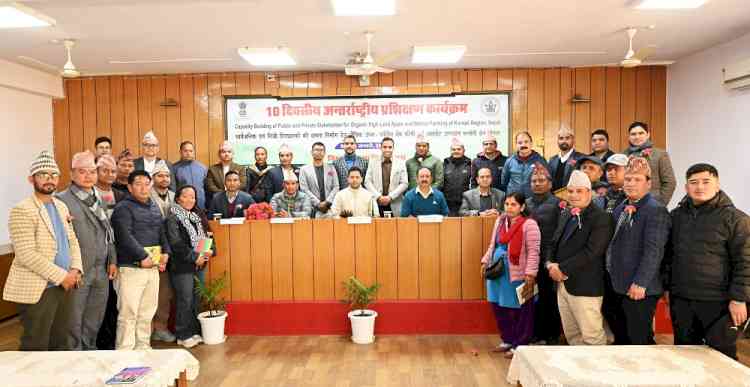
As part of the ongoing collaborative initiatives between the Ministries of External Affairs of India and Nepal, a 30-member delegation from 4 Nepal comprising officers of the agriculture department has arrived at Dr YS Parmar University of Horticulture and Forestry (UHF), Nauni. The delegation comprising officers from four states namely Karnali, Lumbini, Sudurpashchim and Gandaki are participating in a 10-day international training programme titled ‘Capacity Building of Public and Private Stakeholders for Organic Highland Apple and Walnut Farming in the Karnali Region of Nepal’.
The programme is being supported by the Ministry of External Affairs, Northern Division (Nepal Section), New Delhi, in collaboration with the Federal and Provincial Ministries of Agriculture, Government of Nepal. UHF, Nauni has been selected by the Ministry of External Affairs to contribute to the skill development of Nepalese agriculture officials and farmers, with a special focus on the organic cultivation of apple, walnut and kiwi.
Addressing the inaugural session on Monday, Director of Extension Education, Dr Inder Dev, highlighted the long-standing and multifaceted cooperation between India and Nepal. He emphasized the cultural, social and geographical similarities between the hill regions of Nepal and Himachal Pradesh, and underlined Himachal’s notable progress in natural farming. He also reiterated the university’s role as a leading centre for capacity building and training in natural and organic farming practices.
The Registrar of the university, Sidharth Acharya, who was the Chief Guest on the occasion, welcomed the participants and described the initiative as a proud moment for the university. He said that the selection of UHF, Nauni by the Government of India to showcase its technologies and support skill development of Nepalese farmers and agriculture officers reflects the university’s growing national and international reputation. He attributed Himachal Pradesh’s success in horticulture to the scientific approach adopted in farming and the dedication of the farming community. Urging participants to actively engage with experts, he encouraged them to ask questions to make the training interactive and effective. He added that the knowledge gained during the programme would be highly beneficial for farmers in Nepal and would further strengthen Indo–Nepal relations.
Prem Bahadur Oli, Team Leader and Agriculture Extension Officer from Nepal, presented an overview of the agriculture and horticulture scenario in Nepal. He noted that Himachal Pradesh and other hill states of India share agro-climatic conditions similar to Nepal, making the technologies and practices demonstrated during the training highly relevant and easily adaptable. He also mentioned that several agricultural practices from Himachal have already found acceptance in Nepal through knowledge gained by Nepalese labourers who work in Himachal’s apple-growing regions during the harvest season.
Earlier, Dr Anil Handa, Joint Director (Training), welcomed the delegation and informed that this is the second batch of trainees from Nepal under the collaboration, which aims to enhance the skills of around 300 participants in total. He said the programme will emphasize hands-on training in various aspects of apple, walnut and kiwi cultivation.
The schedule includes visits to nursery areas for modern propagation techniques, orchard-based training on pruning and canopy management of temperate fruits, irrigation and water management in high-density plantations, post-harvest management, and management of major pests and diseases. Participants will also visit university research stations and farmers’ fields, and gain practical exposure to organic and natural farming practices along with biocontrol measures.