Minister D. Sridhar Babu Launches Project SHUDH, transforming urban Drainage Systems through AI-Powered Sewer Governance
In a significant step towards safer urban infrastructure and technology-driven public service delivery, D. Sridhar Babu, Hon’ble Minister for Information Technology, Electronics, Communications, Industries & Commerce, Government of Telangana, formally launched Project SHUDH, an AI-powered Sewer Governance Platform developed by Hyderabad-based deep-tech startup The Bot Factory under the guidance of the All India Robotics Association (AIRA).
 City Air News
Jul 11, 2026 01:52
0
City Air News
Jul 11, 2026 01:52
0
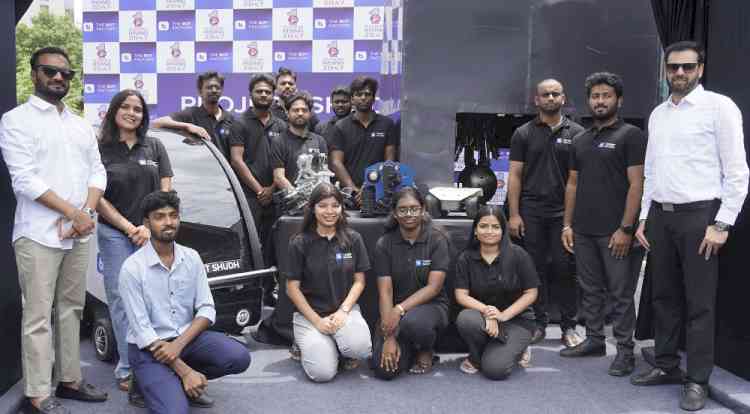
Hyderabad, July 11, 2026: In a significant step towards safer urban infrastructure and technology-driven public service delivery, D. Sridhar Babu, Hon’ble Minister for Information Technology, Electronics, Communications, Industries & Commerce, Government of Telangana, formally launched Project SHUDH, an AI-powered Sewer Governance Platform developed by Hyderabad-based deep-tech startup The Bot Factory under the guidance of the All India Robotics Association (AIRA).
The launch was held on Saturday at T-Works, Hyderabad, where The Bot Factory is currently incubated.
The event was attended by Ashok Reddy, Managing Director, Hyderabad Metropolitan Water Supply & Sewerage Board (HMWSSB); R.V. Karnan, Commissioner, GHMC; Kishshhan, Chairman, AIRA; Anil Bang; Nihitha; and Akilan of The Bot Factory, among others.
Speaking on the occasion, D. Sridhar Babu described Project SHUDH as a pioneering innovation that demonstrates how advanced technologies can be applied to solve critical urban challenges.
He said that Telangana has emerged as a leading destination for innovation, startups and emerging technologies, and the government remains committed to encouraging young entrepreneurs developing solutions with societal impact.
The Minister noted that Project SHUDH could be highly beneficial to civic agencies such as GHMC and HMWSSB. He said the trials conducted with Metro Water Works had shown encouraging results and highlighted the platform's ability to identify drain blockages, generate alerts and provide valuable data for predictive analytics.
He added that the government is actively modernising public systems and institutions to support innovation-led development and create a robust ecosystem for technology-driven solutions such as Project SHUDH.
The Minister further observed that the platform has the potential to significantly improve drainage management and help reduce overflow incidents during the monsoon and other seasons.
Speaking at the event, Ashok Reddy, Managing Director, HMWSSB, said that while robotic technologies had previously been used by the department in specific operational areas, Project SHUDH marks the first major initiative aimed at monitoring and managing sewer pipelines through intelligent robotic systems.
He said several trials had already been conducted and that the product had undergone substantial improvements. While research and development efforts continue, the initial results have been promising. HMWSSB plans to undertake a pilot deployment in a selected area and scale up implementation based on its performance and outcomes.
Nihitha, Robotics Head, The Bot Factory, said that Project SHUDH was developed as part of a disaster-management robotics initiative and represents a fundamental shift from sewer cleaning to sewer governance.
Unlike conventional sewer-cleaning technologies that focus primarily on mechanisation, Project SHUDH is designed as a comprehensive governance platform where every sewer intervention can be digitally tracked, recorded, analysed and monitored. The objective is to help cities move towards zero manual sewer entry while enabling smarter management of underground infrastructure.
The Bot Factory is a Hyderabad-based deep-tech robotics company focused on developing intelligent robotic systems for public safety, disaster management, environmental protection and urban infrastructure.
The company has gained attention for developing Project SHUDH, an AI-powered robotic platform aimed at eliminating the need for human entry into sewers and manholes.
Its mission is to create autonomous robotic systems capable of performing dangerous and hazardous tasks traditionally carried out by humans, thereby improving safety, efficiency and accountability.
The objective is not merely sewer cleaning but the creation of a digital, auditable and data-driven management system for underground infrastructure.
Every intervention generates actionable data, transforming underground maintenance from a reactive activity into a transparent and accountable governance process.
Despite advances in mechanisation, sewer workers across India continue to face significant occupational risks.
Project SHUDH seeks to eliminate the need for human entry into hazardous sewer environments by deploying intelligent robotic systems capable of cleaning, inspection and data collection.
The initiative aligns closely with national priorities relating to worker safety, Smart Cities, digital governance and technology-enabled public service delivery.
The system is capable of operating in both vertical manholes and horizontal sewer pipelines while generating real-time operational data and digital maps of underground drainage networks.
The long-term goal is to help cities achieve zero manual sewer entry, improve worker safety, reduce operational costs and establish a modern governance framework for underground infrastructure.