KMVites Simulate Union Budget with Insightful Policy Debates during Mock Budget 2026
Kanya Maha Vidyalaya, P.G. Department of Economics organised Mock Budget 2026 as part of its academic endeavour with the objective of providing practical exposure to the process of Union Budget formulation in India. The event commenced with the floral felicitation of Director Atima Sharma Dwivedi.
 Rajat Kumar
Feb 21, 2026 09:56
0
Rajat Kumar
Feb 21, 2026 09:56
0
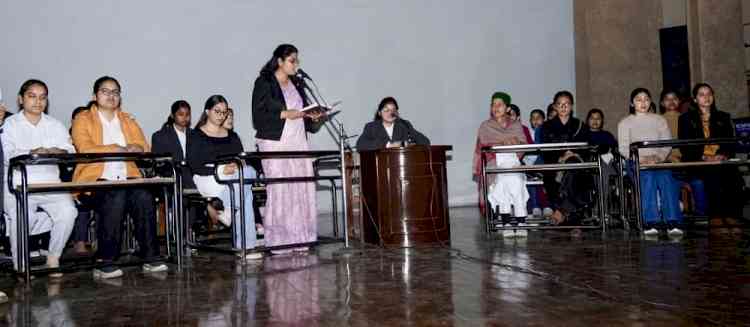
Jalandhar: Kanya Maha Vidyalaya, P.G. Department of Economics organised Mock Budget 2026 as part of its academic endeavour with the objective of providing practical exposure to the process of Union Budget formulation in India. The event commenced with the floral felicitation of Director Atima Sharma Dwivedi.
The event witnessed enthusiastic participation from students of B.A., B.Sc. (Economics), and M.Sc. (Economics) who assumed the roles of political leaders, policymakers, and representatives of various sections of society. The programme began with Harshita (BA–IV) as the comparer and Isha Dhiman (B.Sc. Eco–VI) as the anchor, who introduced the objectives and significance of the budget simulation.
Tanvi (M.Sc. Eco–IV) assumed the role of Finance Minister Nirmala Sitharaman and presented the budget proposals, outlining key policy measures related to taxation, public expenditure, fiscal deficit, and developmental priorities. Sheetal (M.Sc. Eco–IV) portrayed Prime Minister Narendra Modi, while Riya Bhagat (M.Sc. Eco–IV) represented Piyush Goyal.
Other cabinet and opposition roles were enacted by various students, including Sania Jassal (B.Sc. Eco–VI) as Kumari Selja, Anshika Thakur (B.Sc. Eco–VI) as Akhilesh Yadav, Disha Sangar (B.Sc. Eco–VI) as Dharmendra Pradhan, Gurwinder Kaur (B.Sc. Eco–VI) as Shashi Tharoor, and Swati Chaudhary (MBA–II) as P. Chidambaram, who actively debated government policies and economic reforms.
Special discussions were held on MSMEs (with arguments both in favour and against), capital expenditure (Capex), tourism, and sectoral development. Students also represented various sections of society, including farmers, homemakers, the salaried class, youth representatives, and industrial stakeholders, thereby reflecting diverse perspectives in the budget debate. The session was effectively moderated by the Lok Sabha Speaker, ensuring smooth proceedings and disciplined discussion.
The Mock Budget successfully highlighted issues such as economic growth, employment generation, fiscal responsibility, social welfare, and infrastructure development. The activity enhanced students’ understanding of parliamentary procedures, budgetary mechanisms, and policy trade-offs, making it a practically oriented learning experience. The programme effectively bridged theoretical concepts of public finance with real-world policy application.
Prof. Atima Sharma Dwivedi expressed deep appreciation for the dynamic and intellectually enriching Mock Budget event organised by the Department of Economics, praising it as an innovative and effective method of experiential learning. She averred that such activities make students better learners and boost their confidence. She congratulated Mrs. Amarpreet Khurana, Head, P.G. Department of Economics, and the entire faculty of Economics for meticulously organising the event.