Integrated Farming for Prosperity: A collaborative Multi-Stakeholder Effort for Sustainable Rural Development
Advancing education, livelihoods, women’s empowerment, and grassroots innovations are the objectives of RuTAGe Smart Village Centre (RSVC), conceptualised by the Office of the Principal Scientific Advisor (PSA), Government of India and implemented on ground by IIT Roorkee at Khunt Village, Almora.
 City Air News
Jan 21, 2026 09:38
0
City Air News
Jan 21, 2026 09:38
0
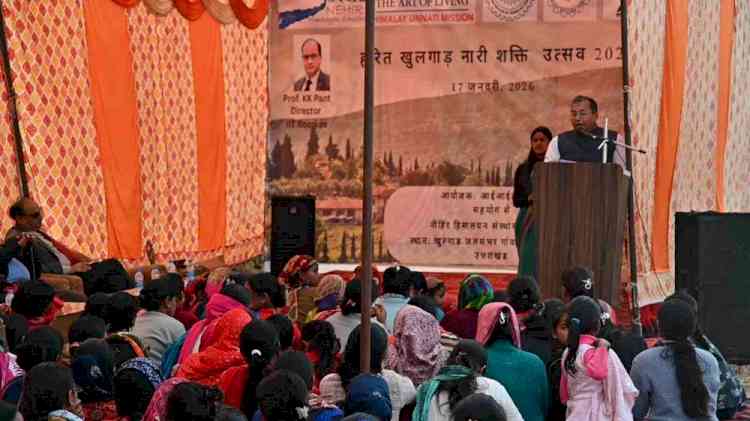
Almora, Uttarakhand, January 21, 2026: Advancing education, livelihoods, women’s empowerment, and grassroots innovations are the objectives of RuTAGe Smart Village Centre (RSVC), conceptualised by the Office of the Principal Scientific Advisor (PSA), Government of India and implemented on ground by IIT Roorkee at Khunt Village, Almora.
The collaborative implementation efforts of IIT Roorkee, SETU Aayog, Nehir Himalayan Foundation, and AARTI Foundation with the support from sericulture departnent and partnership from the villagers is ensuring that initiatives go beyond planning and are visible in everyday village life. A key achievement under the RSVC is the plantation of over one lakh mulberry saplings towards integrated farming, led largely by the women of the region. Their dedication has turned this into a strong example of community-driven development. From plantation and livelihood activities to the community library and technology-based solutions, the impact can be clearly seen. The work in the village also reflects the wider vision of the Ministry of Education, especially through efforts like the community library and learning spaces, which are helping strengthen education at the grassroots level.
This plantation initiative is creating multiple benefits. Mulberry cultivation is opening new livelihood opportunities through sericulture and value-added products, while also helping in reducing soil erosion and improving land stability. Farmers are practicing integrated farming, growing turmeric and ginger alongside mulberry, and exploring products like mulberry tea, which is creating further scope for local enterprise.
The upgraded Bageshwari Wool Charkha installed in the RSVC, redesigned to make spinning easier and more useful for local artisans. The charkha can now be used in both foot-operated and electric modes and includes features like battery backup, solar support and adjustable speed. These improvements help produce better-quality yarn from local, Tibetan, Tibetan-56 and Merino wool. Women and handloom workers shared that the new design saves time, reduces effort and improves productivity, while supporting traditional skills and livelihoods.
Beyond agriculture, the journey has given women a platform to participate and lead. Many women who were earlier confined to household work are now actively engaged in plantation, planning and livelihood activities. Women from all age groups actively took part in this plantation journey, from young girls to elderly women, making it a truly inclusive community effort. Their participation has helped build confidence, strengthened decision-making roles, and encouraged greater independence. The initiative has clearly contributed to women’s development by giving them visibility, voice, and opportunity within the village.
IIT Roorkee organised the “Harit Khulgad Nari Shakti Utsav 2026” on 17th January 2026 at Khunt Village, Almora, to showcase and celebrate the achievements of the local community. The event brought villagers together to reflect on their collective efforts, acknowledge their progress, and engage in discussions on future pathways for sustainable development.
Saraswati Devi, Village Dhamas. Age 45 shared during the event “Earlier we stayed inside our homes all day. Now we go to meetings, work in the fields, learn new things and feel confident speaking in front of others. This work has helped us earn, but more than that, it has helped us believe in ourselves and be independent”
Sushri Jyoti Bisht, Village Dhamas, Age 25 shared, “By being actively engaged in agricultural activities and being involved with RSVC being run by Nehir Himalayan Sansthan with guidance and support from IIT Roorkee, we have gained respect in our homes and communities. We have received a stage where our voices are heard and our opinions matter.”
Komal Bisht, Village Dhamas, Age 24 added, “By being associated with RSVC, we have been able to involve female farmers, we have encouraged our own families as well as the adjoining families to start farming on their fields and this has created livelihood opportunities for everyone.”
Puran Negi, Village Shyahidevi, Age 28 years shared, “It has been a major boost for us to receive equipment for mulberry plantation. With the technical support of IIT Roorkee, we were able to increase productivity significantly—each person could prepare nearly 100 pits compared to just 20 through manual effort. This technical intervention has enhanced our efficiency and allowed us to focus more effectively on the real outcomes of farming.”
Jivanti Devi, Village Salla, Age 75 years, shared, “It is important to stay in our own villages and work in our fields to earn our living and keep the mountains alive. It is also important to provide education to our children so that they can continue this work in future.”
Some women spoke about the positive impact of the free community library established by S. L. Shah and now supported by the joint efforts of his family and IIT Roorkee along with Nehir Himalayan Sansthan. They said, “Now our children can sit and read books, prepare for studies and learn new things. Even adults come to read. This has changed the learning environment of our village.”
Raj Shekhar Joshi, Vice Chairman, SETU Aayog, also addressed the gathering and spoke about continued efforts for the development of hill regions. He said, “IIT Roorkee’s role as the Lead Knowledge Institution has significantly strengthened SETU Aayog’s grassroots initiatives. We are jointly extending the learnings from Rural Centre initiative at Khunt in SETU Aayog`s Integrated Smart Village Centre. The centre at Khunt demonstrates how clustering of small farms and integrated, mixed cropping can unlock sustainable economic development in hill villages. The active inclusion of women, youth, and young girls—building their capacities and confidence, strengthening local leadership, and creating pathways for dignified livelihoods makes it a very powerful initiative. The initiative aligns it completely with SETU Aayog`s vision for socio-economic development of the state. We are committed to scaling such evidence-based grassroots, data-informed and climate-resilient models across Uttarakhand.”
Prof. K. K. Pant, Director, IIT Roorkee, shared a strong message with the community. He said, “Education and technology together form the strongest foundation for progress in rural and hill regions. When scientific knowledge is translated into practical solutions at the grassroots level, it empowers communities to build local livelihoods, reduce migration, and grow sustainably. The women of Khunt village exemplify the spirit of Vocal for Local, demonstrating how targeted technical interventions can transform integrated farming into a model of self-reliance, leadership, and ecological responsibility.”
This initiative reflects the spirit of Vision 2047, which focuses on inclusive growth, self-reliant communities and sustainable development. What makes this effort meaningful is that people are not just beneficiaries but active partners. The changes may be gradual, but they are real building confidence, strengthening skills and creating genuine opportunities within the village.