India’s New Global Positioning in Textiles
 City Air News
Dec 16, 2025 06:25
0
City Air News
Dec 16, 2025 06:25
0
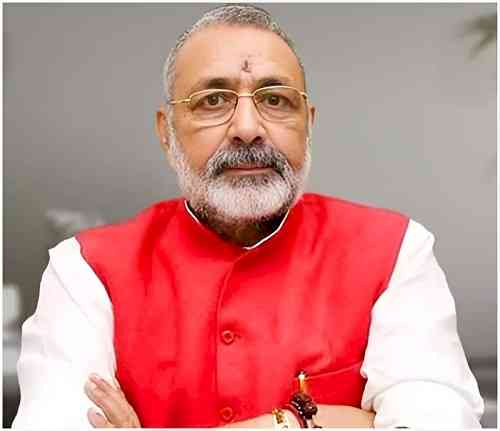
By Giriraj Singh
When we speak of India’s textile sector, we are not merely referring to factories, machines and fashion. We are talking about the lives of millions of Indians whose daily reality is rooted in cotton fields, handlooms, powerlooms and sewing machines.
Over the last 11 years, under the leadership of Prime Minister Shri Narendra Modi, the sector has witnessed a strategic vision, strong resolve and bold policy reforms. These efforts have infused new confidence into the textile industry. Today, the impact of recent reforms is not just structural change. It is a story of new opportunities for farmers, entrepreneurs, women, weavers, technicians and the youth. It is a collective mission to position India as a global textile powerhouse. This article is not a list of schemes, but a reflection of the transformation we have built together.
Farmer-Centric Transformation: Record Cotton Procurement and Historic MSP Increase
The foundation of the textile sector lies in the fields, and farmers are the first link in this value chain. Ensuring that cotton farmers are protected from market fluctuations, price uncertainty and exploitative intermediaries has always been a top priority.
This is why, between 2004 and 2014, government agencies procured a total of 173 lakh cotton bales. But between 2014 and 2024, this figure rose to 473 lakh bales, an increase of 173%. This demonstrates that the government has moved beyond seasonal procurement and provided farmers a system of sustained security.
Similarly, major reforms in MSP have given farmers long-term stability. Cotton MSP, which stood at ₹3,700 per quintal in 2013-14, has been raised to ₹7,710 per quintal for 2025-26 an increase of 108%, strengthening the income, confidence and security of cotton growers.
When we say the farmer is protected, it is not a slogan. These numbers reflect a genuine guarantee that the government is procuring more cotton than ever before and ensuring a remunerative price for farmers.
Mission for Cotton Productivity: Quality, Productivity and New-Age Fibres
Higher production is not enough, global competitiveness demands better quality. With this mission, the government launched the ₹2,500 crore Mission for Cotton Productivity, aimed not only at increasing production but enhancing cotton quality to international standards.
The mission focuses on improved seeds, scientific cultivation, farm management and enhanced quality-control systems. Farmers are being encouraged to adopt new-age fibres so that India can emerge as a major global supplier of high-quality cotton and blended fibres.
The future of the textile industry will not depend solely on traditional fibres. The government has prioritised new-age fibres such as flax, ramie, sisal and milkweed all of which offer low input costs and higher returns. These fibres will open new avenues for processing industries, create large-scale jobs and strengthen the value chain. Milkweed, in particular, is emerging as a promising new-age textile fibre and will soon become an important additional income source for farmers.
Cotton Import Duty Relief: Stability for Industry and Global Competitiveness
The removal of import duty on cotton has provided immediate relief to the industry. Initially applicable only till 30 September, the deadline was extended till 31 December, considering its positive impact. Textile mills can now access cotton at globally competitive prices, reducing yarn and fabric production costs. This directly enhances India’s competitiveness in international export markets.
For SMEs, this move is especially significant as it provides cost stability, better planning and improved financial management. The domestic market too benefits from increased raw cotton availability, ensuring affordable, high-quality fibre for handloom, powerloom, designer segments and fabric-based startups. This decision positions India as a stable and competitive global manufacturing hub.
Industrial Acceleration Through PLI: A New Era for Textile Manufacturing
The Production-Linked Incentive (PLI) Scheme has energised the textile sector, creating an enabling environment for unprecedented investment. In response to industry demand, the application portal has been reopened till 31 December 2025, and 27 new applications have already been received.
These investments will create new factories, advanced technologies and thousands of jobs, significantly contributing towards India’s goal of achieving $12 billion textile exports by 2030. Of the 74 approved companies, 42 are in technical textiles, signalling India’s deep commitment to this innovation-driven sector. Technical textile exports have grown by 12.4% over the previous year, reaching $3.2-3.4 billion. A notable highlight - the top 10 companies have collectively invested ₹4,584 crore, exceeding their committed investment by more than ₹500 crore.
One of the most compelling success stories is that of baby diapers and sanitary napkins. Once heavily dependent on imports, India is now moving confidently towards becoming a net exporter in this category thanks to PLI-driven industrial expansion.
Relief to MMF Value Chain: QCO Removed from MEG and Viscose
The decision to remove Quality Control Orders (QCO) on MEG and viscose was made after carefully evaluating industry needs and global supply chain realities. Post-QCO removal, the MMF (man-made fibre) value chain now has access to raw materials at globally competitive prices, improving production planning as well as cost-efficiency. The downstream sector, especially garmenting, receives immediate relief. This segment currently employs 1.4 crore people, and the goal is to create 1 crore additional jobs by 2030.
Next Gen GST Reform: Relief from Inverted Duty Structure
The textile industry had long demanded correction of the inverted duty structure, which locked up working capital. Next Gen GST reforms have finally addressed this issue. A major decision was also taken to reduce GST to 5% on apparel priced up to ₹2,500, making garments more affordable for the middle class, youth and students. This will also boost demand across Tier 2-3 towns and rural markets.
Labour Reforms: Security and Dignity for Textile Workers
A large proportion of textile workers are women, migrants and contract labourers. Recent labour reforms guarantee equal wages, access to welfare schemes and improved working conditions. These reforms will ensure dignity, safety and stability for the textile workforce.
PM MITRA Parks: Integrated Value Chains and 21 Lakh Jobs
The PM MITRA scheme is a game-changer. These parks are not merely industrial clusters, they are the seven energy hubs of India’s textile sector. Land allocation across seven states is complete, and work is progressing smoothly. The parks have already attracted ₹33,000 crore in investment and are expected to generate 21 lakh jobs.
FTAs and New Global Markets: Expanding India’s Export Footprint
When the Ministry of Textiles was taken over in June 2024, it was clear that India relied too heavily on a few traditional markets. The directive was to identify emerging global markets and study demand patterns and per capita incomes. As a result, 40 new markets were identified markets where India had minimal presence but immense potential.
Today, India is entering these regions confidently through FTAs with 27 countries. The recent CETA agreement with the UK is a prime example. Its impact was immediate, with India’s exports to the UK increasing by $15 million between April 2024 and 2025. Similarly, the India-EFTA Agreement opens doors to a premium market worth nearly $14 billion.
In just one year, India’s textile exports grew in 111 countries with exports rising over 50% in 38 countries and 25-50% in 16 countries. The most remarkable success story is Argentina, once considered a challenging market, where Indian exports recorded a 73% increase.
India’s Textile Sector is Now a Pillar of National Strength
Together, these efforts reflect a simple truth. India's textile sector is no longer just an industry. It has become one of the engines of national growth.The sector stands today with renewed confidence and the capability to lead global competition. Our goal is clear - To make India a trusted, modern and sustainable global textile hub of the future.
****
(The author is Union Minister of Textiles)