India issues chair statement after BRICS meeting amid differences over West Asia conflict
Insisting that there were differing views among members with regard to the situation in West Asia and the Middle East, India on Friday issued a chair's statement instead of a joint statement at the conclusion of the two-day BRICS Foreign Ministers' Meeting in New Delhi.
 IANS
May 15, 2026 11:13
0
IANS
May 15, 2026 11:13
0
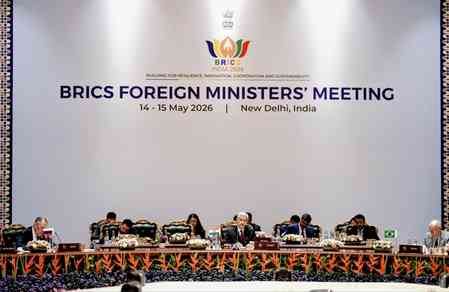
New Delhi, May 15 (IANS) Insisting that there were differing views among members with regard to the situation in West Asia and the Middle East, India on Friday issued a chair's statement instead of a joint statement at the conclusion of the two-day BRICS Foreign Ministers' Meeting in New Delhi.
The BRICS Ministers of Foreign Affairs reaffirmed their commitment to strengthening multilateral cooperation to address humanitarian crisis worldwide and expressed concern at the dwindling of international responses. They strongly condemned all violations of international humanitarian law, including deliberate attacks against civilians and civilian infrastructure, as well as the denial or obstruction of humanitarian access and the targeting of humanitarian personnel.
The ministers underlined the need to address accountability for violations of international humanitarian law. They acknowledged international efforts made by BRICS members to promote respect for, adherence to, and effective implementation of International Humanitarian Law.
"There were differing views among some members as regard to the situation in the West Asia/Middle East region. BRICS members expressed their respective national positions and shared a range of perspectives. Views articulated by them included the need for an early resolution of the current crisis, the value of dialogue and diplomacy, respect for sovereignty and territorial integrity, upholding international law, the importance of safe and unimpeded flow of maritime commerce through international waterways, and the protection of civilian infrastructure and civilian lives. The impact of recent developments on the global economic situation was stressed by many members."
The ministers expressed strong condemnation of any acts of terrorism as criminal and unjustifiable, irrespective of their motivation, whenever, wherever and by whomsoever committed. They condemned the terrorist attack in Jammu and Kashmir in April last year, which claimed 26 lives and injured several others.
"They reaffirmed their commitment to combating terrorism in all its forms and manifestations, including the cross-border movement of terrorists, terrorism financing and safe havens. They reiterated that terrorism should not be associated with any religion, nationality, civilization or ethnic group and that all those involved in terrorist activities and their support must be held accountable and brought to justice in accordance with relevant national and international law. They urged to ensure zero tolerance for terrorism and rejected double standards in countering terrorism," the statement said.
They stressed the primary responsibility of nations in combating terrorism and the global efforts to stop and counter terrorist threats must fully comply with their obligations under international law, including the Charter of the UN, particularly the purposes and principles thereof, and relevant international conventions and protocols, in particular international human rights law, international refugee law and international humanitarian law, as applicable.
The ministers welcomed the activities of the BRICS Counter-Terrorism Working Group (CTWG) and its five Subgroups based upon the BRICS Counter-Terrorism Strategy, the BRICS Counter-Terrorism Action Plan and the CTWG position paper. They looked forward to further deepening counter-terrorism cooperation. They called for an expeditious finalisation and adoption of the Comprehensive Convention on International Terrorism in the UN framework. They called for concerted actions against all UN designated terrorists and terrorist entities.