India, Australia reaffirm commitment to open, rules-based Indo-Pacific
Prime Minister Narendra Modi and his Australian counterpart, Anthony Albanese, on Thursday reaffirmed their shared commitment to an open and rules-based Indo-Pacific. They strongly opposed any destabilising or unilateral action to change the status quo and undermine regional peace and stability.
 IANS
Jul 9, 2026 02:46
0
IANS
Jul 9, 2026 02:46
0
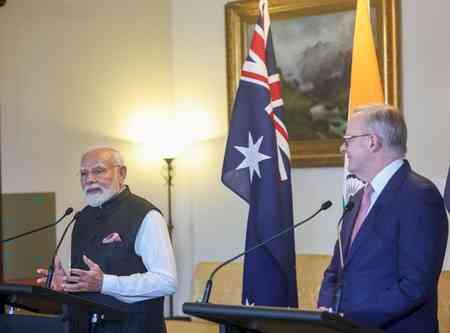
Melbourne, July 9 (IANS) Prime Minister Narendra Modi and his Australian counterpart, Anthony Albanese, on Thursday reaffirmed their shared commitment to an open and rules-based Indo-Pacific. They strongly opposed any destabilising or unilateral action to change the status quo and undermine regional peace and stability.
The two leaders stressed the importance of being able to exercise rights and freedoms consistent with international law, particularly the United Nations Convention on the Law of the Sea (UNCLOS), including freedom of navigation and overflight, and emphasised that disputes must be resolved peacefully in accordance with international law, according to the joint statement released following the third Australia–India Annual Summit.
Earlier in the day, PM Modi and PM Albanese participated in the third Australia-India Annual Summit held in Melbourne. Australian Foreign Minister Penny Wong, National Security Advisor (NSA) Ajit Doval and other officials were present during the meeting.
The two leaders reaffirmed their commitment to strengthening cooperation through regional and multilateral institutions to address shared challenges. They reiterated the importance of the Quad as a partnership that delivers practical and concrete outcomes for the Indo‑Pacific and welcomed the outcomes agreed by Quad Foreign Ministers during the meeting held in New Delhi in May.
PM Modi and Albanese emphasised the importance of strengthening cooperation in the Indian Ocean region, including through the Indian Ocean Rim Association (IORA) under India's Chairship and welcomed continued engagement under regional initiatives.
They welcomed search and rescue training for IORA Member States, conducted jointly by Australia and India at the Maritime Rescue Coordination Centre (MRCC) in Chennai in June, and Australia hosting the sixth meeting of the IORA Working Group on Maritime Safety and Security in Perth in June, according to the joint statement.
The two leaders welcomed cooperation activities under the Indo-Pacific Oceans Initiative (IPOI) and further cooperation through the Australia-India-Indonesia trilateral mechanism. They reaffirmed their commitment to the Pacific Islands Forum (PIF), considering the importance of its 2050 Strategy for the Blue Pacific Continent and partnerships that reflect the collective priorities of the Pacific region.
Albanese recognised India’s role in extending development partnerships to Pacific Island countries, including through the Forum for India-Pacific Islands Cooperation (FIPIC) framework, according to the joint statement.
PM Modi and Albanese condemned terrorism and violent extremism conducive to terrorism in all its forms and manifestations and stressed the importance for all nations to combat terrorism in a comprehensive and sustained manner.
Both leaders called for action against globally proscribed terrorists and terror entities, including those listed by the United Nations Security Council 1267 Sanctions Committee, and their proxies, affiliates, sponsors and financiers. They reiterated their condemnation of terrorist attacks in Australia's Bondi Beach and Pahalgam in India.
"The Prime Ministers recognised the need for enhancing cooperation to effectively counter the challenges of combating terrorism. They committed to increase information sharing on terrorist threats in our region and explore opportunities for enhanced collaboration to counter radicalisation, including online radicalisation, violent extremism conducive to terrorism and countering use of new and emerging technology for terrorist purposes, financing of terrorism, threats to critical infrastructure and the maritime domain," the joint statement mentioned.