Expert lecture on ‘Lifelong Learning and Skill Upskilling under National Education Policy 2020’
The National Education Policy (NEP) Cell of Panjab University, Chandigarh, today convened a high-level online expert lecture on ‘Lifelong Learning and Skill Upskilling under National Education Policy 2020.’ The session was led by the distinguished academic, Prof. Rajan Welukar, a former Vice-Chancellor of the University of Mumbai and current Vice-Chancellor at ATLAS Skill Tech University, who served as the keynote speaker.
 City Air News
Jan 28, 2026 09:19
0
City Air News
Jan 28, 2026 09:19
0
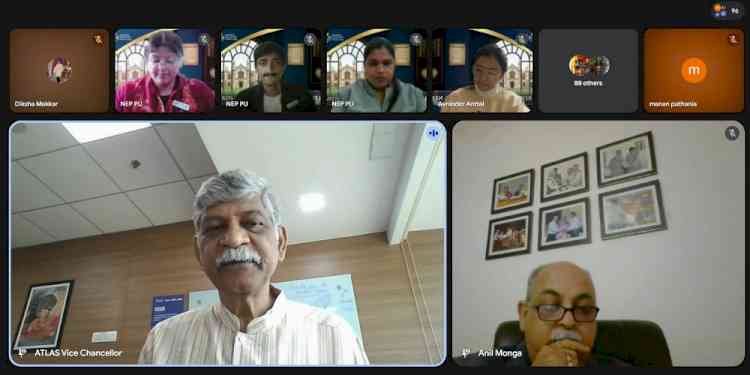
Chandigarh, January 28, 2026: The National Education Policy (NEP) Cell of Panjab University, Chandigarh, today convened a high-level online expert lecture on ‘Lifelong Learning and Skill Upskilling under National Education Policy 2020.’ The session was led by the distinguished academic, Prof. Rajan Welukar, a former Vice-Chancellor of the University of Mumbai and current Vice-Chancellor at ATLAS Skill Tech University, who served as the keynote speaker.
The lecture served as a critical intervention in the ongoing discourse surrounding the structural and pedagogical shifts necessitated by the NEP 2020, drawing participation from academic visionaries, faculty, and research scholars across the regions in India. The lecture was spearheaded under the guidance of Prof. Anil Monga (NEP Coordinator) and Prof. Veenu Mangat (NEP Co-coordinator), with the support of NEP Saarthis.
Prof. Welukar opened the discourse by distilling the essence of the NEP into three core pillars– Nation, Passion, and Education. He argued that the ultimate objective of the policy is Rashtranirman (nation-building), which can only be achieved by fostering individual competency and by empowering stakeholders to look beyond certifications while learning. He reiterated that the transition from a developing nation to a developed nation depends entirely on India’s ability to transform degrees into containers of competency, not just certificates.
“The word ‘Nation’, ending with ‘tion’, has a suffix that denotes action and movement. Similarly, our educational framework must move away from static learning towards a dynamic, lifelong process,” Prof. Welukar observed. He emphasised that education should not be a narrow pursuit of employment—such as training to be a typist—but a multidisciplinary and transdisciplinary journey that aligns with an individual's passion.
Drawing on rigorous comparative analysis, Prof. Welukar then highlighted the developmental trajectories of Singapore, Germany, and South Korea during the 1960s and 70s. These nations, he noted, prioritised a ratio of 70% skill-based learning to 30% theoretical instruction, a model he urged Indian institutions to emulate. He proposed the Calgary model of practical-training as he stated, “We are currently stuck in the classroom; we need action, discussion, and debate.” He then encouraged participants to look beyond binary Pass or Fail labels to cultivate a mindset of continuous improvement in themselves.
Another, impact-driven pedagogical recommendation by Prof. Welukar was regarding the structural revamp of the Indian education system, where the responsibility of youth’s skill development will be shared between industries and Universities.
During the lecture, while addressing participants' questions, the speaker also offered insights into infrastructural and societal barriers that can be dealt with effectively through inclusive education, government action, and philanthropic support.
Concluding the session, Prof. Welukar warned against the pitfalls of being a "learned person" in a rapidly changing global economy. Instead, he championed the concept of being a lifelong learner who understands that skills must be refreshed every 2-3 years.