“Documenting institutional memory is as important as technology itself”: N. R. Narayana Murthy
In a fireside chat following launch of the book, ‘Designing Change: My Journey Through Digital Payments Transformation’ authored by Dr. Balakrishnan Mahadevan, the Infosys Founder discusses India’s digital payments journey
 City Air News
Jan 24, 2026 11:30
0
City Air News
Jan 24, 2026 11:30
0
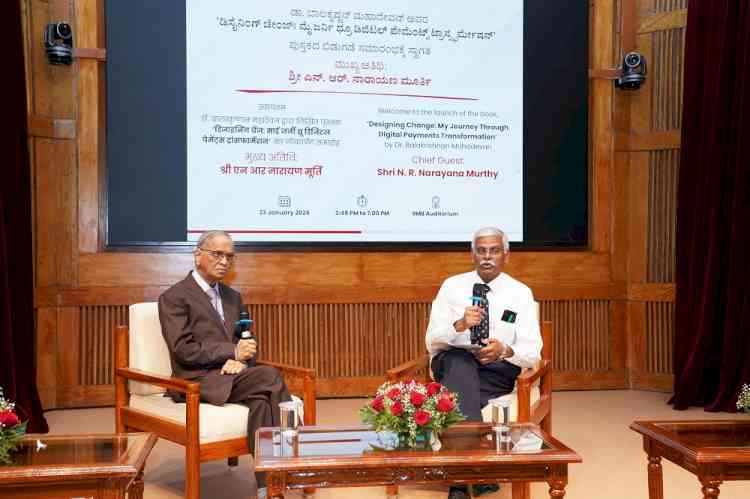
Bengaluru: “If you want to build an organization with strong values, if you want to protect the dignity of every employee, you as a leader has to walk the talk. Value will not come from speeches, but from actions. Values, discipline, strong leadership and compassionate capitalism will take the society/country forward”, said Chief Guest N. R. Narayana Murthy, Founder of Infosys, during a fireside chat with Dr. Balakrishnan Mahadevan, Post Doctoral Fellow at IIM Bangalore, earlier on Friday at the Institute. The Center for Digital Public Goods (CDPG) hosted the launch of the book, ‘Designing Change: My Journey Through Digital Payments Transformation’, authored by Dr. Mahadevan earlier today, and the chat was a highlight of the event. The day also saw leaders from policy, industry and academia reflecting on India’s extraordinary journey in building one of world’s most advanced digital payments ecosystems.
Reflections on the book, institution-building and India’s digital payments journey: A fireside chat
Former Chairman of the National Payments Corporation of India, N. R. Narayana Murthy, who has written the foreword to ‘Designing Change’, shared his reflections on the book. “Documenting institutional memory, covering how to work in a team in the realm of rapidly changing technology, how to reach the pinnacle of our aspirations through hard work, smartness and discipline, are elements of the book that deserve special mention.”
He went on to discuss his perspective on the values, governance principles and institutional choices that underpinned India’s digital payments transformation, during his conversation with Dr. Balakrishnan Mahadevan.
On why it was important to document India’s digital payments journey, as a technology success as well as a story of institution-building, he explained, “Technology is a perishable commodity. Till now, India has been following an oral tradition, as against a written one, in terms of documentation of organizational progress. But how institutions are built, the sacrifices, challenges and constraints involved, the foibles of leaders, complexity of working in teams, how working on the leading edge of technology is, how contributions to society are made, are valuable information. All these will add to the compendium of institutional memory, and the foundations of India’s progress will rest on such key knowledge and information by modern authors.”
He also spoke on leadership, regulators and founding institutions, with reference to NPCI, RBI and the Indian Banks’ Association, and how the founding teams contributed to building institutions that earned trust and endured over time. “RBI has been a catalytic, kind, wise and eternal enabler. It has made UPI a public good by making it less expensive for users and accessible, thereby earning trust of the common man. When you have leaders who have high aspirations and are well intentioned, you can transform the nation”, he highlighted.
The conversation then steered towards public infrastructure and private innovation, and his views on India’s digital payments success resting on a distinctive balance – public, interoperable infrastructure combined with private innovation at the edges. “The most important lesson is making the code a public code which is low cost. This will prevent monopoly and create the platform for innovation. Combining innovation with sturdy foundation needs top quality leaders.
Narayana Murthy also shared his views on scale, responsibility and the future, including issues of resilience, inclusion and trust. “Leaders have already given significant importance to scale, now the focus should be on resilience – how to make the system safe, prevent leakages, enhance accuracy, and boost the trust of users. Every citizen should come under the umbrella that way. We must continue to provide safe and inexpensive population scale system and prevent digital stratification.”
Focusing on compassionate capitalism and societal good, things that Narayana Murthy is himself well known for, he said across industries and sectors, leaders need to balance scale, efficiency and innovation with broader societal good. “Compassionate capitalism is using the principles of capitalism in maximizing value delivered to stakeholders. It is about ensuring that all stakeholders are provided facilities that the corporation provides. You need to earn the respect of all stakeholders – users, employees, etc. Even bureaucrats and politicians will help your industry grow if you earn their respect. Earning respect of the society is most important – even the poorest should feel benefited from the system.”
Stating that leaders should follow a simple life without any vulgar display of wealth, he told the students, “You, the future leaders, are the evangelists of compassionate capitalism, who will take the society/country forward. That will encourage entrepreneurship as well.”
Values, discipline and leadership found special mention in his talk. “At the end of the day, if you want to add value to society and want more customers to be enrolled, you have to sell your products and services at a price which is within the disposable income of the general population. There should be cost control and austerity in running your organization. And you leaders should lead by example – if you want to build an organization with strong values, if you want to protect the dignity of every employee, you as a leader has to walk the talk. Value will not come from speeches, but from actions. Your words have to match your actions and thus, you can lead the country towards further progress”, Mr. N. R. Narayana Murthy advised the students and young professionals present.
Thereafter, the other dignitaries offered multi-dimensional perspectives on the themes explored in the book, and the digital payments ecosystem in India. The speakers discussed the book in the broader context of how integrity, rapid execution and a public-good orientation enabled the creation of a world-class, real-time payments infrastructure.
Unveiling of the book
The book, ‘Designing Change: My Journey Through Digital Payments Transformation’ was unveiled in the presence of dignitaries responsible for India’s digital payments transformation, with some also being behind Dr. Mahadevan’s success in life and career. They included R Gandhi, former Deputy Governor, Reserve Bank of India and Part-time Chairman of Yes Bank; N S Vishwanathan, former Depuy Governor of RBI and Part-time Chairman of Axis Bank, Prof. S Sadagopan, Founding Director of IIIT Bangalore; M Balachandran, former CMD of Bank of India and former Chairman of NPCI; Mohan Tanksale, former CMD of Central Bank of India and former Chief Executive of Indian Banks' Association; Mallikarjuna Rao, former MD and CEO of Allahabad Bank and Punjab National Bank; Dr. N Kamakodi, MD and CEO of City Union Bank; P. R. V. Ramanan and Ms Lakshmi Ramanan, former Collectors, Customs and Central Excise, Govt. of India; P. K. Kavitha, teacher at a higher secondary government school in Palakkad (Kerala); Rema Menon, Senior VP of Indian Banks’ Association, Joohi Smita Sinha, CGM of SBI Bengaluru Circle; Prof. R. Srinivasan, Chairperson, Center for Digital Public Goods and faculty of the Strategy area, IIM Bangalore, and Prof. Vasanthi Srinivasan of the Organizational Behavior & Human Resources Management area and former Chairperson, Digital Learning, IIM Bangalore.
Thanking all the dignitaries who attended the launch, Dr. Balakrishnan Mahadevan shared what drove him to write the book. “The book is not about one product or service, and not about UPI alone or any single institution. It is about India’s digital payments transformation as a whole. At its core, it is about how India built digital payments as public infrastructure through institutional design, governance and careful sequencing.”
“While we often celebrate outcomes, we do not sufficiently document how institutions were actually built, or the choices, trade-offs and constraints that shaped them. This book focuses on systems rather than products, and on institutions rather than individuals. It traces how a fragmented, paper-based payments landscape was gradually transformed into a shared, interoperable digital infrastructure, through sustained collaboration among regulators, banks and technology teams.”
He highlighted that the central idea running through the book is that India’s success in digital payments came from treating payments as public infrastructure – open, interoperable, low-cost and designed for scale. “These outcomes were the result of conscious design and policy decisions, taken consistently over many years”, he added.
He also pointed out that since digital payments have become systemically important, new challenges around resilience, concentration and inclusion are emerging. “What makes a difference is taking responsibility and making the effort to overcome constraints. Documenting all this through the book will help capture institutional memory and will be useful in the future, relevant in India and beyond, in building digital public infrastructure.
The book launch was a significant moment for policymakers, regulators, financial sector leaders, scholars and practitioners interested in understanding how thoughtful institutional design and technological innovation can drive large-scale economic transformation.
Panel discussion on emerging trends in payments
A panel discussion on the ‘Future of Payments’, moderated by Prof. R. Srinivasan, explored emerging trends such as DPI for developing economies, the coexistence of banks and fintech companies, and the implications of new forms of digital money, including Central Bank Digital Currency (CBDCs), stablecoins and tokenized deposits. The speakers included N Kamakodi, MD and CEO, City Union Bank; Ramesh Lakshminarayanan, CIO, HDFC Bank; Vasanth Jeyapaul, CEO, CAMSPay, and Pankaj Gupta, CDO, Karnataka Bank.