District Administration Completes Comprehensive, Time-Bound Review of Rainwater Drainage Preparedness Ahead of Monsoon
In a firm push to ensure seamless rainwater drainage and prevent waterlogging during the forthcoming monsoon, Deputy Commissioner Sachin Gupta chaired an exhaustive, district-level review to assess drain-wise readiness, pumping capacity, machinery deployment, power preparedness, and execution timelines across Rohtak.
 Girish Saini
Feb 24, 2026 10:36
0
Girish Saini
Feb 24, 2026 10:36
0
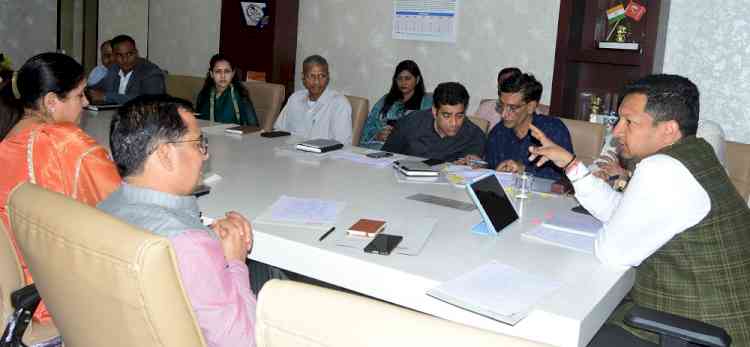
Rohtak, February 24, 2026: In a firm push to ensure seamless rainwater drainage and prevent waterlogging during the forthcoming monsoon, Deputy Commissioner Sachin Gupta chaired an exhaustive, district-level review to assess drain-wise readiness, pumping capacity, machinery deployment, power preparedness, and execution timelines across Rohtak.
The review focused on translating plans into verifiable on-ground readiness, particularly in locations that have historically faced water accumulation during heavy rainfall.
All concerned departments were directed to:
• Map village-wise and area-wise water logging hotspots based on previous monsoon experience and field inputs
• Pre-position pumping arrangements at identified locations before the onset of monsoon
• Complete micro-mapping of low-lying habitations, road crossings, agricultural pockets and internal drainage points to avoid last-mile failures
The Deputy Commissioner emphasised prevention over reaction, with readiness to be established well in advance. The district falls under the Yamuna Water Services Circle, Rohtak, with an extensive drainage network of 108 main and link drains—92 under Rohtak Division and 16 under Sampla Division.
Key drains reviewed included:
• Drain No. 8 (Rohtak Link Drain)
• Humayunpur Drain
• Lakhan Majra Link Drain
• Paksma Drain
• Gandhra Drain
• Makdoli Link Drain
• Samar Gopalpur Link Drain
• Assan Link Drain
• Jassia Drain
Directions issued:
• Mandatory physical inspection of all drains, culverts and embankments
• Removal of silt, vegetation and obstructions restricting free flow
• Repair of weak sections and embankments, wherever identified
• Completion of internal drain cleaning in habitations linked to main drains
Machinery & Operational Deployment
To ensure swift field action, the district has deployed:
• 4 chain-type Poclain machines for deep drain desilting
• 3 JCB machines for silt removal and embankment repairs
• 11 tractors and 2 pickup vehicles for internal drainage and emergency works
Machinery deployment plans are to be finalised zone-wise, with clear officer-wise responsibility.
Pumping Infrastructure: Permanent & Mobile Capacity
For flood and waterlogging management, the district has:
• 49 permanent pump houses
• 165 permanent pumps with a combined discharge capacity of 1670 cusecs, covering almost all villages
For contingencies and temporary sites:
• 203 movable electric pump sets (capacity 670 cusecs)
• 89 movable diesel pump sets (capacity 178 cusecs)
These assets enable rapid deployment at any unforeseen waterlogging site.
Power Readiness & Inter-Departmental Coordination
Recognising uninterrupted power as critical to drainage operations, instructions were issued to:
• Complete advance applications for electricity connections at pumping locations
• Ensure real-time coordination with the Power Department during rainfall events
• Flag and resolve any anticipated power constraints proactively
Materials & Flood Mitigation Works
To strengthen drainage capacity:
• 11,300 HDPE pipes (total 67,800 metres) are available for works
• An additional 3,000 HDPE pipes (total 18,000 metres) stand approved
• 20 flood mitigation schemes have been sanctioned to address chronic waterlogging across the district
Materials are to be deployed strictly on need-based, site-specific criteria to ensure durable outcomes.
Fixed Timelines & Accountability Framework
To lock preparedness into action, the Deputy Commissioner directed:
• All drainage-related tenders to be issued by 5 March 2026
• Allotment of works to be completed by 31 March 2026
• Periodic district-level reviews to track progress
• Responsibility fixation in case of delay, laxity or non-compliance
Concluding the review, the Deputy Commissioner stated that advance preparedness, coordinated execution and adherence to timelines are essential to ensure that citizens face no avoidable hardship during the monsoon.
The meeting was attended by senior officers from the Irrigation Department, Power Department, Panchayati Raj Institutions and Revenue Department.