Discussions at the FICCI Indian Power and Energy Storage Conference 2025
India’s energy transition has entered a decisive phase—where the question is no longer just how much power is generated, but how reliably it can be supplied round the clock. This shifting reality was at the center of discussions at the FICCI Indian Power and Energy Storage Conference 2025 held in New Delhi, where policymakers, industry leaders and financial institutions came together to chart the road ahead.
 Anil Bedag
Dec 25, 2025 11:05
0
Anil Bedag
Dec 25, 2025 11:05
0
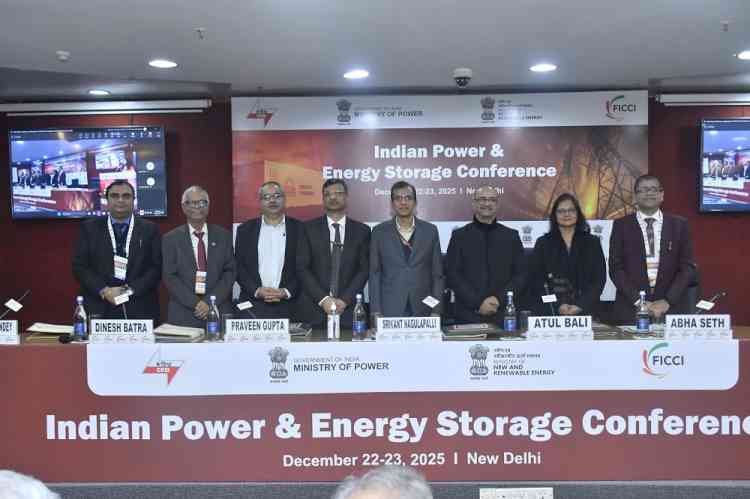
Mumbai (Anil Bedag): India’s energy transition has entered a decisive phase—where the question is no longer just how much power is generated, but how reliably it can be supplied round the clock. This shifting reality was at the center of discussions at the FICCI Indian Power and Energy Storage Conference 2025 held in New Delhi, where policymakers, industry leaders and financial institutions came together to chart the road ahead.
Former MNRE Secretary Bhupinder Singh Bhalla underlined the scale of the challenge, stating, “India can certainly reach 500 GW of non-fossil capacity, but the real test will be integrating this capacity into the grid without compromising stability or affordability.” He pointed out that peak power demand could approach 300 GW by 2030, requiring nearly 230 GWh of energy storage capacity to ensure grid balance and reliability.
From a technology perspective, R. P. V. Prasad, Managing Director, Envision Energy India, noted, “Falling battery prices, fast-charging ecosystems and strong policy support are transforming storage from a balancing tool into a core grid resource.” He also cautioned against ultra-low bidding practices and weak technical standards, stressing the need for robust frameworks.
Speaking on market structure and investments, Ashish Mittal, Director – Energy & Commodities, CRISIL, said, “Energy storage has moved beyond the pilot stage. Clear and stable regulatory frameworks at both national and state levels are essential to build long-term investor confidence.”
Highlighting the role of financial institutions, Ashok Sharma, Deputy Managing Director, State Bank of India, observed, “Storage projects are capital-intensive, and financing models must evolve to reflect their unique risk profiles and long-term returns.”
The clear takeaway from the conference: energy storage is no longer optional. It has become the backbone of India’s clean, resilient and secure power future.