CT Public School Students Explore the Future of Sustainable Farming through Hydroponics
In its continued endeavour to provide students with meaningful, experiential and future-ready learning opportunities, CT Public School organised an engaging Hydroponics Activity for students of Grades VIII, IX and X. The activity offered students a valuable opportunity to move beyond theoretical learning and gain firsthand exposure to an innovative, technology-driven and sustainable method of cultivation.
 Rajat Kumar
Sep 6, 2026 10:53
0
Rajat Kumar
Sep 6, 2026 10:53
0
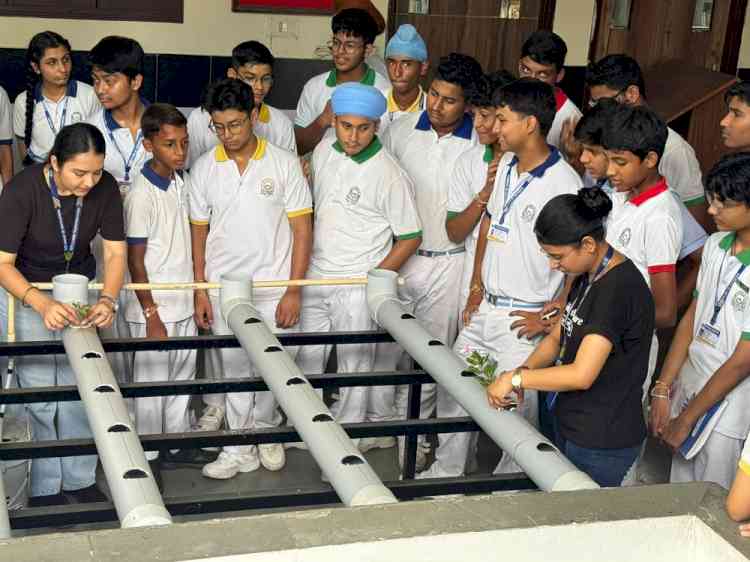
Jalandhar, September 5, 2026: In its continued endeavour to provide students with meaningful, experiential and future-ready learning opportunities, CT Public School organised an engaging Hydroponics Activity for students of Grades VIII, IX and X. The activity offered students a valuable opportunity to move beyond theoretical learning and gain firsthand exposure to an innovative, technology-driven and sustainable method of cultivation.
At a time when the world is increasingly exploring alternative methods of food production due to challenges such as shrinking agricultural land, water scarcity, climate change and a growing population, introducing students to concepts like hydroponics becomes highly relevant. The activity encouraged young learners to understand how science, technology and innovation can work together to address real-world challenges and contribute towards a more sustainable future.
The activity was conducted under the able guidance of Bharat, HOD Science, CT Public School, and was facilitated by Nitika Saini and Keerti, faculty members from the Shahpur Campus of CT Group, which has a specialised department dedicated to Hydroponics.
During the session, the students were introduced to the fascinating world of soil-less farming, wherein plants are cultivated using nutrient-rich water under controlled conditions. The visiting faculty members explained the basic principles of hydroponics, different requirements for plant growth, nutrient management, water efficiency and the role of technology in modern agricultural practices. Students also gained insights into how hydroponic systems can enable cultivation in limited spaces, optimise the use of natural resources and support sustainable food production.
The practical exposure helped students connect classroom concepts from Science with their real-life applications. Concepts related to plant nutrition, photosynthesis, water conservation, ecosystems and scientific experimentation were brought alive through direct observation and interaction. The activity also encouraged students to think critically about the future of agriculture and explore how innovation can transform traditional industries.
The session further introduced students to emerging career possibilities at the intersection of agriculture, environmental science, biotechnology, food technology and sustainable innovation. By exposing learners to such contemporary fields at an early stage, the school aims to nurture curiosity, scientific temperament and an awareness of the rapidly evolving world around them.
The activity held special significance for the students of Grade VIII, as it forms a part of the Kaushal Board Project being undertaken by the school. The project aims to develop practical skills, creativity, critical thinking, problem-solving abilities and an understanding of real-world applications among students. Through such hands-on activities, learners are encouraged to explore, experiment and apply classroom concepts in practical situations rather than limiting learning to textbooks alone.
The initiative is also a reflection of the distinctive educational ecosystem offered by CT Group. With diverse resources, specialised departments and academic expertise across its campuses, CT Group strives to provide students with learning experiences that extend well beyond the conventional classroom. Such interdisciplinary exposure gives students an opportunity to interact with experts, explore emerging fields and understand how theoretical knowledge is translated into meaningful practical applications.
More importantly, the activity sensitised students towards responsible consumption and environmental sustainability. By understanding techniques that require efficient utilisation of water and space, students were encouraged to reflect upon their own role in conserving natural resources and building a sustainable future. The experience reinforced the idea that education today must not only prepare students for examinations but also equip them with the knowledge and skills to respond to global challenges.