Congress shut down CIRUS reactor in 2010 under US pressure, crippled India's nuclear independence: Nishikant Dubey
The CIRUS (Canada-India Reactor US) reactor, a cornerstone of India's early nuclear programme that helped establish the country's capabilities in atomic research and fissile material production, was permanently shut down by the Congress-led UPA government in December 2010 amid allegations of yielding to external pressures.
 IANS
Mar 2, 2026 11:34
0
IANS
Mar 2, 2026 11:34
0
New Delhi, March 2 (IANS) The CIRUS (Canada-India Reactor US) reactor, a cornerstone of India's early nuclear programme that helped establish the country's capabilities in atomic research and fissile material production, was permanently shut down by the Congress-led UPA government in December 2010 amid allegations of yielding to external pressures.
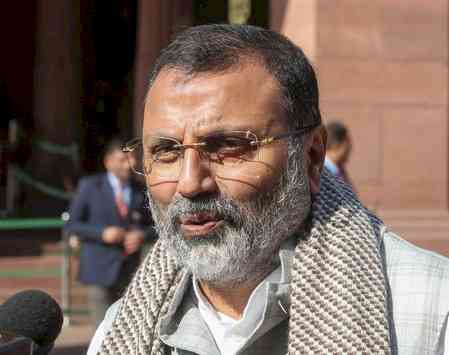
"Member of Parliament Expert in lying and misleading the nation, Canada's CIRUS reactor, which made us nuclear-rich, was shut down by the Congress government in 2010 under US pressure, angering the Canadian government. Cowardly, "Compromised" Congress," Nishikant Dubey, Bharatiya Janata Party (BJP) MP from Jharkhand's Godda constituency, said.
Originally commissioned on July 10, 1960, under the then Prime Minister Jawaharlal Nehru's leadership, the 40-megawatt thermal heavy-water-moderated reactor reached criticality after collaborative efforts with Canada, which provided financial and design assistance, and the US, which supplied the heavy water.
In a Parliamentary reply to a starred question on February 12, 1960, Nehru confirmed the reactor's commissioning status and outlined its initial operations: various circuits were being tested, start-up experiments conducted, and power gradually raised toward its rated 40,000 kilowatt.
Once fully operational, it was intended for research in neutron physics and engineering, alongside isotope production for applications in agriculture, industry, medicine, and broader research.
Over the decades, CIRUS became integral to India's nuclear advancements, producing significant quantities of plutonium through irradiation of natural uranium fuel.
It played a key role in enabling the 1974 "Smiling Buddha" peaceful nuclear explosion, though this strained relations with supplier nations Canada and the United States of America, leading to curtailed cooperation and the formation of stricter international export controls.
By the late 2000s, as part of the India-US civil nuclear agreement negotiated under the then Prime Minister Manmohan Singh and the US President George W. Bush, India committed to shutting down CIRUS by the end of 2010.
This was a condition tied to securing a waiver from the Nuclear Suppliers Group (NSG), allowing civilian nuclear trade with India despite its non-membership in the Nuclear Non-Proliferation Treaty.
The decision separated civilian and military facilities, placing many under IAEA safeguards while keeping strategic elements unsafeguarded.
In a Lok Sabha unstarred question answered on December 16, 2009, Minister of State in the Prime Minister's Office Prithviraj Chavan confirmed the Congress-led UPA government's plan to permanently shut down the CIRUS reactor at Bhabha Atomic Research Centre (BARC) in Trombay by December 2010.
The move accounted for the reactor's useful life nearing its end after nearly 50 years of service, though critics said it stemmed from US insistence to limit India's weapons-grade plutonium production capacity.
The shutdown occurred on December 31, 2010, just before midnight.
Some observers claim the then Congress administration acted under US pressure to facilitate the nuclear deal, compromising strategic autonomy and angering Canada, which had long harboured grievances over the reactor's historical use contrary to original peaceful intent assurances.
Proponents view it as a pragmatic step toward ending decades of isolation in global nuclear commerce, enabling fuel imports and technology access to bolster energy security.
The episode remains contentious in political discourse, with accusations that the previous Congress-led UPA government displayed weakness in national security matters by prioritising international pacts over indigenous capabilities built around reactors like CIRUS, which contributed substantially to making India nuclear-capable.
--IANS
sktr/khz