CICU Hosts Informative Session on New Labour Codes
The Chamber of Industrial & Commercial Undertakings (CICU) organised an informative and industry-focused session on the New Labour Codes at the Muni Lal Dharam Pal Jain Board Room, CICU Complex, Focal Point, Ludhiana.
 City Air News
Dec 6, 2025 06:36
0
City Air News
Dec 6, 2025 06:36
0
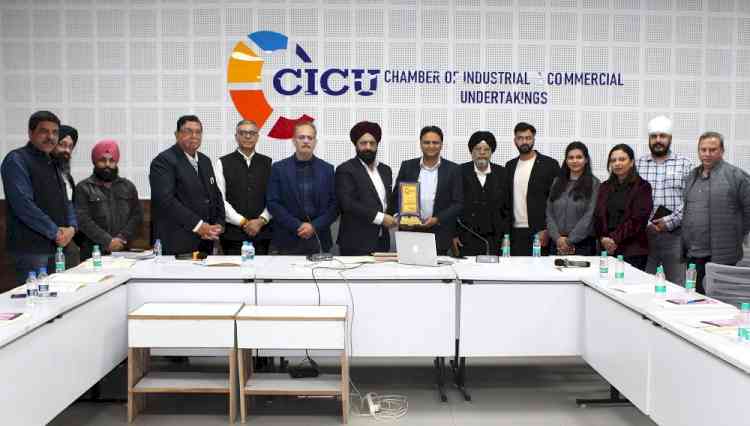
Ludhiana, December 6, 2025: The Chamber of Industrial & Commercial Undertakings (CICU) organised an informative and industry-focused session on the New Labour Codes at the Muni Lal Dharam Pal Jain Board Room, CICU Complex, Focal Point, Ludhiana. The session was addressed by noted legal expert Advocate Punit Gupta, who shared detailed insights into the newly introduced Labour Codes, their legal framework, compliance requirements and their impact on industries, employers and employees.
He explained the four consolidated labour codes—Code on Wages, Industrial Relations Code, Occupational Safety, Health and Working Conditions (OSH & WC) Code, and the Social Security Code—which aim to simplify multiple existing labour laws into a unified structure. The session was attended by industrialists, entrepreneurs, HR professionals and compliance officers.
Key topics discussed included major changes under the new labour regime, compliance challenges, impact on MSMEs and the manufacturing sector, employee rights and benefits, and practical legal guidance for smooth implementation.
Highlighting the benefits for employers, the speaker noted simplified compliance, reduced regulatory burden through digital systems, improved workforce flexibility, uniform wage definitions and enhanced ease of doing business. However, concerns such as increased social security costs, higher accountability in safety and welfare, and rising administrative responsibilities during the transition phase were also discussed.
From the employees’ perspective, the new codes offer universal social security coverage, timely wage payments, improved workplace safety, stronger grievance redressal and better retrenchment protection. At the same time, participants expressed concerns over changes in working hours, fixed-term employment and clarity during the implementation phase.
CICU’s Detailed Suggestions on Draft Central Factories Workers Rules under OSH & WC Code, 2020
CICU informed that it has submitted its views on the Draft Central Factories Workers Rules, framed under Sections 23 and 24 of the OSH & WC Code, 2020, and placed the following key suggestions on behalf of the industry:
• Additional Welfare Officer Provision: The proposed rule mandating the appointment of additional Welfare Officers beyond a certain workforce strength is ultra vires Section 24(2) (IV) of the OSH Code, 2020. The Code mandates the appointment of only one Welfare Officer where a factory employs 250 or more workers and does not authorise multiple appointments based on workforce size.
• Mandatory Appointment of Woman Welfare Officer: Section 24(2) (IV) of the OSH Code is gender-neutral and does not prescribe any gender-based requirement. Therefore, mandating the appointment of a woman Welfare Officer exceeds the authority granted under the Code.
• Chief Welfare Officer Concept: The provision for designating a Chief Welfare Officer becomes redundant, as the OSH Code does not mandate appointment of more than one Welfare Officer.
• First Aid Training for 33% Workers: The draft rule requiring 33% of workers to be trained in first aid has been termed excessive and impractical. CICU suggested that a risk-based and shift-based ratio would be more reasonable and workable.
• Shifting Certain Responsibilities from Occupier to Factory Manager: Despite the appointment of a Plant Head, Factory Manager, Safety Officer and Welfare Officer, the proposed rules still cast responsibility upon the ‘Occupier’ for matters relating to cleanliness and hygiene, ventilation, temperature and humidity control, dust and fumes, potable drinking water, prevention of overcrowding, adequate lighting, sanitation facilities for male, female and transgender employees, and effective waste and effluent treatment.
• Exemption for MSMEs: CICU strongly suggested that Micro, Small and Medium Enterprises (MSMEs) should be kept outside the purview of these stringent changes, or be provided with significant relaxations, considering their limited manpower and financial resources.
CICU proposed that these operational responsibilities should be shifted from the ‘Occupier’ to the ‘Factory Manager’, as the Factory Manager is directly involved in the day-to-day supervision and management of factory operations. The occupier should, however, continue to retain overall policy-level control and oversight.
This amendment, CICU stated, would ensure clear accountability, quicker on-ground response to issues, enhanced operational efficiency and more effective compliance with statutory requirements relating to workplace safety, health and working conditions.
Speaking on the occasion, CICU officials said the session would help industry members gain clarity and confidence in navigating the evolving labour law framework. They reiterated that CICU remains committed to acting as a bridge between policymakers and industry for sustainable industrial growth and workforce welfare.