CICU Business Leaders Meet Calls for Urgent Technology Push, Automation and R&D to Make Indian Industry Globally Competitive
Manpower shortage, AI, automation, China’s manufacturing edge and India’s R&D investment dominate high-level industry discussion
 City Air News
Aug 11, 2026 09:23
0
City Air News
Aug 11, 2026 09:23
0
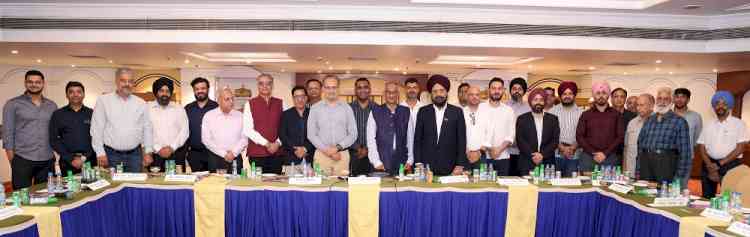
Ludhiana, August 11, 2026: The Chamber of Industrial & Commercial Undertakings (CICU) organised a high-level Business Leaders Meet 2026 at a hotel in Ludhiana, bringing together prominent industrialists to deliberate on the challenges confronting Indian industry and the roadmap required to make businesses future-ready and globally competitive. The meeting was initiated by CICU President Upkar Singh Ahuja and moderated by Senior Vice President J.S. Bhogal. It was attended by prominent business leaders including Amit Jain of Shingora Shawls, Amrinder Dhiman, Ikjot Chawla, Ravinder Singh and Maninder Singh of Pabla Bearings, J.K. Sablok, Ajay Goswami, Rohit Poddar, Jasraj, Vasu Jain, Dev Arjun Bhasin, Dr. S.B. Singh, Gagan Singh Kochar, Nikhil Dhand, CICU General Secretary Honey Sethi, Barunpreet Singh, Shammi Jain, Izu Singh, Rattandeep Singh, Anubhav and CICU Finance Secretary Ajay Kumar Bharti, among many others.
Manpower Shortage: Automation Becoming a Necessity
One of the most important issues discussed was the shortage of skilled manpower, which is increasingly emerging as a major constraint on industrial expansion. Business leaders observed that finding, retaining and continuously training skilled workers is becoming increasingly difficult, particularly for manufacturing MSMEs. The discussion, however, stressed that automation should not be seen simply as a replacement for manpower. Rather, automation can help industry overcome manpower shortages while allowing existing employees to move towards higher-value, technology-driven roles. The focus, therefore, should be on a combination of automation, reskilling and human-machine collaboration. The participants suggested that industry must begin identifying processes that are repetitive, hazardous, precision-intensive or manpower-dependent and progressively automate them. At the same time, workers must be trained to operate, maintain and manage modern machinery and digital systems.
Is This the Right Time for Indian Industry to Embrace Automation?
A central question before the gathering was whether Indian industry can afford to wait before investing in automation. The consensus was that the question is no longer whether automation should be adopted, but how intelligently and how quickly it should be adopted. The International Federation of Robotics reports that China had an operational stock of more than 2 million industrial robots in 2024, while India recorded 52,570 operational industrial robots. China also accounted for more than half of global industrial robot installations in 2024. (IFR International Federation of Robotics) These figures, the participants observed, underline the scale of the competitive challenge. Indian industry must accelerate automation not merely to reduce costs but to achieve consistent quality, higher productivity, faster delivery, precision manufacturing and international competitiveness.
Can India Compete with China?
The meeting also witnessed an important discussion on China's manufacturing advantage and India's preparedness to compete with it over the coming decades. China's manufacturing ecosystem has moved aggressively towards automation, robotics and technology-led production. Its 2025 R&D expenditure reached 2.80% of GDP, while its manufacturing sector continues to expand its use of industrial robotics and advanced technologies. (National Bureau of Statistics of China) The participants felt that India should not look at China merely as a competitor, but as a benchmark against which the country's manufacturing capabilities must be evaluated. India has the entrepreneurial talent, engineering capability, large domestic market and skilled human resources—but these strengths must be converted into greater productivity, innovation and technology adoption.
R&D Investment: The Bigger Question for India's Future
Another significant issue raised was whether India's investment in Research & Development is adequate for the ambitions of becoming a global manufacturing and technology leader. The Economic Survey 2025-26 notes that India's Gross Expenditure on R&D stands at around 0.64% of GDP, significantly below countries such as China, the US and South Korea. It also points out that business enterprises account for only about 41% of India's R&D expenditure, compared with much higher business-sector participation in China and other advanced economies. (India Budget) The business leaders felt that India needs a much stronger industry-led R&D culture, where manufacturers themselves invest in product development, process innovation, automation technologies, materials, energy efficiency and AI-based industrial applications.
The message was particularly relevant for MSMEs: R&D does not necessarily mean establishing a large research laboratory. It can begin with improving a production process, developing a new product, reducing material consumption, improving tooling, introducing AI into quality control or creating a more efficient manufacturing system.
Guest of Honour Kirti Rathod Emphasises Future-Ready Manufacturing
Kirti Rathod, Chairman & Managing Director, Delux Bearings Ltd., Mumbai, while addressing the gathering, shared valuable insights on the rapidly changing manufacturing landscape and emphasised the importance of technology, automation, innovation and operational excellence. He stressed that Indian businesses must continuously upgrade their capabilities and move beyond conventional methods if they want to compete successfully in international markets. He encouraged industry leaders to see technology not as an expense but as an investment in productivity, competitiveness and long-term survival, particularly as AI and automation reshape global manufacturing.
What Should India's Industry Vision Be for the Next Decades?
The discussion ultimately moved beyond today's problems to a larger question: What should be the vision of Indian industry for the next 10, 20 and 30 years? The participants agreed that India must aim to become a manufacturing ecosystem that is technology-driven, innovation-led, globally integrated and highly productive. This will require stronger industry-academia collaboration, greater private-sector R&D, skilled manpower, faster technology adoption, modern supply chains and increased participation of MSMEs in global value chains.
CICU President Upkar Singh Ahuja emphasised that the next phase of industrial growth will belong to enterprises that are prepared to adapt before they are forced to adapt. He called upon entrepreneurs to invest in technology, people, innovation and R&D and to develop a long-term vision rather than focusing only on immediate business challenges.
Senior Vice President J.S. Bhogal highlighted that such interactions provide an important platform for business leaders to openly discuss ground realities and collectively develop practical solutions for the industry's future.
The Business Leaders Meet concluded with a powerful message: India has the opportunity to become one of the world's leading manufacturing powers, but opportunity alone will not be enough. The speed of technology adoption, investment in R&D, availability of skilled manpower and willingness to innovate will determine whether Indian industry merely participates in global competition—or leads it.
“The world is looking towards India. The next question is not whether India can manufacture for the world, but whether Indian industry is ready to manufacture smarter, faster and better than the world.”