Agreements signed during PM Modi's visit showcase India, Australia as long-term strategic partners: Report
India and Australia signed several agreements spanning several areas like defence, economic security, energy, education, science, technology, and culture, during Prime Minister Narendra Modi's recent visit to Melbourne, showcasing that both nations do not view one another as important bilateral partners but as long-term strategic partners whose cooperation covers almost every major area of national policy, as per a report.
 IANS
Jul 12, 2026 11:08
0
IANS
Jul 12, 2026 11:08
0
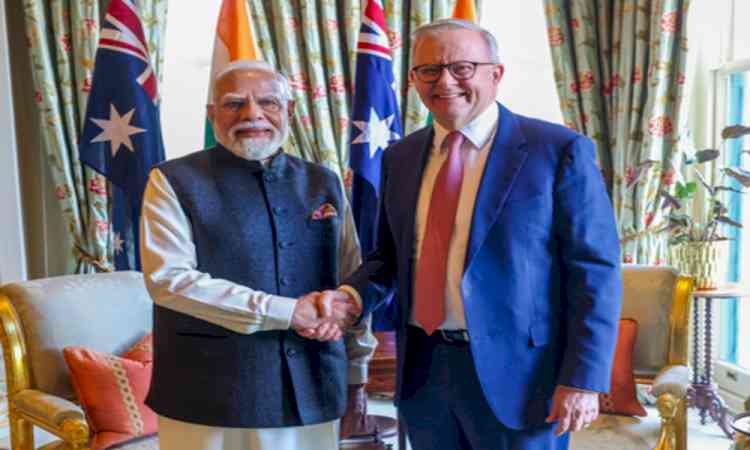
New Delhi, July 12 (IANS) India and Australia signed several agreements spanning several areas like defence, economic security, energy, education, science, technology, and culture, during Prime Minister Narendra Modi's recent visit to Melbourne, showcasing that both nations do not view one another as important bilateral partners but as long-term strategic partners whose cooperation covers almost every major area of national policy, as per a report.
During his visit from July 8-10, PM Modi held meetings with his Australian counterpart, Anthony Albanese, and business leaders and addressed the Indian diaspora at an event at Melbourne’s Docklands Stadium, which was attended by 35,000 people, and included speeches from Albanese and Victoria’s Premier Jacinta Allan.
"Rather than producing a single headline announcement, Modi’s visit delivered a coordinated package of agreements spanning defence, economic security, energy, education, science, technology, and cultural links. Taken together, these agreements demonstrate that the relationship between the two countries is now reaching a level of institutionalisation that has previously eluded them," a report in The Diplomat stated.
Considering the fragile global environment, security cooperation remained in focus in these agreements. The new Joint Declaration on Defence and Security Cooperation was showcased as a "step-change" in bilateral ties, with both nations deciding to create an Annual Defence Ministers’ Dialogue, strengthen interoperability between their armed forces, and increase military exercises under the Mutual Logistics Support Arrangement.
PM Modi and Albanese announced an India-Australia Maritime Security Collaboration Roadmap to strengthen information sharing, capability development, and operational coordination, and a Memorandum of Understanding between Australia’s Maritime Border Command and the Indian Coast Guard.
The two nations finalised the administrative arrangements required to enable the export of Australian uranium to India for exclusively peaceful purposes, with PM Modi saying the landmark agreement would strengthen India's clean energy ambitions and further deepen bilateral cooperation in the energy sector.
Australia previously restricted uranium exports only to nations with strong nonproliferation commitments, and India’s status outside of the Nuclear Non-Proliferation Treaty (NPT) was a major hindrance. However, Australia's decision to disregard this status now showcases the trust that it has in India now. This trust has not been built only due to the geopolitical realities that have brought India and Australia closer in their strategic understanding of the world, but through increased people-to-people connection.
"Defence and economic ties require social foundations. These exchanges not only come through Australia’s burgeoning diaspora, but through cooperation in education, science, and technology and the ability for universities and research institutions to expand their collaborations. Taken together, the swathe of agreements signed during Modi’s visit reflect a holistic conception of national security where each component is both interconnected and critical to the advancement of the others," the report in the Diplomar said.
"Rather than announcing a single major initiative – as is the norm on such visits – Modi’s trip to Melbourne demonstrated the web of institutional cooperation that now comprises the Australia-India relationship. The package of agreements was designed to showcase that both governments increasingly view one another not simply as important bilateral partners, but as long-term strategic partners whose cooperation spans almost every major area of national policy," it added.
--IANS
akl/vd