₹200 crore turnover evasion unearthed in Punjab’s hospitality sector, crackdown intensifies with data-driven probe: Harpal Singh Cheema
Punjab Finance, Planning, Excise and Taxation Minister Advocate Harpal Singh Cheema on Monday revealed a massive ₹200 crore turnover evasion racket in Punjab’s hospitality sector, exposing deep-rooted and systemic under-reporting across dhabas, eateries, restaurants, and fast-food outlets, as the Bhagwant Mann Government launched an aggressive, technology-driven crackdown to protect public revenue. With 882 establishments already under the scanner and ₹2.02 crore recovered so far, Harpal Singh Cheema made it clear that the investigation is rapidly expanding and the total evasion could surge to nearly ₹500 crore as more data is analysed.
 City Air News
Mar 30, 2026 09:11
0
City Air News
Mar 30, 2026 09:11
0
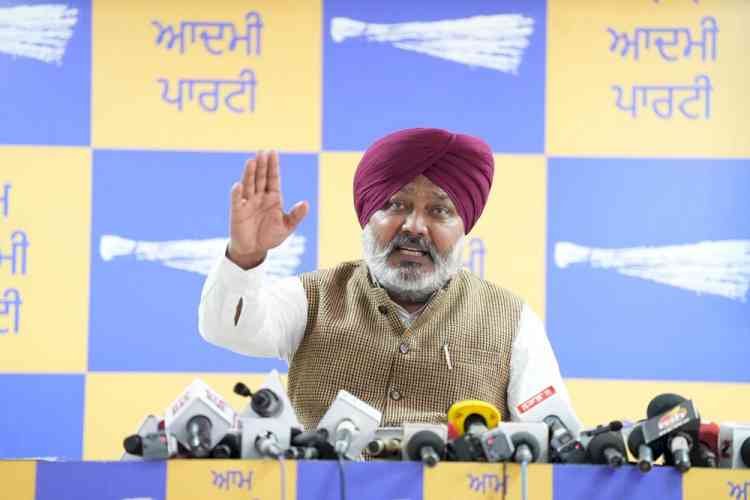
Chandigarh, March 30, 2026: Punjab Finance, Planning, Excise and Taxation Minister Advocate Harpal Singh Cheema on Monday revealed a massive ₹200 crore turnover evasion racket in Punjab’s hospitality sector, exposing deep-rooted and systemic under-reporting across dhabas, eateries, restaurants, and fast-food outlets, as the Bhagwant Mann Government launched an aggressive, technology-driven crackdown to protect public revenue. With 882 establishments already under the scanner and ₹2.02 crore recovered so far, Harpal Singh Cheema made it clear that the investigation is rapidly expanding and the total evasion could surge to nearly ₹500 crore as more data is analysed.
Flagging how major urban centres like Mohali, Jalandhar, and Ludhiana have emerged as key hubs of suppression, he underscored that sectors driven by high cash and hybrid payments are at the centre of the fraud. Backed by advanced data analytics, inputs from TIU and SIPU, and the success of the ‘Bill Liyao, Inam Pao’ scheme, the Aam Aadmi Party (AAP) Government has intensified enforcement, with Harpal Singh Cheema issuing a firm warning that strict action will follow against every violator while ensuring full use of technology to safeguard the State’s revenue.
Addressing a press conference at Punjab Bhawan, Finance Minister Harpal Singh Cheema stated, “Through a comprehensive, state-wide, data-driven enforcement exercise covering hotels, dhabas, eateries, bakeries, sweet shops, restaurants, catering services, and similar establishments, we have identified a total of 882 establishments pertaining to FY 2025–26.”
The Finance Minister further added, “With further analysis and the inclusion of data pertaining to the financial years 2023–24 and 2024–25, the total magnitude of evasion is likely to reach approximately ₹500 crore.”
Detailing the findings of the ongoing verification, Harpal Singh Cheema stated, “In the preliminary inquiry conducted till date, 239 cases have been examined, resulting in the detection of turnover suppression of approximately ₹50 crore.” He added, “This evasion involves a tax of ₹2.54 crore at a 5% rate, and our Department has so far ensured the recovery of ₹2.02 crore, with further recovery proceedings still ongoing.”
Underlining the scale of discrepancies across taxpayers, Minster Harpal Singh Cheema said, “We discovered turnover suppression above ₹2 crore in 3 taxpayers, above ₹1 crore in 6 taxpayers, above ₹50 lakh in 18 taxpayers, above ₹25 lakh in 26 taxpayers, and above ₹5 lakh in 91 taxpayers.”
Highlighting sector-specific trends, he noted, “Our further analysis indicates systemic patterns of under-reporting in high-cash and hybrid-payment segments.” He added, “Dhabas account for approximately ₹10 crore of the suppression, followed by small eateries, coffee, and chai bars at around ₹8 crore, and pizza and fast-food outlets exceeding ₹6 crore.”
Providing a district-wise breakdown, the Minister said, “Mohali has reported the highest turnover suppression of ₹8.16 crore, followed by Jalandhar with ₹6.72 crore and Ludhiana with ₹5.48 crore, making them the major contributors to the detected evasion.” He added that Patiala and Amritsar have shown comparatively lower discrepancies, with ₹3.83 crore and ₹0.99 crore respectively.
Explaining the methodology behind the crackdown, Minister Harpal Singh Cheema said, “During detailed scrutiny of business data by the State Investigation and Preventive Unit, it was observed that a significant number of such establishments were using online billing applications.” He added, “I give full credit to the Tax Intelligence Unit, the State Investigation and Preventive Unit (SIPU), alongside the overwhelming success of our ‘Bill Liyao, Inam Pao’ scheme, for making this large-scale detection possible.”
He further elaborated, “Based on risk parameters, data analytics, and comparative analysis with GST returns, we identified instances of possible suppression of turnover. We accordingly directed the concerned online platforms to furnish detailed transactional data, which field formations are now using for on-ground verification and reconciliation with statutory returns.”
Emphasising balanced enforcement, Minister Harpal Singh Cheema said, “It is pertinent to note that no discrepancy has been observed in 52 establishments, reflecting balanced enforcement and verification based on data-driven selection.”
Outlining the next steps, he said, “The remaining cases are under active verification and detailed scrutiny, and it is expected that the entire exercise of verification and recovery shall be completed within one month.” He added, “To further strengthen the investigation, the Department is in the process of obtaining UPI transaction data and other digital payment trails, which will enable a deeper reconciliation of actual receipts with reported turnover, thereby enhancing detection accuracy.”
Issuing a clear warning to violators, Minister Harpal Singh Cheema stated, “The Bhagwant Mann Government is committed to leveraging technology, data analytics, and coordinated field enforcement to ensure tax compliance and safeguard State revenue.” He emphasised, “Strict action shall be taken in all cases of tax evasion, while compliant taxpayers shall continue to be facilitated.”