You don't want it to be too hot, you don't want it to be too good: EAM Jaishankar on US-China rivalry
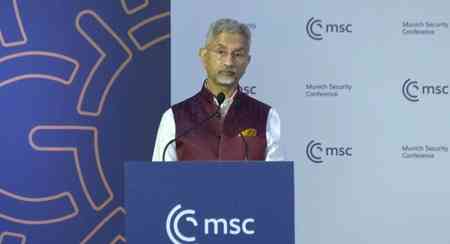
External Affairs Minister (EAM) S Jaishankar on Sunday compared the US-China rivalry to a Goldilocks scenario, quipping that "You don't want it to be too hot, you don't want it to be too good".
 IANS
Oct 4, 2026 10:31
0
IANS
Oct 4, 2026 10:31
0
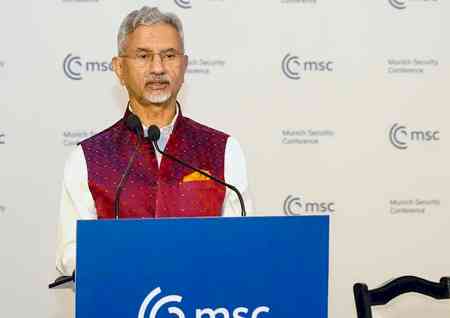
New Delhi, Oct 4 (IANS) External Affairs Minister (EAM) S Jaishankar on Sunday compared the US-China rivalry to a Goldilocks scenario, quipping that "You don't want it to be too hot, you don't want it to be too good".
“In the context of a US-China rivalry. I think we are looking at what is often called a Goldilocks scenario: You don't want it to be too hot; you don't want it to be too good. You want it somewhere in between, at the right temperature," the EAM said in his address at the Munich Security Conference.
Jaishankar also raised a question about where this leaves emerging and middle powers.
"I would argue that today, most of them are focused on diversifying and de-risking in every sense of the term - not just their economy or their security, but also building more resilient supply chains. In many ways, they are working out new arrangements; they are developing agenda-based cooperation. And the operating principle for emerging and middle powers should be, and perhaps is already, a reasonable degree of convergence," he noted.
Jaishankar contended that having an identity of views or a very strong congruence of interest is "too high a bar today" and that if there are enough touch points, that is good enough for countries to work together.
He noted that through the process of de-risking, diversifying, hedging, slowly, a new architecture is coming into place.
"Now, the question flows from that as to who cooperates with whom. And obviously, amongst the emerging and middle powers, to the extent that they don't have a direct clash of interest. They have an obvious interest in strengthening their inter-state cooperation. But it is also natural that they would have cooperation with the United States and, of course, also with China," he said.
During his remarks, he also highlighted that the "third way" will become more of a norm than exception.
He noted that many countries that until now may have been secure in the first way or the second way would be much more open to the third way.
"And the third way, at one level, can be staying away from others, but since that is not possible in a much more interdependent world, I think how to engage while hedging, while diversifying. So what will come into increasing practice will be the idea of multi-alignment. The idea that countries will have relationships with players that may not always be easy to harmonise, nevertheless are a reality or a compulsion for countries," the EAM highlighted.
He said It's a sort of strategy of advancing by hedging.
"And one will then have to look at what the consequences of this are for multilateralism, a multilateralism which is already under visible pressure because the main multilateral body, the United Nations, is very visibly gridlocked," EAM Jaishankar noted.
--IANS
ksk/vd