USTR ignored its evidence: India
India on Wednesday accused the U.S. Trade Representative (USTR) of overlooking evidence and arguments submitted by New Delhi while recommending a proposed 12.5 per cent tariff on Indian imports under its Section 301 investigation into forced labour.
 IANS
Jul 8, 2026 10:35
0
IANS
Jul 8, 2026 10:35
0
Washington, July 8 (IANS) India on Wednesday accused the U.S. Trade Representative (USTR) of overlooking evidence and arguments submitted by New Delhi while recommending a proposed 12.5 per cent tariff on Indian imports under its Section 301 investigation into forced labour.
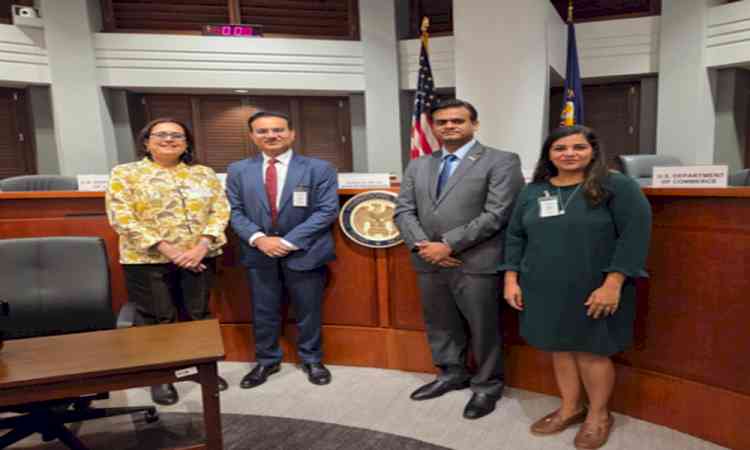
In India's presentation before a USTR public hearing, Dr. Brij Mohan of the Ministry of Commerce and Industry said the report failed to adequately consider India's earlier submissions and engagement during the investigation.
"India would like to state that the USTR report had not taken into account the evidence and argument based on the argument in the previous public hearing," he told the committee, adding that India remained committed to eliminating forced labour "as a constitutional obligation, law and a matter of principle."
Dr. Mohan then outlined four principal objections to the USTR's findings.
First, he argued that the investigation had failed to meet the legal standards outlined in Section 301 of the U.S. Trade Act.
According to India, "a mere absence" of a specific import prohibition cannot by itself be treated as an unreasonable trade practice under Section 301.
"The USTR has neither identified nor engaged with the discrete elements of Section 301 for any country, including India, that directly amounts to an unreasonable act, policy or practice," he said, adding that the determination also marked a departure from previous USTR Section 301 investigations.
Second, India rejected the assumption that countries without explicit import bans on goods produced with forced labour were effectively permitting such practices.
Dr. Mohan argued that the International Labour Organization recognises that eliminating forced labour requires action on multiple fronts, tailored to country-specific circumstances, and that import bans are only one possible policy instrument.
Third, he criticised the proposal to impose a country-wide tariff of 12.5 per cent on nearly all Indian imports.
He said the methodology relied on studies involving only a handful of economies and broad trade patterns rather than sector-specific or product-specific evidence relating to India.
"The adopted methodology is particularly flawed," he said.
Fourth, India argued that the USTR had failed to establish any causal link between India's policies and harm to U.S. commerce.
"There is inadequate, insufficient evidence" that India's lack of an import prohibition creates an unfair competitive advantage for Indian exporters or harms American industry, Dr. Mohan said.
He pointed to the USTR's own Appendix A, saying that trade data on cotton, rice, and tobacco contradicted the report's conclusions by showing rising U.S. exports and negligible or declining third-country competition in India.
"This indicates that absence of import ban in India is not causing any adverse impact on U.S. commerce," he argued.
India also challenged the methodology used in the report's appendices, saying they merely identified overlapping trade flows rather than demonstrating that products allegedly made with forced labour were actually incorporated into exports shipped from India to the United States.
Dr. Mohan urged the USTR to reconsider the proposed tariff in light of what he described as inconsistencies in the report and the Federal Register notice.
He said India remained willing to engage constructively with Washington through consultations and dialogue on any specific concerns but maintained that such issues should be addressed through bilateral trade discussions rather than unilateral trade measures under the Section 301 investigation.
--IANS
lkj/dan